Why Did You Get into Education?
Funny story. My parents said I had to be a doctor and being a doctor is really hard – so I thought, okay, I’ll be a nurse. Also hard.
Then I sat down and made a list of all the things I had ever done in life, and all of it went back to students. I was in my twenties and still sitting at the children’s table at Thanksgiving on purpose because I liked being around kids.
I thought, I’m going to be a teacher. How hard can it be?
And that’s how I got into education. I’ve never really looked back. I truly think I was guided there. Teaching isn’t just a job to me, it’s a calling. It’s how I give back to society.
You can take everything else from a person. You can take their house, their clothes, their things. But you can’t take away their education.
That’s why it matters so much.
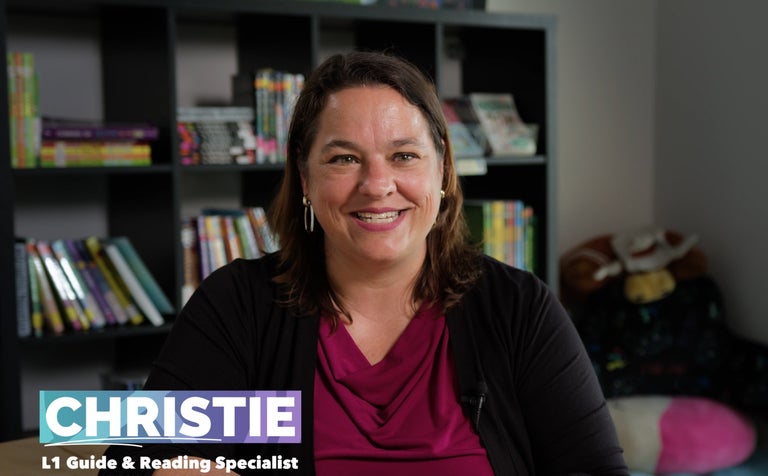
My name is Christie Ray and I’m an L1 Guide and Reading Specialist at Alpha Austin.
How Did Your Career Grow Before Alpha?
I started in Tampa, Florida, working at a university study school. I was always looking for that edge of learning, I loved constantly growing.
I was a teacher for about 11 years, and then I decided I wanted to do more. There was a grant Bill Gates put out to study teaching, so I became a new teacher mentor. That allowed me to get my master’s degree, and then I became an assistant principal.
Every time you move up, you feel like you’re adding more impact. As a new teacher mentor, I mentored 16 teachers. As an assistant principal, I worked with the whole school.
But as an assistant principal, you’re not really running the ship. And I kind of like to be in charge. So I became a principal.
After that, I realized I loved coaching, guiding, and mentoring. I learn just as much from the people I mentor as they learn from me. So, I moved into a district role where I created the program to make people principals.
It was an interesting arc.
But then you reach a point where you’ve read all the books. You’re hanging out with the experts. And there’s really this question of, where do you go from there?
I looked at education, and I realized it was broken. I was looking for something, but I didn’t know what. I didn’t necessarily want to move away from kids, because that’s why we’re here.
We’re all here for students.
What Made You Realize Traditional Education Was Setting Teachers Up to Fail?
When I was a principal, and even when I mentored new teachers, I would go into a new teacher’s classroom and say, “Hi, new teacher. I need you to differentiate for students.”
And I’m throwing everything I can at them. I’m going to give you as much time, but there’s no time. I’m going to give you as many resources, but there’s no money. I’m going to ask you to differentiate for every student in your classroom.
And I know in my heart that I’m setting them up for failure. I would never set a student up for failure. Why am I setting my staff up for failure?
That’s what traditional education started to feel like to me. Teachers are constantly failing. You’re either failing to meet kids’ needs, failing to be a mom at home, failing to make the deadlines, or failing to get everything done.
Even as a principal, I worked 7 to 7 on a good day, and it still wasn’t enough. I was doing everything I could. Then the school grade would come out, and I felt like a failure.
There was a moment I’ll never forget.
I was sitting in a fourth-grade classroom, and I was bored to tears. And I thought, if I’m bored as the school leader, imagine what the kids feel.
We had been awarded an extra hour of school because the kids were struggling in reading. And I thought, yes, let’s do enrichment. Let’s make them love school. We’ll still do reading and writing and math, but we’ll do it in a project. We’ll go to the Humane Society. We’ll make neckties for dogs to be adopted. We’ll write scripts.
And the answer was, no, no, no. You’re going to have them do more reading. But the first 90 minutes didn’t work! What makes you think the next hour is going to work?
That broke my heart.
Education needs people bold enough to try something different. I get that it’s scary, because you’re playing with kids’ lives. But so was going to the moon. At some point, you have to take a leap and trust in something different.
That’s what Alpha was for me. Something different. Something edgy.
What Made Alpha Sound Too Good to Be True?
I happened to be on a job site, looking at somebody else’s history for a job they were applying for, and I saw a role called Educational Consultant.
I thought, all right, I’ll just click yes. Every now and then we do that, and then you don’t hear anything. Well, I heard something.
They asked if I wanted to take this CCAT test, and I thought aptitude tests are kind of fun, which may tell you a little bit about me. So I did that.
Then they asked me to answer a question on student behavior, and I thought, oh, behavior. That I have. Before I knew it, they were asking if I would be willing to relocate to Austin. And I thought, that's the only place right now I’d be willing to relocate.
Once I dug into the model, I was astounded by the concept of it. It sounded too good to be true. I came in waiting for the other shoe to drop.
I thought, I can’t possibly be making $6,000 more than I made as a principal to work with six or seven children. No lesson plans? Really? And I don’t have to fund everything out of my own pocket?
That’s just not real, but it was.
Find out more about the selection process here.
When Did You Realize Alpha Worked?
My first placement was at a failing charter school Alpha had taken over.
Because I had behavior experience, I was given seven of the most difficult children. These were first graders who had been at that school for three years, and they were still at a pre-K level.
I thought, sure. Behavior is my forte, I can do this. Day three, I wasn’t sure I could do it.
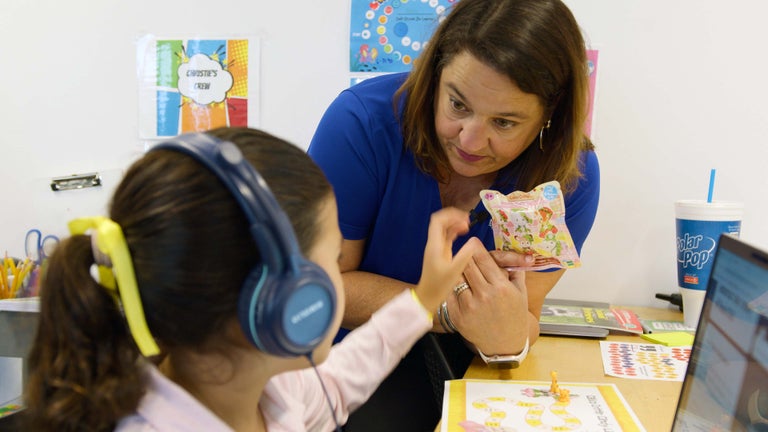
It was tough! The students were dysregulated, they hadn’t learned. They were already starting two years behind, and now they were being asked to learn in a completely different way.
In a typical school, you might learn something new once or twice a day, if you’re lucky. A lot of it is practice or repetition. At Alpha, you’re hitting the wall in every subject, every day. You’re doing what you need, and it’s an incredible brain lift.
So that first week was a lot of pivots. But Alpha gave me exactly what I needed.
I’ll never forget bringing in all this stuff, because I’m a teacher, right? I went and bought things. And the director sat there and said, “Did you pay for all of this?”
I said yes. She said, “Don’t do that again. We’ve got it.” And I thought, maybe it really is what I thought it was going to be. We made it through.
And of those seven students, every single one of them, in just three months, grew a full year. One of them grew three years. She went from pre-K level to surpassing first grade and second grade content in such a short time.
That was when I was hooked.
If we can do that with students who have all sorts of scarcities, students who were living in hotels, students who didn’t have the basic needs of humanity, imagine what this can do for any other child.
Was had to find a way to get this into the hands of every kid in America.
What Changed When You Came to Alpha’s Main Campus?
After that, I had seen how the model worked in a public setting, but I wanted to know the real model. I wanted to understand the heart and core of Alpha.
We call the main campus the mothership. So I asked to come here and learn the model with fidelity. They were kind enough to grant me that request.
When I came to campus, I remember being so excited. I took a selfie with the sign. I was like, I’m at Alpha. The real Alpha.
I was astounded by how friendly and open and kind everybody was. Everywhere you walk, kids say hi to you. Staff say hi to you. Staff know every kid’s name. It’s such a welcoming, happy place.
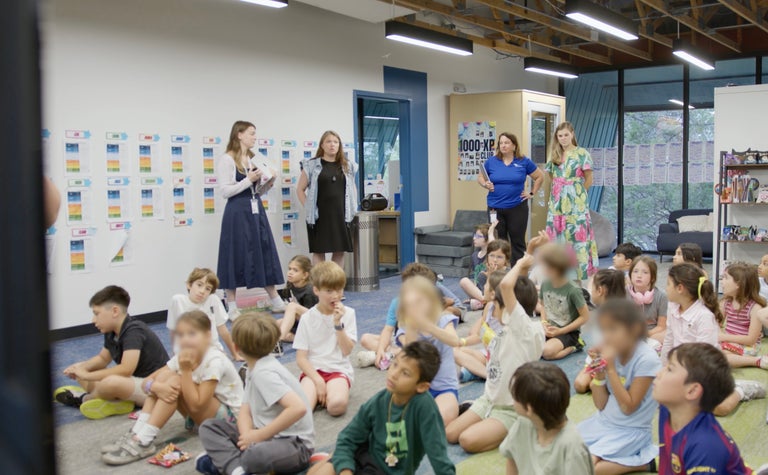
And honestly, it was a little humbling to be around so many smart people. It’s difficult to get hired here. It’s quite a process. Now I’m really not the smartest person in the room.
But that’s not intimidating in the way I thought it might be. Everybody has expertise, and we lean into that expertise. It’s, “You’re good at this, so I’m going to come talk to you about that.”
In schools, sometimes it seems like the principal has a favorite, or one person who always gets the opportunities. Here, you’re given ample opportunities to grow, interact, and build who you are. I’ve grown more in the last few months than I have in 20 years.
I’ve had to learn AI. Before, my idea of AI was, “What should I pack for my trip to Europe?” Now I’m creating bots that coach kids through TED Talks.
I had a student who wanted to be an author. I don’t know how to tell her how to be an author. So, I created a chat that helped her write a children’s book.
Then I put it out in our organization and asked, does anyone know a children’s author?
Somebody did. We got her a 15-minute call with a children’s author who read her book and gave her feedback. It’s incredible what we can offer students with this network.
What Does Alpha Give You That Traditional Schools Didn’t?
Alpha gives me what I need to make students successful.
I always say, I’ve run through walls for things. I feel like Alpha would run through walls for me. We get very critical feedback, blunt feedback. And if you don’t like change, this is not the job for you.
We are constantly innovating because we’re constantly trying to get better. Where we are today is not where we need to be. It may be many times better than where a traditional school is, but it’s still not where we want it to be.
And I get to be a part of that.
I get to give feedback to the academic team and say, this app isn’t working. I get to make a kid’s day because they love dragons, and I found a really cool 3D printed dragon. If they do X, Y, Z, then I get to present them with this dragon.
We’re given anything we need to help students be successful. If something is getting in the way of us delivering the three commitments to students, Alpha finds a way to take it away.
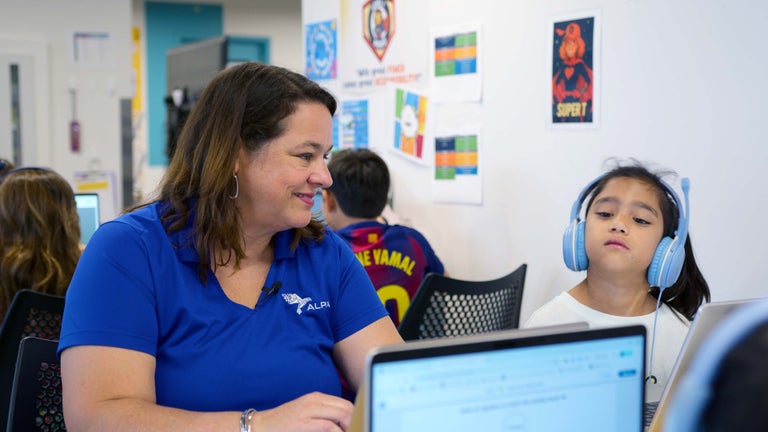
I’m not doing endless paperwork or lesson plans. I’m planning engaging, fun workshops, which is the fun part anyway.
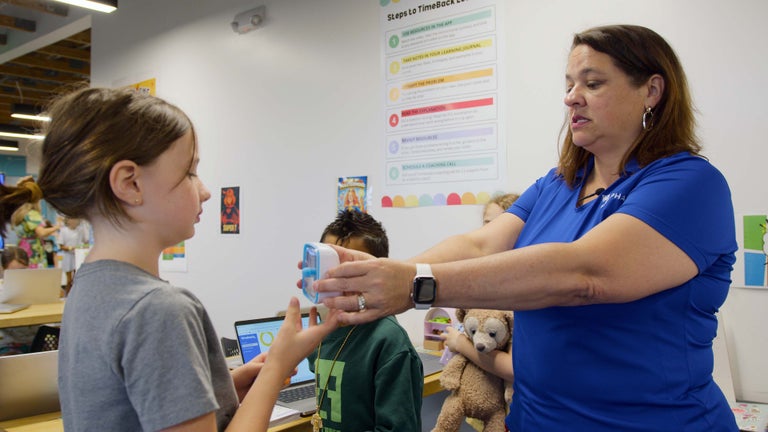
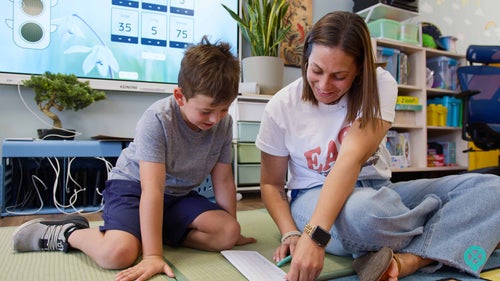
One of our workshops involved riding horses. Second graders had to bridle, get on, ride, get off, and strap up the horse by themselves. Some of them were terrified of horses. By the end, they were able to get up on a horse by themselves and ride it.
We think our kids are limitless, and we are given what we need to make sure we can deliver on that commitment. That’s the difference.
In traditional education, the F-word became “fun.”
You couldn’t have fun because there was no time. It was this mad dash. At Alpha, we’re having fun again. And kids are still getting where they need to go.
How Is AI Used at Alpha?
It’s really interesting because the message got out that we were a school run by AI. That’s not what this is.
We use AI almost like you would watch game film. AI can help track how students are learning and give us a fresh path every day if they’re not getting something.
But as a Guide, I use AI to make student work better. Students don’t use AI to write things for them. They use AI to get critique and feedback and to make their thinking stronger. We call it a second brain.
For example, we were doing TED Talks, and I built a chat where students could go in after they had written their TED Talk. It would ask them questions and help guide them to make their TED Talk better.
That is the same thing I would do if I were sitting with them. But AI lets them get more feedback, faster. Today, I had to inventory the beautiful library behind me. I was sitting there with my basket of books, and my Lead Guide walked over and said, “Did you think about using AI?”
I thought, no. So I snapped four pictures, fed it into AI, and it gave me a list. That’s what we use it for - to make our jobs quicker, faster, better, stronger.
And it’s the same for students.
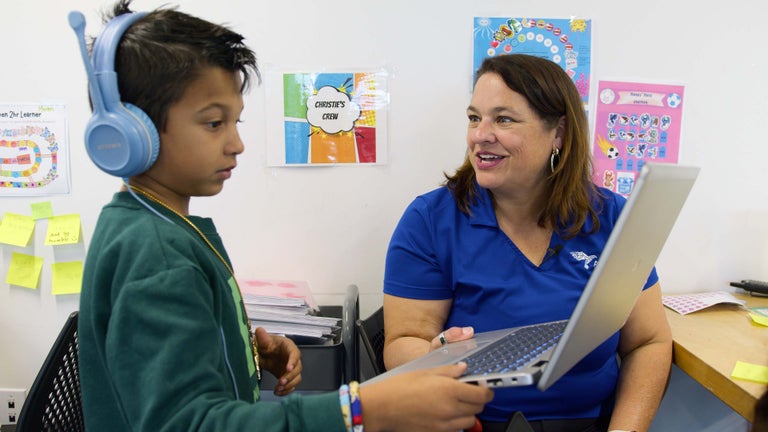
We teach them that AI doesn’t do the thinking for you. It helps you do deeper thinking about your work, so your message is as clear as possible.
It also helps customize learning. Not a single kid here is doing the same thing on any given day. Every kid gets the track they need. If a student is struggling, we can customize what they need. We can give them more of this and less of that.
Every kid’s prescription is different.
You go to the doctor, and they look at your symptoms, then they treat you. They don’t put everyone in a field and say, “You might have diabetes, so you go over here too.” Alpha treats every student where they are and gives them the best education they can get.
How Has Alpha Changed Your Life?
We’re with the kids all day long.
We eat lunch with them. We don’t have prep periods. So, you might think, wow, you must do a lot of work after school. I can count on one hand the number of times I’ve had to work after hours.
I do put in a little extra work because I want to do extra things, but we are given time during the week. If I go to my Lead Guide and say, “Hey, I need some additional time to work on something,” that happens.
That’s the benefit of having a bunch of adults in the room. We also have staffing days that are genuinely useful. If you’re a traditional teacher, you know staff days can mean sitting through PowerPoints full of information you probably could have read in an email.
At Alpha, staff days are hard and long, but they’re 100% about our role, our job, and prepping for what we need. We get to do the actual work there.
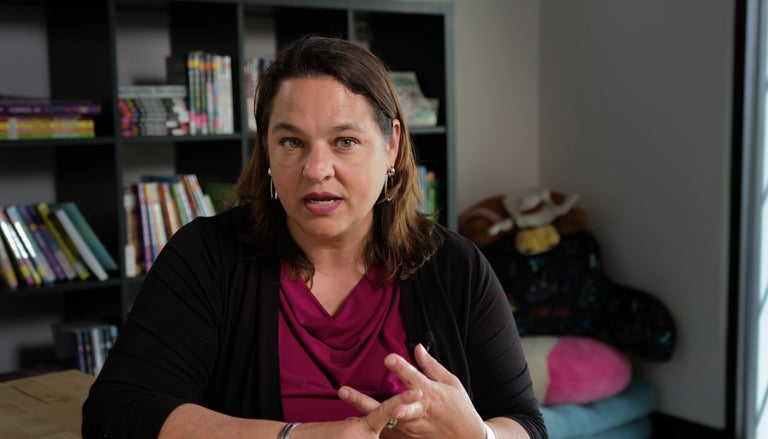
All of that means I don’t need to bring work home.
I remember my husband saying to me for the first time, “You’re back.” And I said, “What do you mean?” He said, “You’ve been gone for years. It’s so great to see you back with us as a family.”
So yes, the kids get their time back. But I got my time back too.
I’m home by a decent hour. I’m hanging out in my backyard with my dogs and my husband. I still get to be passionate. I still get to work with students. But I don’t leave every day completely exhausted.
Well, some days I leave exhausted. Let’s be real.
But 90% of the time, I have my life back.
Why Do You Love Being a Guide?
Every day, I get to do what teachers love best.
I get to be with kids, to make their day, to help them love learning. And our kids run into school faster than they run out, which is the measure of a truly great school.
I can’t think of a single kid who walks into school frowning. Even the ones who don’t love doing the apps still run in. They want to be here.
Our metric is whether kids love school over vacation. And we’re talking about kids who go to Cabo and Turks and Caicos and Hawaii. That’s a hard metric to beat. But we have kids who say they love school over vacation.
One of my students said, “I don’t want to go to Hawaii again. We’ve been three times. I just want to come here and close my rings.”
That’s Alpha.
It feels almost unreal when I tell people about it. I know they probably think I’m exaggerating, because I do occasionally over-exaggerate in my life. But I can’t tell you how incredible it is to be at a place where kids are this happy.
I can’t believe I get to do this job, it’s amazing and I love it - and it’s because I applied on Crossover.
Want to keep reading? Meet Chris an L2 Guide at Alpha.



 AI-first remote workers.