What Is Ikigai and Why Does It Matter at Alpha?
Ikigai is an activity we do with all of our middle schoolers when they enter the middle school program.
It’s basically a way to think about what you love doing, what you’re good at, what you can make money from, and what the world needs. When all of those things overlap, that’s your ikigai. It’s your passion and your purpose, but it’s also practical.
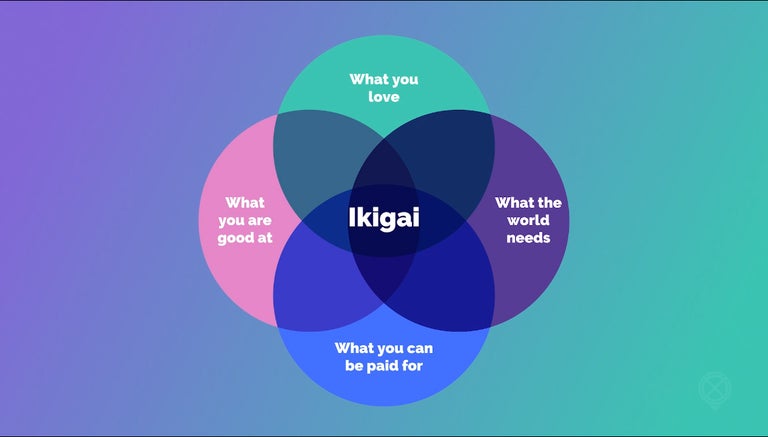
I think it’s really important for students to think about that early, but I also think it’s important for adults.
A lot of people spend years trying to find a career that fits all of those pieces. They might find work they love, but it doesn’t pay enough to be sustainable. Or they find work that pays well, but it doesn’t feel connected to anything meaningful.
For me, Alpha is where those pieces came together.
It’s what I love doing. I love working with kids and mentoring students. It’s what I’m good at. It’s what the world needs, because education really does need to be rethought. And it’s also how I can make a living and build a career.
That combination is rare.
My name is Carson Lehmann, and I’m the Lead Guide at Alpha San Francisco.
When Did You First Realize You Loved Working with Kids?
I first connected with that part of myself when I was a teenager working as a camp counselor.
I had a mentor at that camp who told me I should keep working with kids. At the time, that wasn’t something I had really thought about for myself. I’d always known I wanted to do something service-oriented, but I didn’t know exactly what that would look like.
It could have been education. It could have been tech. It could have been politics or nonprofit work. I just knew I wanted my work to connect to something bigger than myself.
When my mentor said that to me, a lot of things started to click.
After that, I kept finding my way into education-adjacent experiences. I worked with students, in youth programs, in adult education, and I kept coming back to that same feeling - I loved helping people learn and grow.
Working with kids filled my cup.
But at that point, I still didn’t see how it could become a long-term career.
Why Didn’t Education Feel Like a Real Career Path at First?
I grew up in North Carolina, and it was a very well-known fact that educators were criminally underpaid.
So even though I loved working with kids, education felt like a path I’d already discounted for myself. I wanted to be financially independent and successful. And in my mind, education was not the path forward for that.
That was hard, because the work itself made sense to me.
I loved it. I was good at it and it felt meaningful. But I didn’t see how it could support the future I wanted.
So, when I went to university, I didn’t directly pursue education. I studied Spanish and political science instead, because those felt like other ways to help people and live a life of service.
They were connected to the same desire, but they weren’t concretely tied to education.
Looking back, I think I was trying to stay close to service without choosing a career path that didn’t feel sustainable.
Explore more resources on the broken education system.
What Did AmeriCorps and Google Teach You About the Career You Wanted?
Right after college, I did a year of service with AmeriCorps as an English as a Second Language teacher for adults.
I loved that work.
I loved working with students and linguistics. And I really loved being in a classroom where adults were learning a language that could change their careers and their lives.
After my year of service, I stayed with the same nonprofit and became a manager for other AmeriCorps members. I also mentored ESL teachers who were just coming into the program.
That part was meaningful too, because I got to pass down what I’d learned.
But I realized pretty quickly that, as much as I loved it, it wasn’t financially sustainable for me. During AmeriCorps, I had a second job. I was working close to 80-hour weeks, and that’s just not something you can keep doing forever.
So, I made a conscious pivot into the private sector.

I worked for Google in an analyst role, and that gave me a different side of the equation. It was better compensated and had a more obvious career path - but it wasn’t the work for me either.
Not because of the money, but because it didn’t fill my cup in the same way.
That was the tension I kept running into.
The nonprofit world gave me impact, but not enough sustainability. The private sector gave me compensation, but not the same sense of purpose.
I knew I needed something service-oriented and also high-paying, or at least something that could become high-paying over time.
Those roles are really hard to find.
How Did You Find Alpha and Why Did It Feel Different?
I saw the job posting for Alpha while I was still working at Google.
It caught my attention right away because it involved so many of my past experiences, which at the time had felt a little random.
I’d worked in tech, in education, in management and in nonprofit leadership.
Alpha somehow combined all of those things into one role.
I remember driving home that day and thinking, wow, I really hope I get this. I hadn’t even applied yet. I’d just seen the posting. But I was already imagining how it could fit into my life and how it might be the kind of work I’d been looking for.
It felt like the position was built out of all these different pieces of my background. That was the first time those experiences stopped feeling random.
They started to feel useful.
Find out more about our selection process.
Did Alpha Sound Too Good to Be True?
Yes, definitely.
When I first saw the role, I had some hesitation because on paper it can look like a traditional teaching role. You’re an adult in a classroom. You’re with kids all day. So, I wondered if I was really the right fit.

I had education experience, but I didn’t come from a traditional teaching background. I’d never been a teacher with 30 kids in a public school classroom.
I’d done camp counseling, after-school programs, adult education, nonprofit work, and education-adjacent roles. But I wasn’t sure what it would be like to be with elementary and middle school students Monday through Friday.
There was also the question of whether Alpha was real.
When I left my job, some of my coworkers joked that I would probably be back in 48 hours because they didn’t believe it was. On paper, sounds way too good to be true.
The website talked about incredible academic results, exciting projects, and a completely different model of school. They were convinced I’d be back.
I’m happy to say Alpha was very much real.
The things we talk about on the website are real. The academic model is real. The projects are real. The impact is real. And the compensation model is real too.
I like talking about compensation, because Alpha prides itself on well-compensated Guides. You don’t hear a lot about educators whose salaries start in the six figures, and that matters.
If we want excellent people in education, they need to be able to build sustainable lives and careers.
How Did Alpha Become a Career to You - Not Just Another Job?
To me, a job is something that meets a financial need. It might be useful, even enjoyable. But it’s not necessarily something you see yourself growing into for a long time.
A career is different.

A career is something you can grow with. It’s something where you can take on different roles, develop over time, and keep adapting. It becomes part of your professional life in a bigger way.
Early on at Alpha, I recognized that I wanted to be here longer than I had wanted to be in any of my other jobs.
That was a real mindset shift for me.
I started at Alpha, then moved through different roles, from Assistant Guide to Guide to Lead Guide. Each step made me feel like I was growing into my full potential.
Then I had the opportunity to help start Alpha San Francisco, and that showed me even more of what my career at Alpha could look like.
It was an incredible challenge. It connected me with so many strong people across Alpha and in San Francisco. It also made me feel trusted.
I was given the opportunity to help lead the charge at a new campus, and that isn’t something I take lightly.
Every time I’ve moved into a new role at Alpha, I’ve felt challenged, but I’ve also felt capable and ready for the next chapter.
That’s what made it feel like a career.
Not just a job I had for now, but a place where I could keep growing.
What Does a Lead Guide Do?
As Lead Guide at Alpha San Francisco, I oversee our team of Guides who mentor and coach students across different ages on our campus.
I’m also directly responsible for delivering Alpha’s three commitments to our students from K through 8.

That means making sure every student loves school, every student is learning 2X in two hours, and every student is building life skills.
The academic side is important, of course, but being a Guide is not just about academics.
A lot of the work is mentoring, coaching and helping students become better versions of themselves. We’re helping them learn how to work through hard things, how to take ownership, how to communicate, how to lead, and how to build the skills they’ll need for life.
That’s one of the things that makes Alpha so different.
Students aren’t sitting at desks for six or seven hours a day just to get basic instruction. They spend a focused part of the day on academics, and then they get time back to be kids, explore what they care about, build life skills, and think about what they want to do with their lives.
As a Lead Guide, I support the adults who make that happen, and I get to stay connected to the students at the same time.
That combination is really meaningful to me.
Why Is This Work Worth It?
Alpha’s the best job I’ve ever had.
It’s also probably the most fun job I’ve ever had.

I get to work with kids, mentor them, coach them, and help them grow in ways that I know will matter later. I get to work in education, but in a way that’s sustainable. And I get to use my background in tech, leadership, nonprofit work, and teaching.
It feels like the intersection of everything I’ve done and everything I care about.
My Ikigai.
The work is challenging, but I like that. It keeps growing. Every new role has stretched me. Every new chapter has made me better.
And the mission matters.
The world needs a revamp in education. Students deserve learning that is personalized to them. They deserve to move at their own pace. To work ahead when they’re ready, close gaps when they need to, and spend more of their day building the kind of skills that help them thrive outside of a classroom.
That’s what makes the work worth it to me.

I help students build confidence earlier. Help them think about their own Ikigai earlier, and become better than I was at their age.
And at the same time, Alpha’s allowed me to grow into my own potential too.
For a long time, I was trying to find work that could hold all of those pieces - purpose, impact, compensation, growth, and service.
At Alpha, I found that.
It’s what I love. It’s what I’m good at. It’s what the world needs. And it’s something I can build a real career around.
I found my Ikigai, because I applied for a job on Crossover.
Want to keep reading? Meet Katie a Lead Guide at Alpha Denver.






 AI-first remote workers.