Contents
- Step 1: Map Your Jagged Frontier
- Step 2: Be Both The Titanic and The Tugboat
- Step 3: Skill-Stack With Your Tugboats
- Step 4: Build the Automation Flywheel
- Step 5: Show, Don’t Tell
- Sidebar: Don’t Outsource Your Brain
- How to Build Your Career in AI: Proof > Pedigree
A PhD is NOT how to build your career in AI. The academic establishment has gaslit brilliant professionals into believing they're 'not qualified enough' for the AI age. But REAL AI-enabled companies don’t care about your credentials if you can’t deploy AI when and where it matters. Tear the paper ceiling and prove your worth through action.
Fact: Knowing how to build your career in AI has less to do with collecting certificates and everything to do with delivering outcomes.
Here's what we're working with:
- Business AI Transformation - Roughly half of companies are restructuring their operations around AI capabilities, and approximately two-thirds are actively hunting for AI-capable workers.
- Skills-First Hiring Revolution - Nearly three out of four recruiters now prioritize what candidates can do over what degrees they hold.
- Workplace AI Adoption Surge - Employee AI usage has nearly doubled, jumping from 21% to 40% for occasional users, 11% to 19% weekly users, and 4% to 8% for daily users.
- The Massive Opportunity Gap - Even with growing adoption, only about 20% percent of working professionals use generative AI for work.
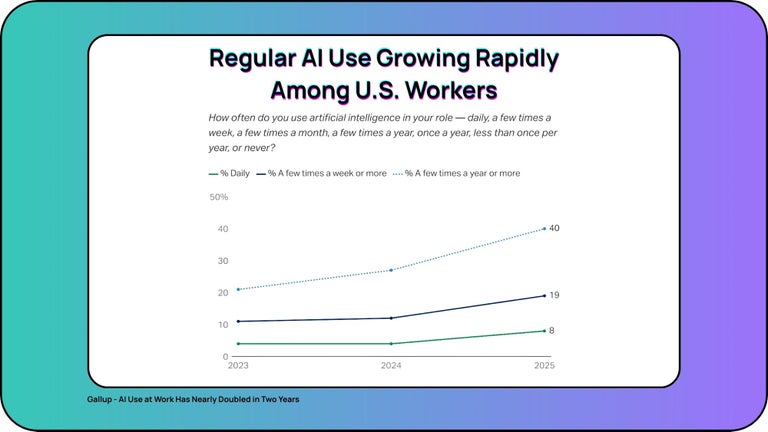
Companies are scrambling for AI talent. Recruiters want proof over pedigree. And most professionals are... dabbling...
That's what we call an opportunity.
The elite professionals winning in today's AI race don't hold some super-secret machine learning credential. They did the hard graft and approached AI the right way.
Mapping AI against their skills. Building automations that solve real problems. Racking in the results. And sharing their wins.
Best of all, they didn't have to start from scratch.
The professionals who learn to harness AI in their roles (and prove results) WILL leapfrog their competition. And you can join their ranks in 5 Steps.
Step 1: Map Your Jagged Frontier
Most people get caught up in AI hype. Trying to apply AI to everything, everywhere, all at once.
WRONG approach.
AI’s abilities are uneven. Ethan Mollick - Wharton professor and author of Co-Intelligence - coins this unevenness the Jagged Frontier. Here's how he explains it:
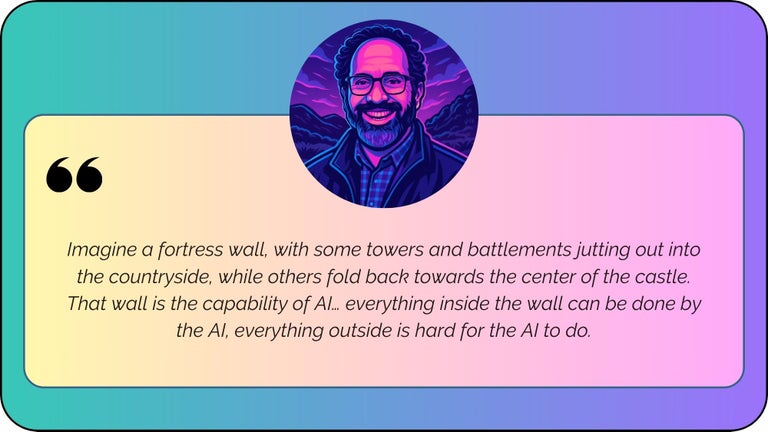
The jagged frontier isn't standard. Shifting with technology AND your abilities.
AI might struggle to write better than a skilled writer, but it could easily outperform someone who hates writing. It might not extract useful insights better than a data analyst, but it could clean data much faster.
Your professional strengths and weaknesses AND your role shape where AI adds value FOR YOU.
Map your frontier.
Take a week to track everything you handle. Experiment with AI on each task. Push it until it breaks. You NEED to build a clear picture of where AI amplifies your work, where it needs your oversight, and where you stay in control.
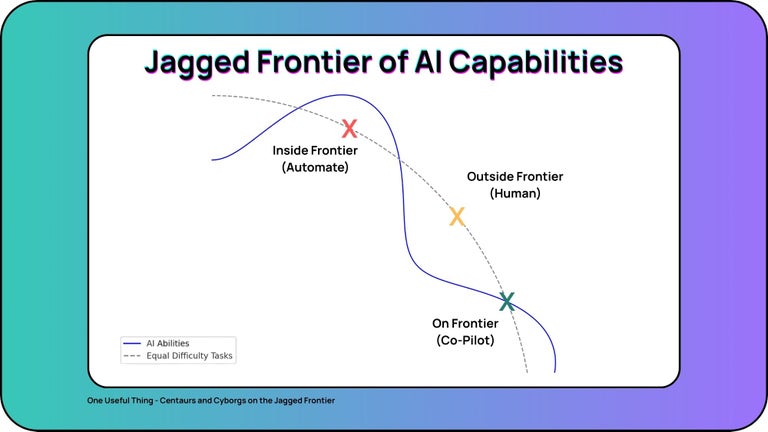
Elite AI users know where to deploy AI. You need to know the same.
Step 2: Be Both The Titanic and The Tugboat
Most people screw up AI career building in one of two predictable ways:
- They set massive AI goals without any path to get there.
- They build cute AI demos with little to no impact.
Elite AI professionals balance big ambitions with small wins.
I recently had a call with Andrew Allen - Crossover's VP of Content Marketing - who shared a metaphor that changed how I think about my AI work. He calls it the Titanic and the Tugboat.
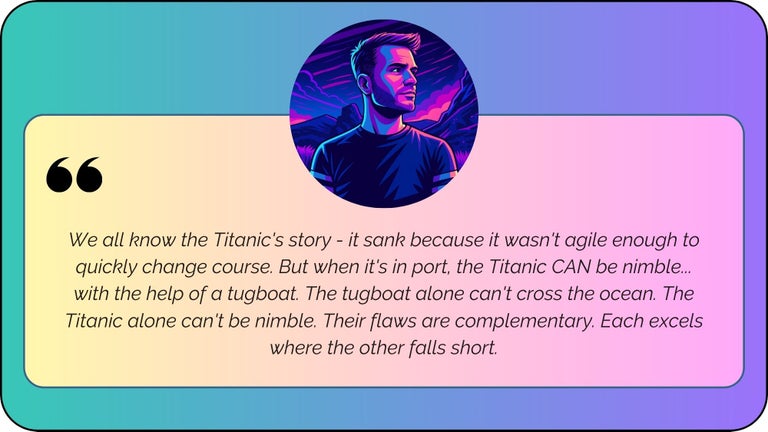
In the metaphor, your Titanic is a measurable, business-level outcome a company would PAY to achieve. Your Tugboats are the many small, nimble projects that drag your Titanic towards the finish line.
If you want to build a career in AI, you NEED to build your own Titanic-Tugboat system. Here's how:
Step 1: Find a big, audacious pain point in your work - something that eats time, or drives stakeholders crazy
Step 2: Frame the pain as a guiding Titanic
Step 3: Use your Jagged Frontier to spot where AI automation or augmentation can start chiseling away at that pain
Step 4: Design measurable Tugboats that solve one piece of the puzzle
Nobody gets promoted for 'knowing AI.' But people DO get promoted for cutting costs, boosting efficiency, and solving problems that keep leaders awake at night.
Your Titanic gives you direction. Your Tugboats pull you forward.
You need both.
Step 3: Skill-Stack With Your Tugboats
Too many people use credentials as an analog for ability. Thinking more certificates equals better career prospects.
But credentials don't solve problems.
Elite AI professionals use their Titanic for direction and their Tugboats for learning. If your Titanic is ambitious enough, you'll eventually hit an AI skills gap. This is something important that you don't yet know.
When that happens, take target action, fill the gap, and then keep working through your tugboats.
Here's the magic of tugboat learning. By the time your Titanic has finally reached port, you've got a measurable outcome to show AND a skill stack that lets you do it again.
This creates something the credential collectors can't touch. You're not a generic 'AI person' competing against thousands of other generic AI people. You're an AI-augmented professional with a track record to back it up.
When you can explain REAL results instead of reciting coursework, you win.
Step 4: Build the Automation Flywheel
At some point, using AI stops being enough. Your tugboats WILL get you started, but they won’t carry you to the elite level without some help.
The real leap happens when you start building automations. Small systems that handle repetitive work free up your time, let you take on more ambitious projects, and - most importantly - GROW.
Each success makes the next one easier. And over time, their momentum is what pays dividends.
My colleague Carla Dewing - AI strategist at Crossover - calls this the AI Automation Flywheel. Here's how she explains it:
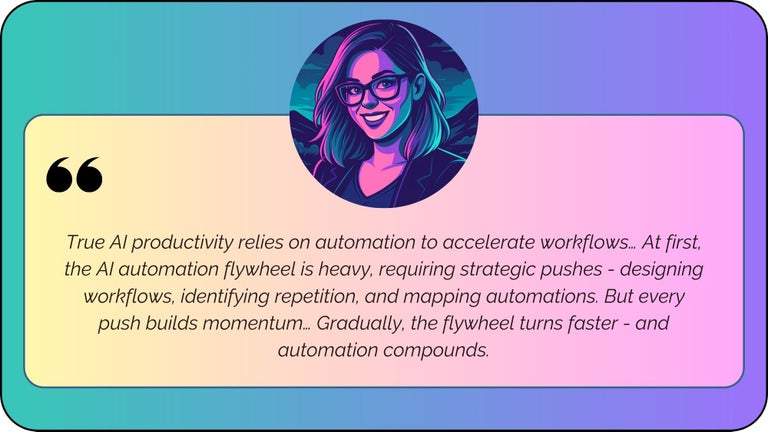
This is why automations are such a career catalyst.
Your first attempts might feel clunky, but each system you design creates leverage. Over time, your role shifts from using AI tools to architecting AI processes.
The kind of work that turns one person’s output into a team’s worth of impact.
If you want to build a serious AI career, this is the step where you stop tinkering and start architecting.
Step 5: Show, Don’t Tell
This is where most people stop short. They do the work but fail to show it.
When building a career in AI, proof is everything. Employers don’t want to hear you’re 'good with AI.' They want to see what you built, how you built it, and the measurable outcomes it delivered.
That means documenting your builds with metrics attached.
‘I helped automate our reporting’ ❌
‘I built custom reporting automation using Make, cutting our processing time by 5 hours a week’ ✅
But DON'T stop there.
The best AI professionals go one step further. They share their wins AND failures publicly. Walking through their processes and opening themselves up to feedback.
Building in public attracts other AI-elite. It creates feedback loops that help you grow faster, while showcasing your skills to the people who matter most.
Over time, this compounds too. Instead of chasing opportunities, opportunities start chasing you.
Sidebar: Don’t Outsource Your Brain
There’s one topic we can’t afford to ignore: AI replacement.
But not in the way you think. AI isn't likely to replace you. But you WILL replace yourself with AI if you use it wrong.
Here's how Carla puts it:
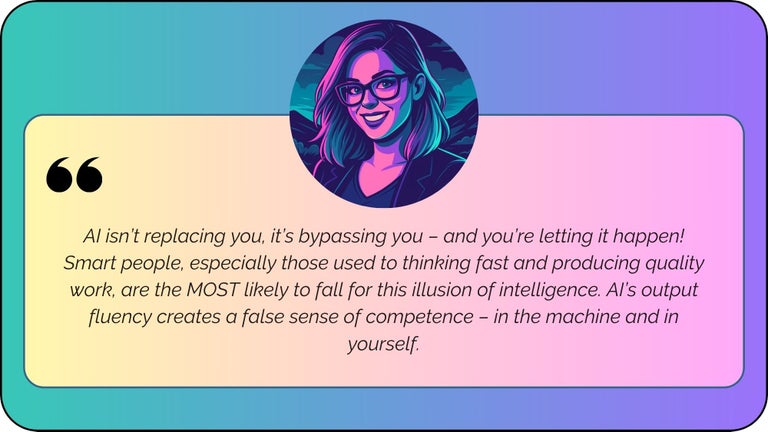
And the science backs her up. Studies show a strong negative correlation between frequent AI use and critical thinking. The more people offload their cognitive work to machines, the weaker their problem-solving and judgment become.
But the fix is simple: treat AI as a thinking partner.
Use it to automate the mechanical tasks that don’t need you, so you can focus on the impact work that does. Use it as a tool, don't let it use you.
That’s how you stay sharp and become an irreplaceable AI elite.
How to Build Your Career in AI: Proof > Pedigree
You don’t need a PhD to build a career in AI. You need expertise.
The people landing elite roles aren’t pointing towards the paper ceiling. They’ve mapped where AI helps, set ambitious goals, stacked new skills, built automations, and shown results with hard metrics.
Map → Target → Stack → Build → Show
Credentials might get you a foot in the door, but the proof is in the pudding.
So start building. And start showing.
Now you know how to build your career in AI. You don't need to start over, you need to level up. Show the world your proof, and let the results speak louder than your résumé.
Similar post


Want to read more?
We have a lot more where that came from



 AI-first remote workers.