Contents
- Step 1: Choose Your Direction
- Step 2: Choose Your Core Curriculum
- Step 3: Use AI as Your Study Partner
- Step 4: Build and Practice Relentlessly
- Step 5: Find Your Community
- Teaching Yourself How to Code for 2026
Teaching yourself how to code feels like a fast track to elite roles - until you meet the tutorial purgatory on the other side. The engineers who break through aren't the ones blundering through the most code, they're the ones who master fundamentals first, then weaponize AI to accelerate understanding and stress-test thinking. In this article, we're breaking down the 5 Steps that separate the vibecoders from the REAL self-taught engineers.
Thinking of teaching yourself how to code? Smart move.
Learning to code has historically been a seriously solid career choice. But the number of people who start their coding journey with the best intentions, only to tap out a few weeks later, is LONG.
When most newbies peel back the coding curtain for the first time, they find themselves face to face with a tall wall of complexity. Dozens of languages. Hundreds, if not thousands, of frameworks. Confusing terminology, tools, and technologies. All on a path with very little intuitive signal on what to prioritize when.
But challenge be damned. The allure of learning to code hasn't gone anywhere, and there's a really solid reason why:
- Growing Demand - Software developer and QA roles are projected to hit a 15% growth rate between 2024 and 2034, far outpacing the 3% average across all occupations.
- Massive Investment - Global IT spending is expected to reach $5.61 trillion in 2025, marking a nearly 9.8% jump since 2024.
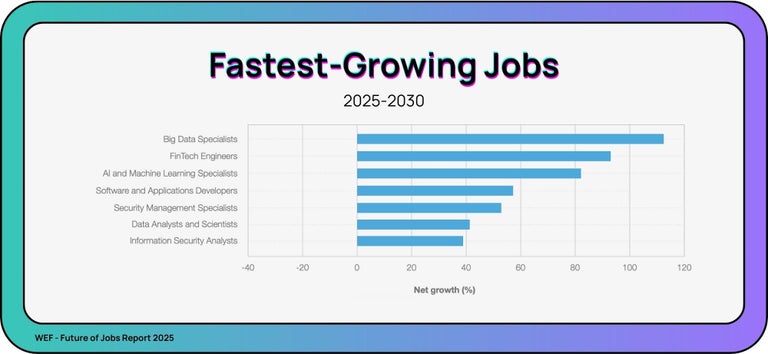
- Explosive Career Paths - Roles like Big Data Specialists, FinTech Engineers, AI and ML Engineers, Software Developers, and Data Analysts are flagged as some of the fastest-growing jobs between 2025 and 2030.
Figuring out how and where to start in your coding journey can feel right near impossible. But for those who commit and learn with intention, the career rewards WILL be well worth it.
If you're serious about teaching yourself how to code, we're serious about putting you on the right track and expediting the process.
Thinking of teaching yourself how to code (or level up your skills)? Here's our 5 Step AI-supported framework for learning to code like an elite engineer.
Step 1: Choose Your Direction
Your journey starts with choosing a path.
Learning to code without direction is like trying to sip water from a firehose. You'll get blasted, overwhelmed, and somehow end up more confused and exhausted than you were walking in. The volume’s too high, the pressure’s too intense, and your brain has ZERO chance of managing the flow.

Project numero uno when teaching yourself to code is direction.
So, start thinking critically about what you actually want. What world do you want to contribute to? What product space feels like home? Do you want to shape what people see on a screen, or shape the decisions happening behind it?
Ask questions that bring you closer to clarity.
Once you’ve got even the roughest idea of a direction, pull AI into the room as your personal guide. Get it to map the world you’ve set your eyes on. Ask it to outline common roles and surface portfolios or example projects that live in that space.
This is your Step 1 gut check.
Do you feel energized? Are you raring to go, or are you already looking for an exit route? Adjust ruthlessly. If you’re not sold now, the finish line WILL move further away.
Next up: narrow the field.
Get your AI assistant to identify the languages, tools, and foundational skills that consistently appear in the space that gets you pumped. If you’re focused on web development, you’ll likely see HTML and CSS as your opening chapter, with JavaScript joining the party once things get real. More interested in data structures? Expect Python plus analytics libraries, and SQL for talking to databases.
Again, you don’t need to understand any of this yet. You’re not learning the tools; you’re building your first mental map and reducing the noise.
Here's why this is important.
Most beginners skip the work before the graft. They jump in with a wild idea like 'learning to code,' get thunder-punched in the brainstem, and dive headfirst out of the chaos first chance they get.
Big, audacious dreams dying on first contact with reality.
Self-taught coders who actually reach the goal make sure to have a REAL goal to begin with. In the eternal words of Lewis Carroll, "If you don't know where you're going, any road will get you there."
Step 2: Choose Your Core Curriculum
Stealing a great curriculum is the smartest move you can make.
You do not get bonus points for reinventing the wheel. There are loads of phenomenal free online coding courses out there that have a proven track record of taking beginners from total confusion to genuine competence. And ignoring that horsepower so you can 'figure it out yourself' is not brave, it is bonkers.
Take the sane path and find a solid program to scaffold your journey.
Khan Academy is a great place to start when you're just dipping your toes in the water. But when you're ready to really get going, programs like freeCodeCamp and Codecademy are crowd favorites.
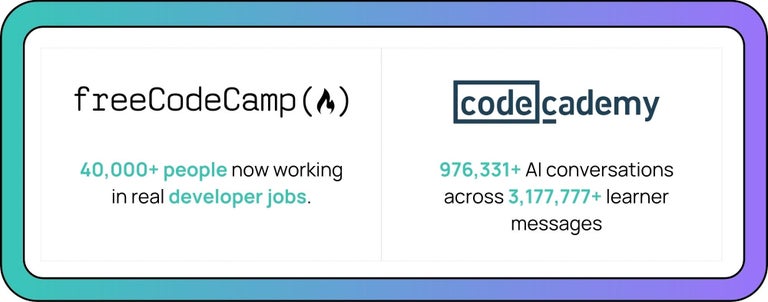
freeCodeCamp is a powerhouse in the space, with their open-source projects and curriculum having already helped more than 40,000 people land real developer jobs. And if you want something with a bit more juice, Codecademy has released its own AI Learning Assistant that, by 2024 numbers, had already handled over 976,000 conversations across more than 270,000 learners.
The options are there. Use them.
Here's the next pro where serious learners step up.
While you work through your curriculum, start getting familiar with how to lean on official documentation. That means learning to read MDN if you're in the web world, and Python or Java docs if you're in the data world.
And AI can help with this, too.
Give it a seat at the table as a personal teaching assistant. Get it to translate dense paragraphs, giving extra examples, or suggesting which sections to tackle next.
Stepping in ten steps behind the starting line isn't smart. Use what's already out there.
Step 3: Use AI as Your Study Partner
AI is powerful for learning when it works with you, not for you.
Most AI-casuals make the mistake of outsourcing their thinking. They hit a snag, fire off a vague question, AI spits out a SOLUTION, and they move on, thinking they get it.
This is the 2025 version of watching a YouTube explanation and thinking you know the work. YOU DON'T!
If the model did the lifting, your brain didn’t.
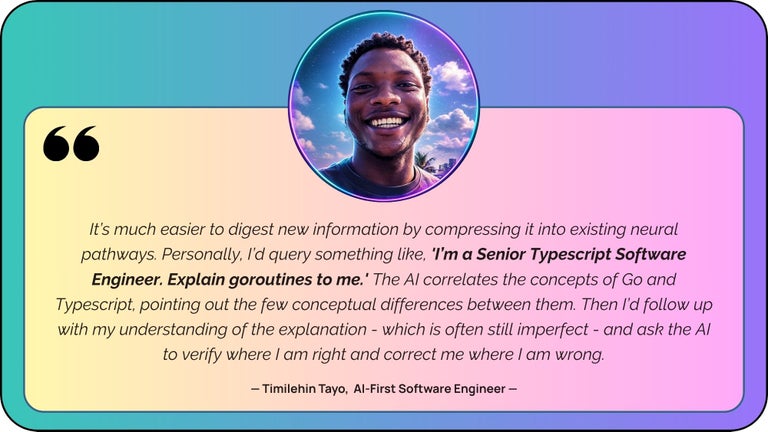
Using AI to accelerate learning requires being radically intentional about how you use it. We recently touched base with Timilehin Tayo - an AI-First Software Engineer at Trilogy - to get a better idea of what the experts think. This is what he had to say:
This is the mindset shift that pays back dividends.
Use AI as your personal tutor-in-residence. Ask it to break down a concept using a topic you understand, in a format that fits your style. Think analogies, step-by-step breakdowns, visual descriptions, whatever works for you.
If it doesn’t land on the first pass, keep going. Get it to push, question, reframe, clarify, and expand until you feel things actually slotting into place.
Then take it to the next level by getting your AI partner to critique your understanding.
Share what you think you understand about the concept using your own words. Don't copy-paste from the model. Don't parrot its phrasing.
Ask it to poke holes in your logic. Get it to surface counterexamples or edge cases that force you to sharpen your thinking. Use it to highlight where your understanding holds up and where it’s still flimsy.
Whatever you do, resist the temptation to ask for the fix.
This is the deliberate use that sharpens your thinking. If you want to accelerate, you need to be strategic about the friction you remove and the friction you keep.
Step 4: Build and Practice Relentlessly
The transition from student to coder lives and dies on building things.
You can binge courses, crush quizzes, and fly through flashcards until the cows come home. But you're not a coder until you code.
The people who actually cross the line into real software work are the ones who spend an uncomfortable amount of time inside broken projects. There’s a reason elite organizations lean so heavily on intense, practice-first programs.
We believe in this so much in this kind of hardcore building that we LITERALLY back programs built on this philosophy. Just take Gauntlet AI’s AI Challenger Fellowship, which we actively recruit for.
This is a 10-week, all-in AI engineering crucible designed to turn developers into the kind of AI-first talent companies compete over. There’s no tuition, no padding, and no endless lectures. Fellows are expected to put in 80–100-hour workweeks building stuff, but regularly receive $200,000/year AI engineering offers if they make it through.

These programs are often for those with a bit of experience in their back pocket. But as a beginner, you can mirror the exact same elite mindset on your own path.
Here's how.
Pick a project that sits directly in your chosen space. Then use AI to help you scope it, outline features, and break the work into clear, sequential steps. Treat the model like a project manager and technical sounding board.
But NEVER treat your AI like a Fiverr developer.
It handles the PM stuff. But you write the code, and wrestle with the bugs.
The goal in this step is not to glide through as cleanly and quickly as possible. Because you need to work through the repetition and problem solving skills that turn theoretical understanding into practical skills.
Here's the added bonus: When you do finally reach the other side, your 'practice projects' now form an elite portfolio.
Step 5: Find Your Community
Code might be technical, but the world is human.
You can go fast on your own. But if you want to go far - and stay sane - you need other people in your orbit.
The coders who grow best aren’t just the ones grinding in silence. They’re the ones who surround themselves with people who know their sh!t. Those who learn from builders who’ve already scraped their knees, broken their projects, hit impossible bugs, and found the weird, unconventional solutions courses don't mention.
Skills matter. But people matter too.
You need a crew that pushes your thinking, exposes you to better ideas, and helps you see where theory collapses in the real world. And the good news is you don't need to already be an engineer to find them.
GitHub is packed with open-source communities where you can watch real engineering happen in public. Stack Overflow is still where developers go to sharpen each other’s thinking. Reddit spaces like r/programming and r/learnprogramming offer brutally honest insights from people actually doing the work. And platforms like Dev.to are built for developers who want to learn and think out loud.
Find the rooms where the conversations are happening, and join the people who are building what you want to build.
Because yes, code is technical, but growth is human.
Teaching Yourself How to Code for 2026
Teaching yourself how to code isn't magic. It's a system.
By this point, you’ve probably noticed something crucial. Nothing we've shared in this article involves being a savant or grinding yourself into dust. You don't need to understand machine learning. A computer science or data science degree isn't necessary.
Using AI as a study-partner to learn how to code is all about lining things up so your effort moves you forward.
At its simplest, teaching yourself how to code is as simple as:
- Choosing a goal
- Finding a curriculum
- Using AI strategically
- Building and breaking stuff
- Finding your community
That’s the whole game. No self-flagellation required.
As we head toward the end of 2025, there’s never been a better moment to finally pull the trigger. The industry is shifting fast, AI is rewriting the rules, and the opportunity window is wide open. Who knows, a bit of graft and the right strategy might be all that stands between you and the life you’ve been dreaming about.
Time to get after it.
Already got coding chops and just looking to level up? Our partners are currently recruiting elite coders with AI skills!
Check what's available, join one of our elite partners, and be the one shaping the AI-future of software.
Similar post


Want to read more?
We have a lot more where that came from


![Crossover’s Basic Fit Check [Official AI Screening Guide]](https://assets-us-01.kc-usercontent.com:443/7beb5311-75a4-0049-50f5-8f58fd55aba7/90bfc8de-1a38-4802-8432-c063c215e90a/BasciCheckGuide.jpg?fm=jpg&auto=format&w=500&h=500&fit=clip)





 AI-first remote workers.