
Contents
- AI Is NOT a Complete Software Engineer
- The Three Eras Of Software Engineering
- Where Era 3 Engineers Focus
- Becoming an Era 3 Engineer
- Will AI Replace Software Engineers? That's a Hard No...
The question 'will AI replace software engineers' is built on the belief that engineering = coding. That's the fatal mistake to make. In this article, we'll reveal how artificial intelligence is forcing a brutal recalibration of what engineering actually means, and why the engineers that learn and adapt fastest aren't doubling down on today's core functions. Smart engineers don’t fight AI on the tasks it excels at; they focus their attention strategically to scale their value.
Will AI replace software engineers? This is the question hanging over the heads of every engineering team right now.
Engineers have lived with 'AI' for years through smarter test automation, intelligent monitoring, basic-test prediction, and static analysis tools. AI isn't anything new. But the generative AI explosion post-2022 has rejigged the mental calculus of what that AI means.
What used to be pretty rudimentary supportive tooling has recently become something wildly more capable.
Tools like ChatGPT’s Coding Assistant, GitHub Copilot, Cursor, and Windsurf have slipped into workflows everywhere and taken center stage. And the week-to-week improvement curve is so steep that smart engineers have no choice but to wonder where the train's headed...
The numbers show just how much everything's already changing. AI in 2025 is:
- Thinking deeper – Models now score 83.8%+ on GPQA Diamond, one of the most demanding advanced reasoning evaluations available.
- Solving better – Newer models are hitting 74.9% on SWE-bench Verified, a benchmark that tests real multi-step coding tasks pulled from actual GitHub issues.
- Working faster – Developer productivity is rising, with AI-enabled devs completing tasks 55% faster than those working without AI assistance.
- Used more – 84% of software engineers are already using or planning to use AI tools in their workflow.
- Delivering results – Companies adopting best-in-class coding agents report 39% more merged pull requests on the ground.
We know, that's a lot... so let's change tack and put your mind at ease.
Rest assured, software engineering ISN'T going away. But that doesn't mean the job is changing.
And your place in the profession come 2026 rests on making one CRITICAL adjustment.
Asking yourself 'will AI replace software engineers?' We’re breaking down what’s really changing in software engineering and how becoming an Era 3 engineer is set to make you more valuable than ever.
AI Is NOT a Complete Software Engineer
AI is here. But how it's here matters a heck of a lot to your future profile.
Zoom out on the typical week as a software engineer, and you'll notice the job is a lot more than 'take ticket, write code.' It’s a messy blend of technical and human work layered together in unpredictable ways that don’t fit neatly into a box.
Right now, AI is aggressively targeting the execution layer, where clear intent becomes tangible output. If you can express a basic need clearly enough, current models will happily spit out a first draft that falls somewhere between 'fine' and 'surprisingly good'.
Robinhood CEO Vlad Tenev recently dropped this bombshell on the 20VC podcast that brings this reality into sharp focus:
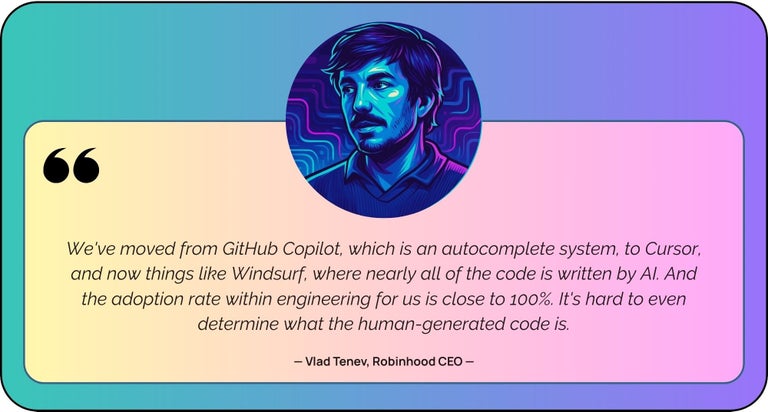
The ground feels like it's moving under software engineers because they're seeing a real time shift in the 'build it' parts of the job. With AI automating a ton of the task-level work many software engineers see as their bread and butter.
But smart engineers understand that basic tasks aren’t where their primary value lies.
So yes, software engineering is undeniably changing. But understanding the trend of that change (and strategically adjusting) is set to shoot your value through the roof.
The Three Eras Of Software Engineering
To get a sense of how things are changing, it helps to zoom out and look at how engineering has historically evolved over time.
While living through it, the changes we're experiencing today can feel very unique. But what we're living through with AI is not the first time the ground has moved under software engineers. It’s the third big tooling jump in a long-running pattern.
I like to think about it like a building site.
You had the era where everyone was swinging hand tools. Then came power tools that made the same people far more capable and the work far more efficient. Later, large-scale machinery hit the building site, and the most valuable person around was the one who could direct it all to build bigger and better structures.
Software engineering is following the same arc.
Era 1 - The Hand-Tool Engineer

In the early days, being an engineer meant living close to the metal.
You wrote everything by hand, glued systems together yourself, deployed manually, and owned the whole stack in a very literal sense. If something broke, it was you, your terminal, and a lot of late nights working through code based solutions.
Your value came from raw, manual implementation.
You were the person who could take an idea, wrestle with the limitations of the hardware and the language, and eventually beat it into working software with hard-earned skill and sheer force of effort.
Era 2 - The Power-Tool Engineer

The ecosystem shot through the roof.
Frameworks, libraries, cloud platforms, managed databases, CI pipelines, container orchestration - one by one, power tools showed up to remove repetitive tasks from your hands.
Yes, you still wrote code, but you weren't carving every brick yourself.
And the center of gravity slowly started to shift. Your job became choosing frameworks instead of re-implementing them, wiring together managed services instead of hand-rolling infra, and letting CI handle the repetitive validation you used to run locally.
Knowing what to build with these tools and how to assemble them into a coherent system gradually became more valuable than proving you could do everything manually.
Era 3 - The AI Foreman
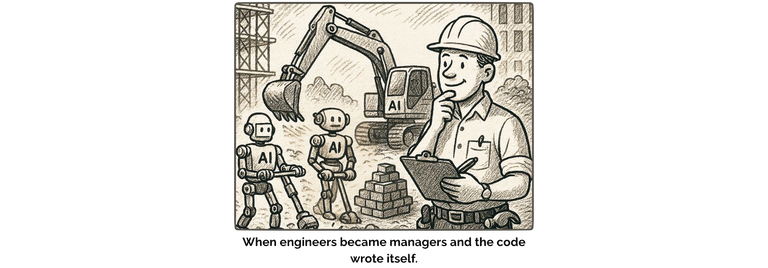
We're now entering the third era.
In Era 3, tools move past basic automation and infrastructure, and onto large chunks of the building work itself. Models write most of the boilerplate, propose refactors, and even open pull requests for you to review.
Code generation has never been cheaper. And good decisions have never been more expensive to get wrong.
In this era, you look less like a lone craftsperson and more like a foreman on a site full of autonomous machinery. You still care about the quality of the work, but your leverage comes from deciding what gets built, in what order, under which constraints, and with which guardrails.
----
Focus on the pattern.
Each era has automated more of the last era's manual labor. And every time that happened, the real value of an engineer moved further up the stack.
Being valuable in Era 3 means stepping into the foreman role. That’s your one BIG adjustment - shifting from doing the work at the task layer to becoming the engineer who designs the system, directs the tools, and takes radical ownership of what ships.
You won’t win in Era 3 by holding firm as an Era 2 operator.
Where Era 3 Engineers Focus
To step into the foreman role, you need to know where your attention now falls.
Before AI got good at writing code, the bottleneck in most engineering teams was straightforward human time. There were always more ideas, bugs, and requests than there were engineers who could handle them. Roadmaps revolved around capacity, and tension between product and engineering usually boiled down to some version of 'we don’t have enough time or people to build all this.'
In that world, most of your leverage came from execution.
If you could move faster and write more, you pushed the whole system forward. Therefore, the advice we'd give you was simple: optimize your focus, guard your maker time, and get more done.
But when a decent first draft can be generated in minutes instead of hours, 'building it' becomes less of a question. You still have to do real engineering to get from draft to production, but the time cost of trying ideas has dropped dramatically.
Ironically, that's made it far easier to ship the wrong thing, or to ship the right thing in a dangerously brittle way. The hard questions have shifted from ‘can we build this?’ to much sharper ones like:
- Did we ask for the right thing?
- Did we understand the constraints well enough?
- Did we evaluate the AI output thoroughly enough?
- Did we consider the long-term maintenance and safety cost?
That's a new target.
In Era 3, your engineering focus falls on three core areas:
- Judgment
- Execution
- Ownership
Becoming an Era 3 Engineer
Era 3 is all about thinking sharper, directing smarter, and taking responsibility for where AI-driven systems succeed or fail.
We touched base with Manuel da Silva - an AI-driven customer support architect at Trilogy - to get a better idea of what this looks like on the ground. And this is what he had to say:
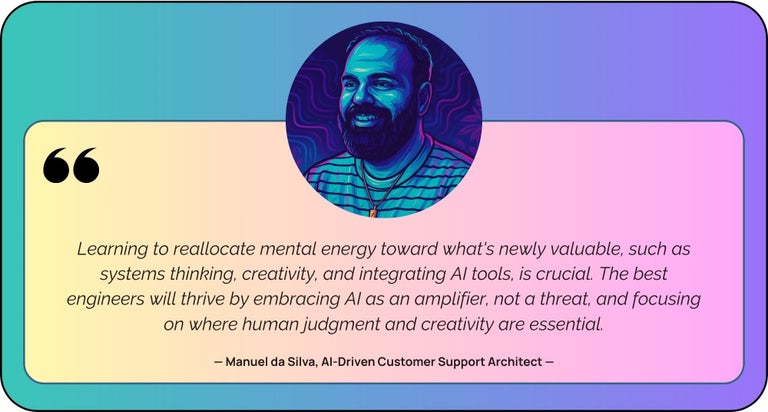
The Era 3 engineer isn’t the craftsperson who insists on doing everything manually. They have all those skills, but their oversized value comes from building a very specific profile.
Here's what it looks like:
1. Agentic Workflow Designer
You know how to turn a rough business ask into a workflow that AI can execute.
Instead of handing models vague tasks and hoping for the best, you shape clear, structured workflows that give AI the footing it needs to execute consistently well. You understand where human-in-the-loop is needed, but your core focus is machine-driven progress with less of the frustrating hand-holding.
2. Evaluator-In-Chief
You decide what clears the bar and what gets sent straight back into the system.
You define the quality threshold, build the evaluation points that expose weak execution, and review AI-generated output with a sharp sense for risk, correctness, and long-term impact. When something's almost right but not quite there, you’re the one who catches it early and puts it back on track.
3. Systems-First Thinker
While others focus on individual tasks, you concentrate on the whole.
You've doubled down on critical thinking and problem solving. You understand how components interact, where friction builds, and how design decisions ripple outward across the whole system. When workflows stitch together, you make sure they’re all pulling in the same direction.
4. Tooling + Integration Engineer
You care deeply about using the right tools for the right jobs.
You think in terms of fit: which models suit the problem, which services belong in which workflows, and how all the pieces should fit together to deliver the best possible results. When it comes to building, you choose, integrate, and refine the stack so the system's as powerful AND practical as possible.
5. Communicator + Change Agent
You’re the human-AI bridge.
You take it upon yourself to make sure everyone's on the same page and expectations land in the right, reasonable place. AI doesn’t get stretched until it fails and gets written off as useless, and it doesn’t sit underused while everyone keeps doing things the hard way. You shape how the team sees and uses AI, so it adds maximum leverage.
Will AI Replace Software Engineers? That's a Hard No...
The ground's shaking, but the world's not ending.
Software engineering has never just been the neat tasks that fill your sprint board. It’s a messy blend of human judgment, technical execution, systems awareness, and real-world responsibility. It’s coordinating intent, design, risk, and impact, all while keeping the entire system stable under pressure.
Replacing a FULL software engineer is a distant pipe dream. But the value you bring to the table IS changing.
Execution-heavy work is getting automated fast, and the median engineer is going to feel that squeeze. If you cling to the predictable parts of the job, you are going to find yourself competing in a losing battle.
But shift to judgment, execution, and ownership, and you might just become the person the entire system relies on.
Will AI replace software engineers? No… but it will replace the ones who refuse to grow. It’s time to face the new reality of software engineering and become the Era 3 engineer who leads the machines. Upgrade your profile today to become more valuable than ever.
Similar post


Want to read more?
We have a lot more where that came from



 AI-first remote workers.