Contents
- Step 1: Develop Your Thinking
- Step 2: Communicate Your Decisions Their Outcomes
- Step 3: Turn Your Work Into Reusable Artifacts
- Step 4: Unblock Others at Scale
- Get Seen From Your Remote Office
They said working from a remote office meant fighting for visibility. Turns out - the best remote remote work professionals haven't had to fight at all. In this article, we'll reveal how top performers architect recognition through a simple four-stage system. From thinking better to amplifying others, THIS is how strategic remote workers are building influence that makes them impossible to ignore.
Working from a remote office should mean more work life balance, less synchronous distraction, and a global career built on your terms. But for many, that's not the on-the-ground reality they're experiencing.
You put in the work, hit your deadlines, deliver clean outcomes – and yet the recognition doesn't follow. But the solution isn't more effort, it's better visibility.
The data paints a pretty grim picture for remote workers struggling to be seen:
- Management Disconnect - 38% of remote workers feel disconnected from their leadership
- Recognition Gap – 27% of flexible office workers believe they’ve been passed over for promotion
- Promotion Penalty – Managers are 9% less likely to give a raise to a full time remote team member when compared to in-office employees
- Layoff Risk – Remote workers are 35% more likely to be included in layoffs
Visibility IS NOT optional when you work remotely. But it IS an equation you can solve.
Tired of flying under the recognition radar when working from a remote office? Here's our four-stage system for getting noticed even when you're not getting seen.
Step 1: Develop Your Thinking
Visibility's great irony is that it's built on a foundation no one sees...
Most people make their first mistake right out of the gate. They notice they’re not being seen, decide they want to be seen, and then jump straight to trying to draw attention. It's completely reasonable and intuitively logical... but it skips a critical truth.
Your primary goal ISN'T to be seen. It's to be seen for the right things.
Underneath every visible result is an invisible chain of decisions - and the quality of those decisions is a big deal. High-quality decisions create work that’s easier to trust, easier to understand, and easier for others to champion. Low-quality decisions do the opposite. They force people to compensate for your thinking instead of benefiting from it.
Most people are wildly flippant about elite-level thinking. They assume it’s a natural gift, something the geniuses have and everyone else doesn’t. But thinking is a very trainable skill. And one of the fastest pathways to an elite level is adopting a strategy that forces the right process.
Here's a foundation we recommend building off of:
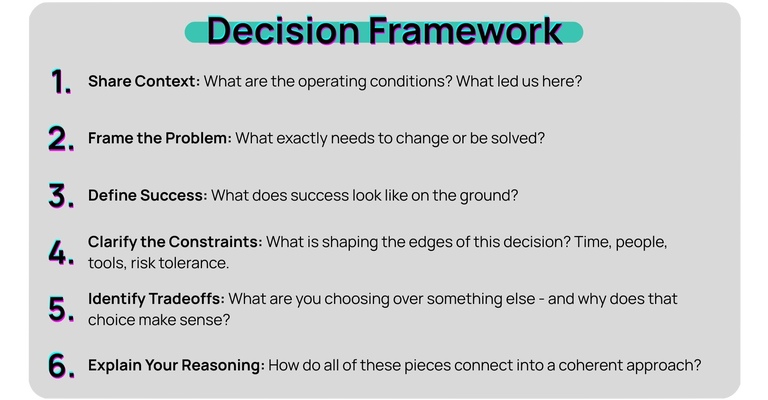
You can customize the process however you like, but your goals should stay the same. You want to 1. know the actual problem, 2. have a grounded definition of success, 3. understand your tradeoffs, and 4. be able to explain and justify the decisions you’ve made.
From there, the cascade takes care of itself:
clear thinking → better decisions → cleaner outcomes → easier stories → stronger visibility
Step 2: Communicate Your Decisions & Their Outcomes
Most people are worrying about their own sh!t, not thinking about yours...
A lot of talented remote workers fall into one of two traps:
Trap 1: They go quiet, assuming their work 'speaks for itself.' They deliver solid results but share the bare minimum. Their manager sees closed tickets, but focuses on the team's impact. Their reputation is good, but no one can connect their name to specific outcomes.
Trap 2: They opt for visibility first. They comment on everything, narrate every micro-step, and flood channels with half-formed updates. The signal gets buried. People start skimming. And the important information gets lost in the noise.
Both patterns hide value.
Remote performers who stand out do it by communicating like owners. They don't say 'done'. They make the information that matters quick and easy to understand. This is all about compressing your foundational thinking into something the team can use.
At a minimum, that means sharing:
- What you did
- Why you took that approach
- What changed
- What you recommend next
In practice, it might look something like this:
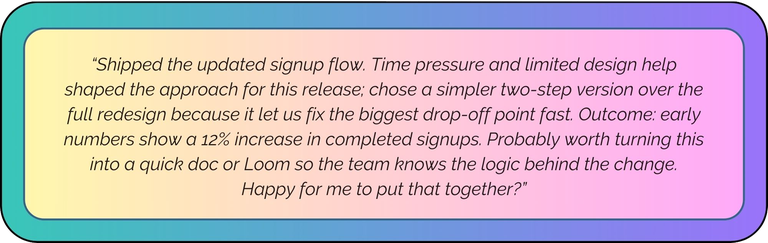
Anyone reading that update can answer the most important question on your behalf:
"What did they do, and why does it matter?"
Communicating decisions and outcomes this way does four powerful things. It shows your judgment, builds trust, reduces confusion, and creates a visible trail of value attached to your name.
In an office, someone might notice you staying late or see the work on your screen. Remotely, silence = nothing. Clear, USEFUL updates turn your decisions into visible impact that feeds the kind of visibility you want.
Step 3: Turn Your Work Into Reusable Artifacts
Most work disappears when the project closes. Yours shouldn't.
The pattern on most teams is painfully predictable. Someone fights through a messy problem, figures it out, ships the solution… and then walks away. Six weeks later, a new person runs into the same issue and starts from scratch.
Elite remote workers understand that an artifact is what you create when a one-off win deserves a second life. It's your thinking rebottled for when you're not in the room.
Artifacts can take plenty of different forms:
- A Loom walking through how you debugged a tricky issue or set up a workflow
- A short “how we solved X” doc that captures the problem, the approach, and the final call
- A checklist or template that makes the next run faster and less error-prone
- A simple decision log that stops the team from re-arguing the same thing in six different meetings
Don't get me wrong. This isn't a call to document everything. But it is a call to capture the wins worth keeping.
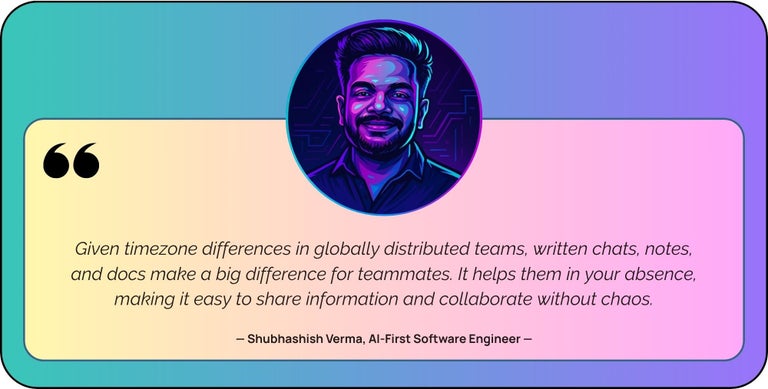
We recently touched base with Shubhashish Verma - AI-First Software Engineer at Trilogy - to learn more about his thinking around working effectively while remote.
Shubhashish had this to share:
Here’s a simple filter you can run before you invest time in an artifact:
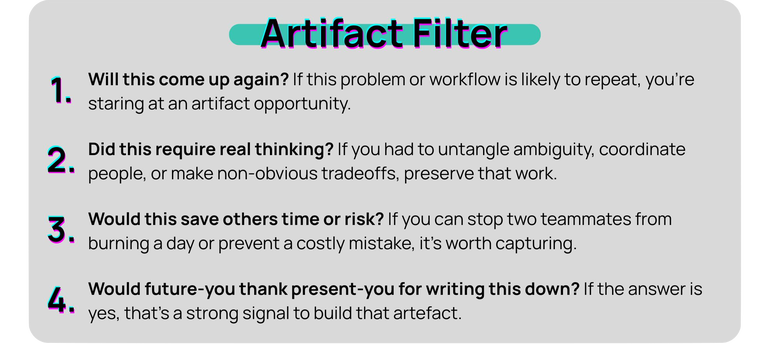
If you pass your filter, next up is pairing the right artifact with the right purpose. Think Looms when people need to see it, docs for reasoning, checklists for speed, and decision logs when the 'why' behind a choice will matter later.
And don’t underestimate the power of the social move. Think back to our communication from earlier:

That's the sentence that leaves people saying 'Shubhashish made a doc for that' six weeks later...
Artifacts are leverage. They let your thinking keep adding value in rooms you’re not in, for months (or more) beyond your initial investment. Start using them strategically, and move front of mind.
Step 4: Unblock Others at Scale
Every team has that one person everyone thinks of when they hit a snag.
Elite remote workers treat unblocking others as part of their core function. Seeing it as a natural extension of the things they’ve already built:
- Clear thinking that cuts to the heart of a problem
- Sharp communication that makes complex things understandable
- Artifacts that turn one answer into a reusable resource
This is where those core visibility skills you've been working on shift from serving your work to reducing discomfort for everyone else. In practice, that often means targeting four kinds of friction:
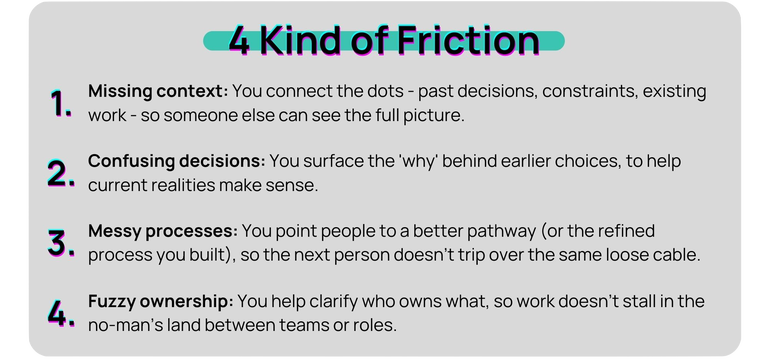
The more you’ve invested in thinking, communicating, and creating solid artifacts, the easier and more scalable this becomes. You'll find yourself moving past answering the same question ten times in ten DMs, to unblocking once and letting that solution (and your name) travel.
And over time, a pattern will inevitably form. People are less stressed when you’re in the thread, projects run smoother when you’re involved, and your name comes up more when people want clarity on how things fit together.
You've now hit visibility at a deeper level. Not from volume or 1:1 experience, but from scaling value across your org.
Get Seen From Your Remote Office
You can’t control who shares a hallway with the boss. But you can control the visibility and reach of your work.
Visibility is not magic. It's not luck, charisma, more face time or being the loudest voice at the party. The simple truth is that the remote workers who get seen are the ones who add value, and value almost always follows a predictable pattern.
Lock onto that pattern, and you lock in the visibility.
Right now, the gap between 'ghost in the corner' and the person people actively look for comes down to four moves:
- Upgrade Your Thinking - Invest in the thinking skills so your work’s worth shining a light on.
- Communicate Your Outcomes - Strategically share your work and outcomes so people can immediately attach impact to your name.
- Turn Your Work Into Reusable Artifacts - Bottle your wins as docs, Looms, and checklists that keep delivering results long after you’ve left the room.
- Clear the Path for Others - Use your new skills and artifacts to remove friction across the team and become everyone’s front-of-mind operator.
Run this loop consistently, and you will become the trusted colleague that's impossible to overlook.
Tired of being overlooked while working from your remote office? Join a remote team that does remote RIGHT.
Similar post


Want to read more?
We have a lot more where that came from



 AI-first remote workers.