Contents
- The Office Productivity Lie
- The Shift from Hustle to Meaningful Productivity
- What Does Productivity Mean to You?
- The System Shift Behind Meaningful Remote Work
- 5 Steps to Designing a Meaningful Productivity System
- Productivity Tools That Work
- Build The Life of Your Dreams
Why are remote workers 91% more satisfied with their jobs than office workers? Because they’ve realised that real productivity isn’t about doing more – it’s about doing what matters. Here’s how you can shift the way you create results so that work feels more meaningful and less busy.
Productivity is a dirty word.
We’ve twisted it into something toxic - overwork, an obsession with urgency, and the constant relapse and reload culture of burnout in tech. A productive day often means you’ve worked well beyond 8 hours and have completely ignored your health and wellbeing.
Well done! You’ve sold your day so effectively you didn’t even see it.
That’s not great, that’s messed up.
No wonder morale and motivation are at an all-time low.
According to a Global Work-Life Survey, 65% of us are extremely satisfied with our jobs, but only 34% of office workers can say the same.
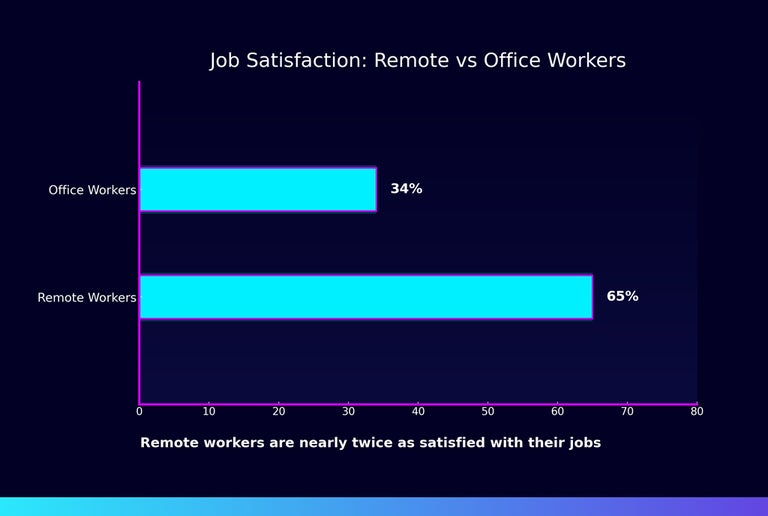
That’s a 91% difference in job satisfaction!
It means that fully remote workers are TWICE as likely to love their jobs.
And it’s not just because they’re at home. Or travelling. Or they’ve discovered the epic benefits of flexibility we all know so well by now. It goes SO much deeper than that.
Remote work and AI technology have become authentic paths to total autonomy, reframing how top remote workers harness productivity to build their best lives.
If you’re still stuck in workaholism – you’re missing a MAJOR opportunity.
Remote work can give you the space to design work that actually matters and will help you reclaim the energy to enjoy life outside of it.
In this article I’ll teach you about the productivity mind shift that top remote workers swear by. You’ll learn to abandon the cult of busyness - how to define what productivity means to you, and how to align your energy with what matters. You’ll learn how to build a modular productivity system that fits your life.
Today is the last day you’ll ever be busy for nothing.
The Office Productivity Lie
You’ve been lied to (sorry).
Office culture has made it impossible for you to keep up with the levels of productivity they demand, if you’re a knowledge worker. Coding, writing, designing – any kind of super-focused work simply ISN’T as effective when you’re at the office.
Because it’s hard to track productivity, they use presence as a metric. Not just presence but busyness. As long as you look busy, you’re safe. But are you?
Constantly being busy is the literal WORST.
It feels like harassment having 10,000 things to do and no time in which to do them. You’re not living in the upside down or bizarroland – you’re just experiencing a system that weaponizes productivity to keep you working for longer.
The result is that work crowds out your life.
- The office is NOT a great separator of life and work
Truth is, the office is a trashbasket of unwanted conversations, interruptions, meetings and distractions that KEEP you from deep work. That’s why 41% of office workers burnout vs 26% of fully remote workers.
- People are NOT happier at the office
If you believe the press, remote work will turn you into a lonely cave-dweller with no friends, who regularly talks to pigeons for some form of daily engagement. If that was the case, why are 82% of remote workers happier in their jobs?
- Tech folk are NOT more productive at the office
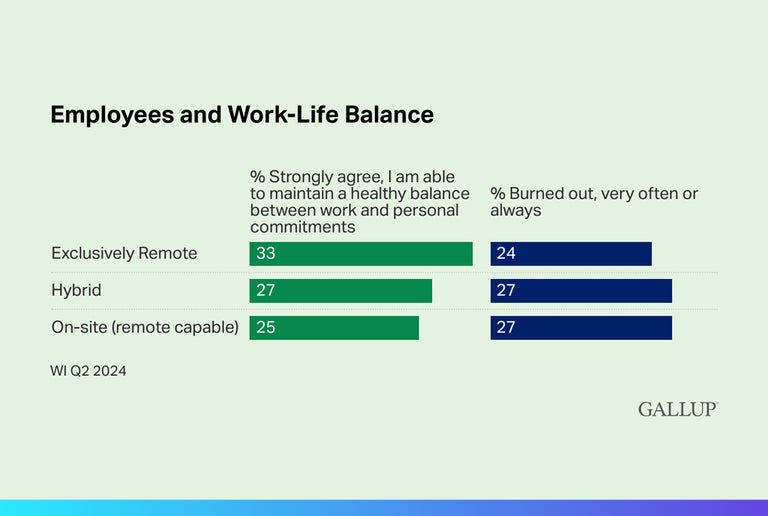
Companies have been banging on about productivity slumps and using them as an excuse to get everyone back into the office. But 77% of remote workers are MORE productive at home and 68% of workers accomplish more in less time.
The math is pretty clear – the office is broken for knowledge work.
The Shift from Hustle to Meaningful Productivity
There are two types of productivity:
- Performative productivity: What looks impressive in standups or in office
- Meaningful productivity: The kind that leaves you fulfilled, focused, and progressing
Most people are stuck in the first kind, and they don’t even know the second exists.
But remote work changes that.
It hands you back autonomy - and with it, the chance to redesign how you work.
Gallup says more autonomy often = increased productivity.
There’s a real reason for this. When a knowledge worker has the space to repossess their time and redesign HOW they work, they can fix the system that was rigged against them to begin with.

There is zero autonomy at the office.
When you’re sick, you have to bring your boss a doctors note like you’re in kindergarten. You have to ask special permission to stop working so that you can take a break, have time off or go on holiday.
You’re subject to unbearably unfair and erroneous productivity rating systems based on how much someone you barely know likes you. You have to juggle work that isn’t yours with work that is yours, then justify why none of it is done on time.
Productivity isn’t your manager’s responsibility.
It’s yours.
And when you start treating it that way, things change fast. You stop working to prove that you’re productive. You start working in ways that feel productive.
That move you forward. That mean something.
What Does Productivity Mean to You?
We wanted to find out from our LinkedIn followers how productive they really are. So, we posed a question: “How much of your 8-hour workday is actually productive work?”
Then we followed up with an even sharper one: “What does productivity mean to you?”
Some 7469 people weighed in with their answers and opinions.
They were revealing.
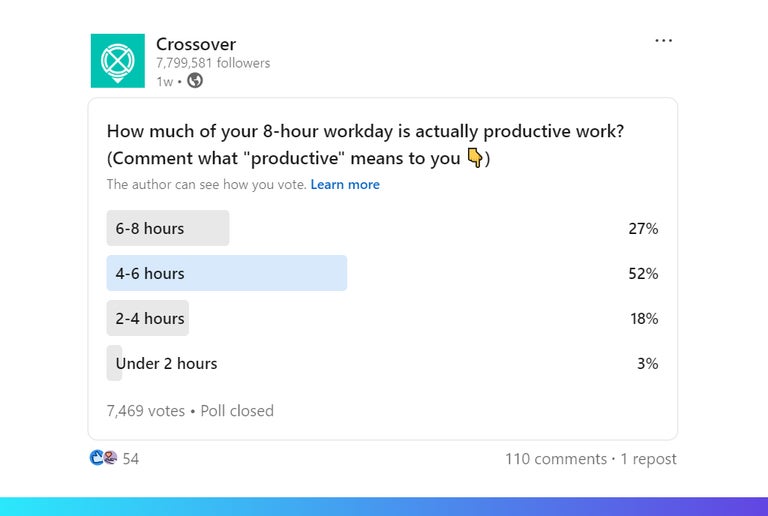
- 52% said they were productive for 4-6 hours
- 27% said 6-8 hours
- 18% said 2-4 hours
- 3% under 2 hours
Even though 79% of people said that they’re productive for at least half the workday, what counts as productive differs for everyone.
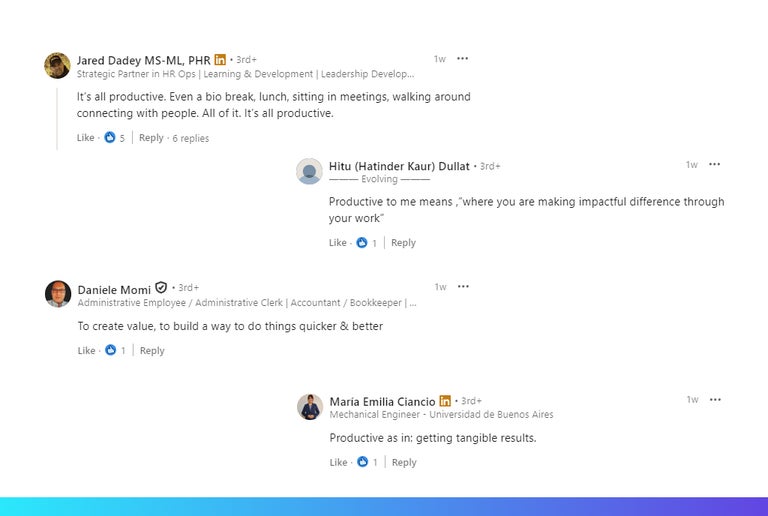
Some interesting takes were:
- Everything is productive!
- Getting tangible results
- Value creation and finding ways to do things fast
- Impactful difference through your work
For some, it means deep, focused work that bares fruit. For others, it was ploughing through emails, chats, and back-to-back meetings in an attempt to reach inbox zero.
And that’s the real problem.
- If you can’t define productivity, you can’t achieve it
- If your definition of productivity is too shallow, you’ll never enjoy your work
You can be busy and miserable. You can do one important thing in 5 minutes and feel satisfied. Meaningful productivity is personal.
And it’s time to define yours.
The System Shift Behind Meaningful Remote Work
You might have guessed it – the shift is significant.
- From reacting to designing
- From passive consumption to active intention
- From a fixed linear system to a modular one
Instead of always being busy, you switch to thinking of productivity as a modular process – like building a complex Lego set.

There are distinct units that allow for modularity, and these will help you build sustainable productivity into your days, weeks, months and quarterly goals.
Modular systems can be impossibly complicated, but when you have the power to break these systems into smaller interchangeable parts, they become flexible, scalable, efficient and easy to maintain.
Because productivity is so intensely personal it suffers when applied to systems that don’t allow for constant change. That’s why office productivity is terrible for folks that want to achieve meaning in their workday.
The biggest shift you can make is in designing a modular productivity model that ALWAYS works for you.
And remember systems aren’t strategies.
- Cal Newport advocates for slower productivity to achieve meaningful work, which means focusing on doing less, working at your natural pace and being a stickler over quality.
- Robin Sharma’s 90/90/1 rule advocates for spending the first 90 minutes of your day for 90 days straight on the most important task you have.
While remote work makes these strategies possible, they are simply strategies within a FAR more complex design system made up of many things that influence your productive time.
- Your emotional state: Stress, anxiety, or calm all dictate how much focus you can actually bring to the table.
- Your general health and wellness: Sleep, nutrition, and exercise aren’t side notes, they’re productivity fuel.
- Your daily challenges: When your dog gets sick, your PC crashes, or your uncle Jim drops by for a visit, productivity gets hijacked.
- Your environment: Whether it supports flow or constantly drags you back into distraction changes often, even in a home office!
- Your boundaries: The ability to say no, end the day, and protect your energy.
So, you see, meaningful productivity isn’t a single strategy because no single strategy is fully sustainable with such an ever-changing system. You can have 100 productivity hacks in your back pocket that you use on the reg – and still feel empty at work.
Because productivity was never only about work, it’s about LIFE. What is the point of effort and creation without fulfilment and reward?
A strong modular productivity system will supply you with endless rewards.
Let’s build yours.
5 Steps to Designing a Meaningful Productivity System
Out with the old mindset, and in with the new.
You’re not reacting to your day anymore. You’re building a system around yourself - a modular design that adapts to the real-time complexity of your own life. Instead of one rigid formula, you’re snapping together pieces that work in the moment.
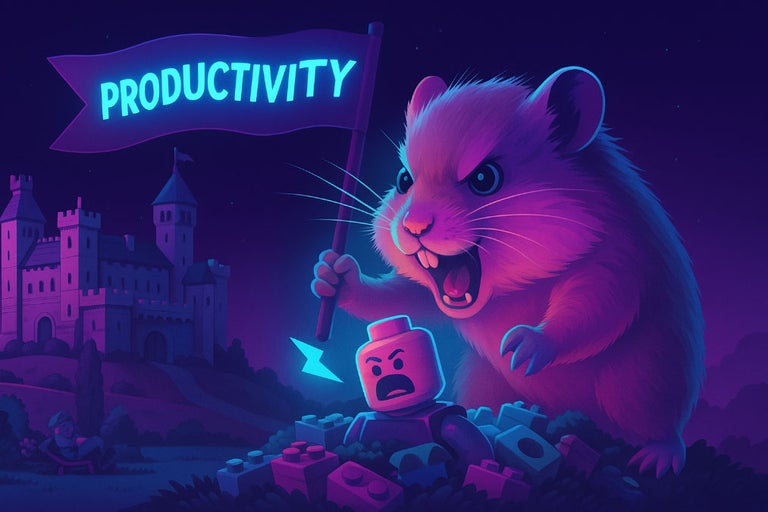
Lego is a great analogy for this: each block is simple on its own, but when you assemble them strategically, you create something much bigger - a system that makes your workday both productive and meaningful.
Here’s how your pieces should fit:
Step 1: Your Quarterly Goals
Think of your quarterly goals as the castle foundation. These are your big pieces, your main blocks – the board and the shape of your entire structure.

In other words, the longer-term vision of productivity you’re working towards.
- What do you want to achieve or create in the next 90 days?
- What are the parameters that would allow that to happen?
- What is non-negotiable and what is flexible?
Design with work and life in mind. If success to you means never working overtime, and only every being productive for 8 hours a day that becomes a guiding system rule. This is your baseline, every other piece connects to this.
Step 2: Monthly & Weekly Priorities
Think of your monthly and weekly priorities as the rooms in your castle – the wings, the kitchen, the banqueting hall. Each specific space will have its own unique requirements and purpose – but for the castle to be complete, each must be built.
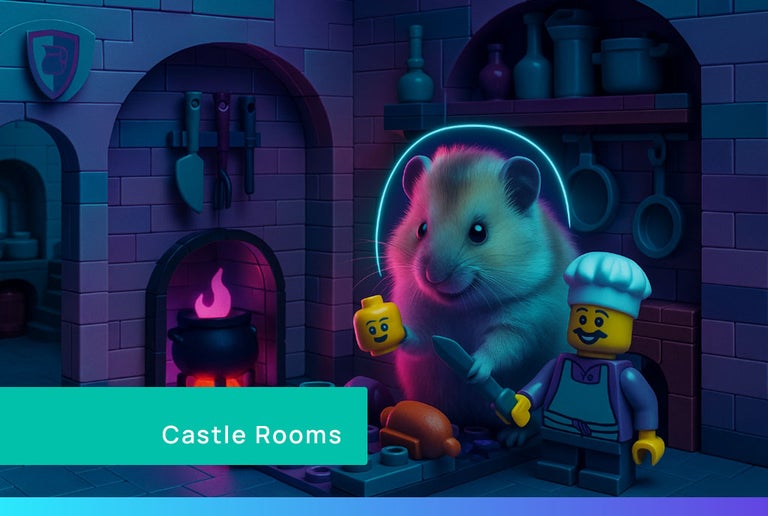
In the shorter term, define productivity in terms of progress.
- Which milestones bring you closer to your quarterly goals?
- What does a productive month or week look like?
- Which projects or problems deserve their own room in the castle?
Priorities shift, but they should all serve the castle.
Step 3: Daily Energy Matched Work
A castle without people is just stone. The same is true for your productivity system, your daily energy is what animates the structure. No two days will be the same, because you won’t be the same.
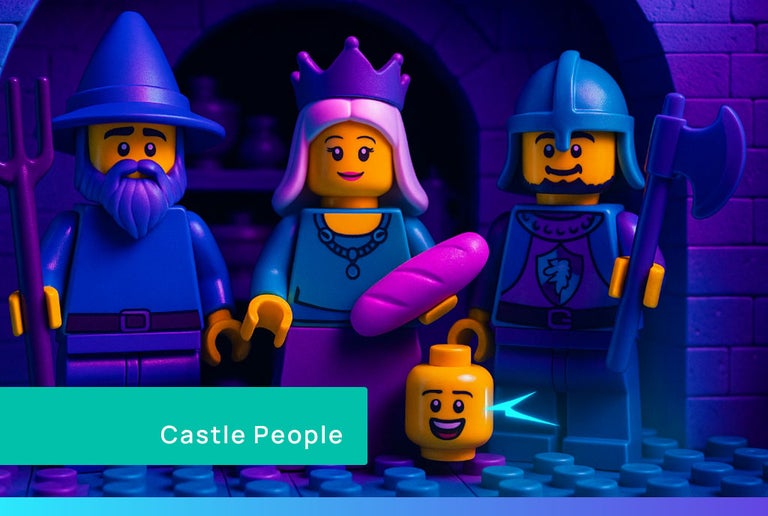
- Always consider your energy levels (focus, creativity, grit, curiosity)
- How much intensity do you have to offer your tasks?
- How often will you need to switch between tasks to maintain your levels?
When you are the priority as the ‘person,’ every day becomes a chance to rebuild yourself to maximize your ability to be productive and produce meaningful work.
There’s no point trying to build a castle fireplace when all you can manage that day are placing the pots and pans.
Step 4: Task Hierarchy in Real Time
Not every room needs a throne. Some are fine with a few stools. But you need them, or where will people sit?
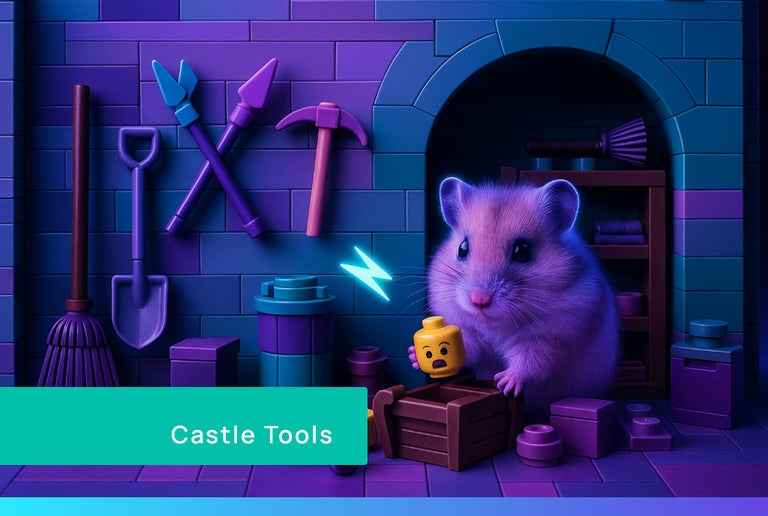
Task hierarchy is about choosing (in real time) which tasks deserve your best focus and which can be done with less. These are the furniture items in your castle and often present as to-do lists.
- Identify which tasks that day demand deep work and which are shallow
- Prioritize them by order of importance, speed or fast delegation
- Take what you know of the day and schedule like a strategist
Very few tasks are genuinely urgent. Your castle will need its furniture and tools, but you get to decide their importance, where they go and when you can manage them.
Step 5: Space for Chaos, Creativity & Unknowns
Every castle needs an open courtyard and yours will differ depending on the day. Life happens and being productive means meaningfully planning for unrewarding or empty work in your day.

- Breaks, walks, time for liminal space between tasks
- Do something random to inspire yourself, switch tasks, find your energy
- Create daily routines that set you up for perfect deep work
After a meeting I go outside, walk my dog or take 30 minutes to decompress, think about what was said and plan the next steps. Without that space, I couldn’t go back into the castle knowing what to do, with the right tools to do it.
Without the courtyard, the castle can become a prison.
Each of these steps contains modular pieces or bricks that become the larger, flexible productivity system. It adapts to real life while gently guiding you towards meaningful productivity.
I’ve had a day or two where I’m exhausted and can’t work.
Sure, I could sit there and stare at the bricks making zero meaningful progress – or I could immediately understand today is not the day. Today is a courtyard. That way, tomorrow has the space to be a turret.
That’s why remote workers often stack hours based on how productive they feel.
Productivity Tools That Work
Meaningful productivity doesn’t happen in a void.
Remote workers have unique access to incredible tools that will help you build things faster and better. The trick is to avoid the tools that drain your time and embrace the ones that genuinely help you achieve your goals.
It’s an ongoing game of trial and error.
- Async tools should free you from constant interruption and let you work inside of your natural rhythm.
- Automation and AI can handle repetitive, shallow work so you don’t burn cognitive fuel on checkboxes and admin.
- WorkSmart shows you how trust and autonomy can scale. By proving outcomes without micromanagement, you get the freedom to focus on meaningful work, not just visible effort.
All of these tools give you metrics that you can use for task prioritization, energy alignment and short (and longer term) goal achievement.
Tools can be wrecking balls for your castle or the Leg-Glue that holds it all together.
Build The Life of Your Dreams
No-one ever said being productive was going to be easy - especially when the world rewards urgency over clarity, motion over meaning, and burnout over boundaries.
But productivity CAN be the foundation of the life that you’re trying to build.

Meaningful productivity isn’t about stuffing yourself into the confines of rigid rules, working yourself to death and having nothing to show for it.
It’s about being intentional with your time, energy and attention – to build a sustainable system that supports the life you actually want to live.
That’s what work is for!
Productivity is a practice - but first you have to make the shift.
Leave your office productivity where it belongs – in the dirt. Stop reacting to harmful urgency and hustle culture. Start building the productive days you deserve.
- It’s not about presence, it’s about purpose
- Forget being crazy busy, it’s impact that counts
- Leave rigidity at the door, you’re not a machine
That’s the productivity shift remote workers swear by – designing your day, week and career that reflects what actually matters - to you.
You decide - you’re the system architect!
And like any good builder, you know some days you’ll design castles. Other days, just broom cupboards. Sometimes a dungeon. Sometimes a courtyard filled with sun and silence. That’s the beauty of a modular system, it adapts with you.
So build slowly. Build with intention. Get off the hamster wheel.
Over time, you won’t just have a better workflow - you’ll have a life that finally fits.
And a name that’s known all over the world for elite remote performance.
Similar post


Want to read more?
We have a lot more where that came from



 AI-first remote workers.