Contents
- Step 1: Create a Storage System You’ll Use
- Step 2: Source The RIGHT Information
- Step 3: Turn Information Into Insight
- Step 4: Use It or Lose It
- Step 5: Protect Your Energy
- How to Become a Lifelong Learner for the Long Game
Wondering how to become a lifelong learner? Most 'lifelong learners' are career self-saboteurs, hiding procrastination behind self-improvement hype. The elite secret? Top performers consume less to achieve more. You NEED to stop knowledge hoarding and start building systems that compound.
The story you're being fed about how to become a lifelong learner is wrong.
Every productivity guru, LinkedIn influencer, and self-help evangelist pushes the same toxic myth. More is better.
More courses. More books. More consumption.
A predicted 39% of workers' core skills will change by 2030. Nearly 6 in 10 will need to be retrained. And around half (49%) are terrified they'll be left behind.
The consumption myth feeds on these numbers. Selling a solution of ongoing preparation that leaves workers perpetually searching for more.
But quantity of information ISN'T the issue.
Most lifelong learners find themselves building an infinite archive. But without a system that turns information into action, all that *ahem learning becomes nothing more than socially acceptable procrastination.
The best lifelong learners know the gap between information and outcomes. And they've built a system to cross it.
Tired of a pursuit of knowledge that never returns results? We’re here to share the elite 5-step system TRUE lifelong learners use to turn information into a compounding advantage.
Step 1: Create a Storage System You’ll Use
Your brain isn’t a filing cabinet.
It’s brilliant at spotting patterns, connecting rogue data points, and solving particularly sticky problems. But flood it with every half-useful article and random fact, and it's water through a sieve.
Our short-term memory is built to hold around four pieces of information at any one time. After that, something HAS to get pushed out.
Most of what you see ends up in that pushed-out pile.
But the fix is simple. Stop using your brain for storage.
Build a single, frictionless inbox where you capture anything and everything that sparks interest.
The tool doesn’t matter - Notion, Obsidian, Google Docs, even pen and paper. What matters is that it’s always at hand and dead-easy to use.
Our very own Manuel Da Silva - L2 Support Agent at Trilogy - calls this his Brain Dump. When we touched base, this is how he put it:
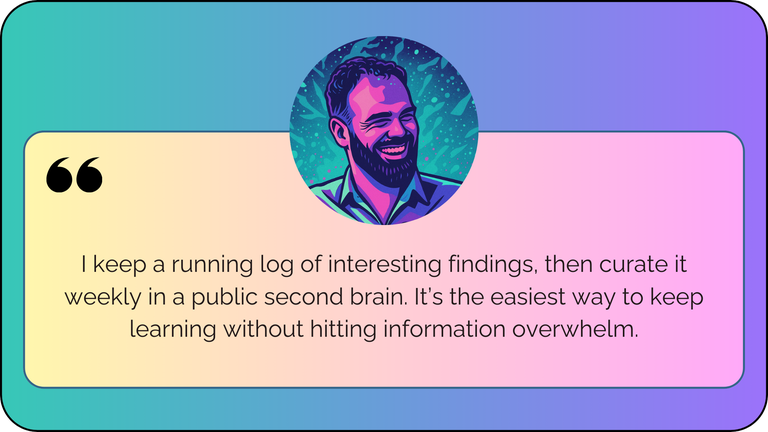
The key words here are log and curate.
Store everything. But set aside time each week to sort, label, and delete.
Keep the gold, dump the junk.
This forces you to revisit what you’ve captured. Letting your brain move the best ideas into long-term memory where they can spark new connections later.
Step 2: Source The RIGHT Information
Inputs determine outputs.
You’ve built your storage. Now you need to fill it with the right stuff.
For Chintan Parekh - CS Cyborg at Trilogy - that meant building a deliberate daily and weekly sourcing ritual. Here's how it goes:
Daily routine (15 minutes)
- Review team activity: good (adopt), bad (avoid), weird (investigate).
- Note tools others use that you’re not.
- Flag legacy hacks to replace with something cleaner or faster.
Weekly checklist
- What did the top AI players - OpenAI, Anthropic, Google, Meta, Microsoft - launch this week?
- What new tools are trending and gaining real traction?
- What got funded - and why does it matter? (TechCrunch, X/Twitter, Hacker News)
Most people treat information like a buffet - piling their mental plate with whatever’s in front of them. But Chintan’s system is different.
It's built to filter for relevance, timeliness, and signal. Giving what enters his storage a real chance of becoming something useful.
And to the eagle-eyed out there, yes, Chintan checks X (🤯). But not the way most people do:
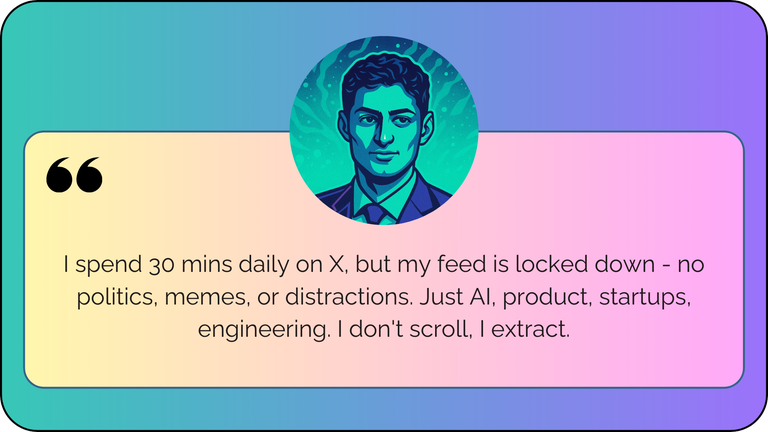
The takeaway? All sources are valid... as long as they're intentional.
Step 3: Turn Information Into Insight
Information is potential. Now it's time to refine it into value.
Once your storage is filling with high-quality sources, the next step is to interrogate what’s there. Looking for patterns, themes, and learning opportunities that can guide your decisions.
This is where many lifelong learners stall. They’ve collected a lot, but haven’t converted any of it into something that changes what they do.
At Crossover, we like to build based on BrainLift.
Fact + Fact = Signal
Signal + Signal = Insight
Insight + Insight = Something NEW
Here’s your new flow:
- Review your captures - Open your storage and pull the most relevant notes for your current goals.
- Spot signals - Look for at least two facts pointing to the same theme or trend.
- Build insights - Find connections between seemingly unrelated signals to uncover previously unseen insights.
- Distill the insights - Reduce each insight to its core takeaway.
- Spot something new - Turn your best insights into a small, testable action.
Top performers don't just store. They process into something NEW.
It's the difference between 'I read something' and 'Let's TRY something.'
Step 4: Use It or Lose It
Information has a half-life. If you don’t use it quickly, you’ll lose it.
Studies show we remember a meagre 10% of what we read. But a staggering 90% of what we do.
So action your 'something new'.
- If it’s a skill, apply it in your next project.
- If it’s a concept, test it and teach it.
- If it’s an idea, run it past a trusted colleague or mentor.
Action locks in your learning.
Top performers don’t chase novelty. They act, refine, and repeat until they’re operating at a level higher than before.
The more you do, the more you own the knowledge. The more knowledge you own, the faster it compounds.
Step 5: Protect Your Energy
Burnout doesn’t come from learning too little. It comes from trying to learn everything... all the time.
Right now, 41% of workers report feeling “a lot” of daily stress. Layer unfiltered, non-stop self-improvement on top of that, and you’re setting yourself up to crash.
The best lifelong learners know when it's time to reflect.
Manuel sums it up perfectly:
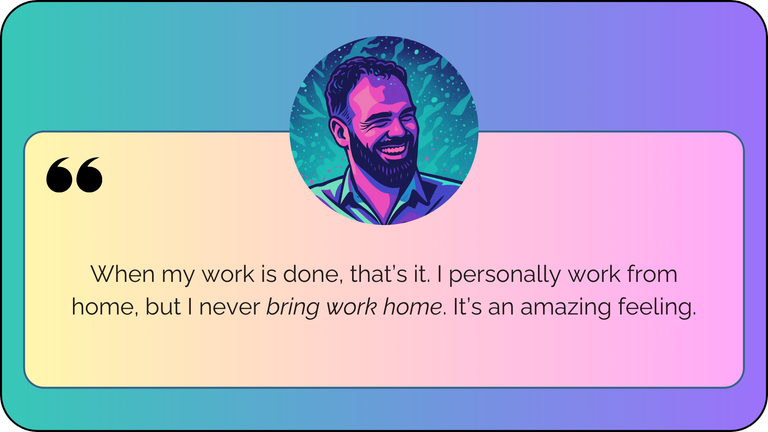
Here’s how to keep your learning loop alive without burning out:
- Curate once a week - Block 30–60 minutes to sort your Brain Dump. Tag what’s worth keeping, delete the rest.
- BrainLift monthly - Every 4 weeks, zoom out. Review what you’ve collected. Spot one 'something new' worth acting on.
- Test, refine, repeat - Apply your 'something new' in small, low-risk ways. Adjust based on results before scaling up.
- Set a daily cut-off - Whether it’s 30 minutes of sourcing in the morning or an evening review session, draw the line and stick to it.
The goal isn’t a one-off sprint. It’s a sustainable cycle you can run for years.
Burnout kills learning. Protecting your energy protects your growth.
How to Become a Lifelong Learner for the Long Game
Creating a storage system. Sourcing quality information. Refining information into action. Protecting your energy.
That’s the loop.
Most people will never commit to REAL lifelong learning. They’ll keep trying to learn new skills by binging online courses and skimming articles. All while wondering why nothing changes.
But if you build a system (and run it consistently), you’ll quietly outpace them year... after... year.
The REAL secret about how to become a lifelong learner? It’s not about learning more. It’s about learning better.
So now you know the truth about how to become a lifelong learner. What will you do with it? Build your system, commit to continuously learn, pull ahead.
Similar post


Want to read more?
We have a lot more where that came from



 AI-first remote workers.