Contents
- Anthropic: AI’s Impact on Your Job (2026)
- #1: Your Job Isn’t Your Title – It’s a Bundle of Task Bricks
- #2: AI Isn’t Replacing Jobs – It’s Compressing Them
- #3: Don’t Worry About Firing – It’s Hiring That’s The Issue
- #4: AI Will Target Your Job First – Not Weak Ones
- Restacking Your Tower (Using AI in Your Work)
A brand-new Anthropic study was just released – and it’s huge. In it, they expose the reality of how AI is going to impact your job. From observed exposure to task advantage, we pick apart the findings and pull insights on what they mean for tech workers in the coming months. Just a heads up – not everything is what it seems.
The great unbundling is here.
And according to Claude, we should all immediately change how we think about our work. The latest findings are exciting (and terrifying to be sure) and the way in which we respond to them is likely to determine our career trajectory over the next few years.
But studies aren’t particularly people friendly, or practical.
They’re pretty abstract and about as usable as an 88 tab spreadsheet at 3am.
Everyone and their dog wants to know if AI will take their jobs. It’s the reason Anthropic did this study.
But the headline isn’t what people think. AI doesn’t take jobs, it takes TASKS.

AI is actively breaking tech jobs into tasks, and the market has started to separately price those tasks.
Job titles are becoming less meaningful, because AI rewards task advantage, not role identity.
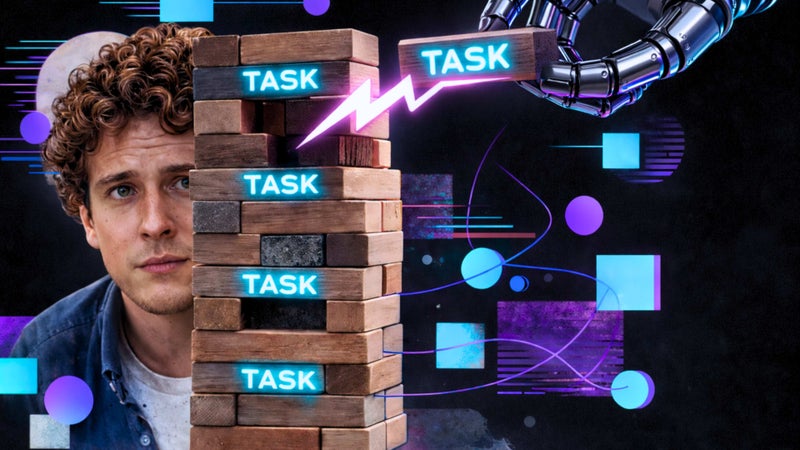
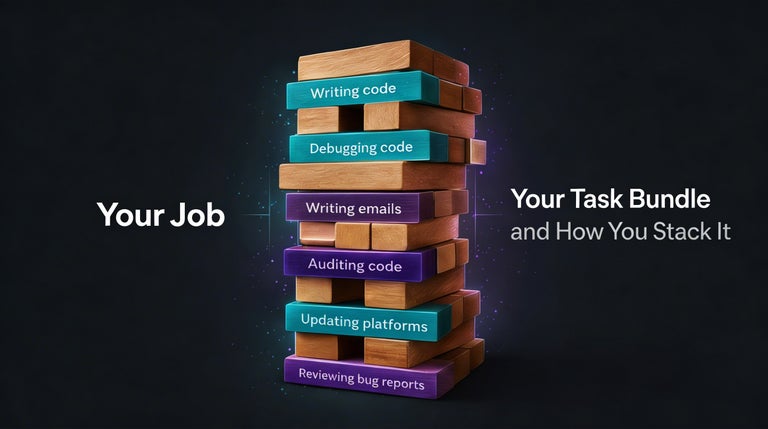
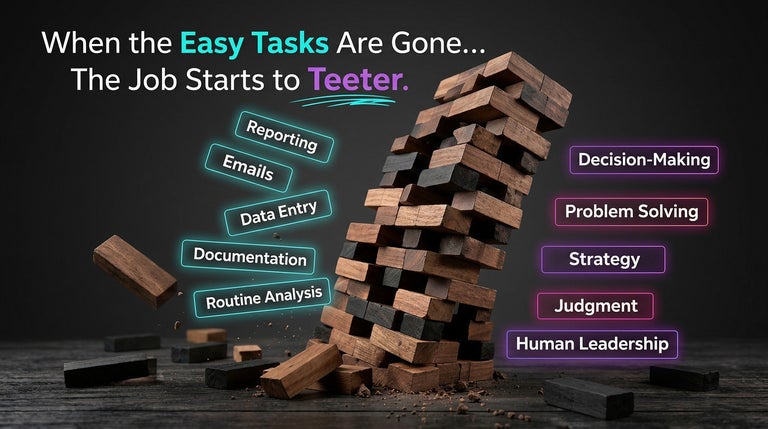
Think of your job as a Jenga tower.
Every block in there is a task that makes up your work. You’ll have your emails, and metric reporting, your data analysis and decision-making capabilities. Your next-level spreadsheet skills, and killer presentation ability.
Your career has always been a bundle of these tasks, and the way you stack them determines how valuable you are, depending on what your company prioritizes.
For years, we’ve been carefully building these towers, stacking our strengths in ways that create stability and advantage.
Now, AI is reaching in and removing the easy blocks.
Of course, the tower is destabilizing! Block by block it’s revealing where you’ve assigned your value – and a LOT of people are realizing that what felt solid was more fragile than they thought.
I’ve said it before. AI isn’t taking jobs, it’s changing them.
Jobs used to bundle high-value and low-value tasks together, and that bundling protected people. That’s what’s changing.
Now low-value tasks are automated, medium-value tasks are being sped-up, and high-value tasks are becoming the only real differentiator that matters.
Right now, most of our jobs are Jenga towers at the start of the game. As AI keeps pulling more and more task blocks from your stack, things will get wobbly.
At first, it’s fine…but then your role doesn’t look like it used to. The structure you once built to succeed no longer holds the same way.
That’s the great unbundling.
And that’s what this study gives us, a sneak peek at which parts of your job are already being pulled apart, which ones are next, and how your value is shifting.
I’m going to break down the key insights you need to understand and, how to protect and grow the parts of your work that will authentically keep you earning as the tower starts to sway.
Anthropic: AI’s Impact on Your Job (2026)
What you need to know about the findings.
Will AI take my job?
Anthropic says that this is the wrong question to ask. Instead, we should be more concerned with the realities of the labor market, asking:
- Which parts of our job are already being absorbed?
- Which parts have been automated?
- And which parts have become cheaper, low-value work?
It makes sense after all.
In the past when economists and organizations tried to measure the impact of offshore hiring on the job market, the predictions were WAY off.
Outsourcing to global markets hasn’t in fact made a quarter of all US jobs vulnerable, it’s contributed to healthy and consistent job growth. New ways of working like remote work took jobs out of the office, not out of the country.
The fear-mongering that jobs would vanish, workers would be replaced and there would be a massive job crisis simply didn’t happen.
Anthropic recognized this and created a new framework for understanding how AI will impact the job market. Prepare for a lot of reality coming your way.
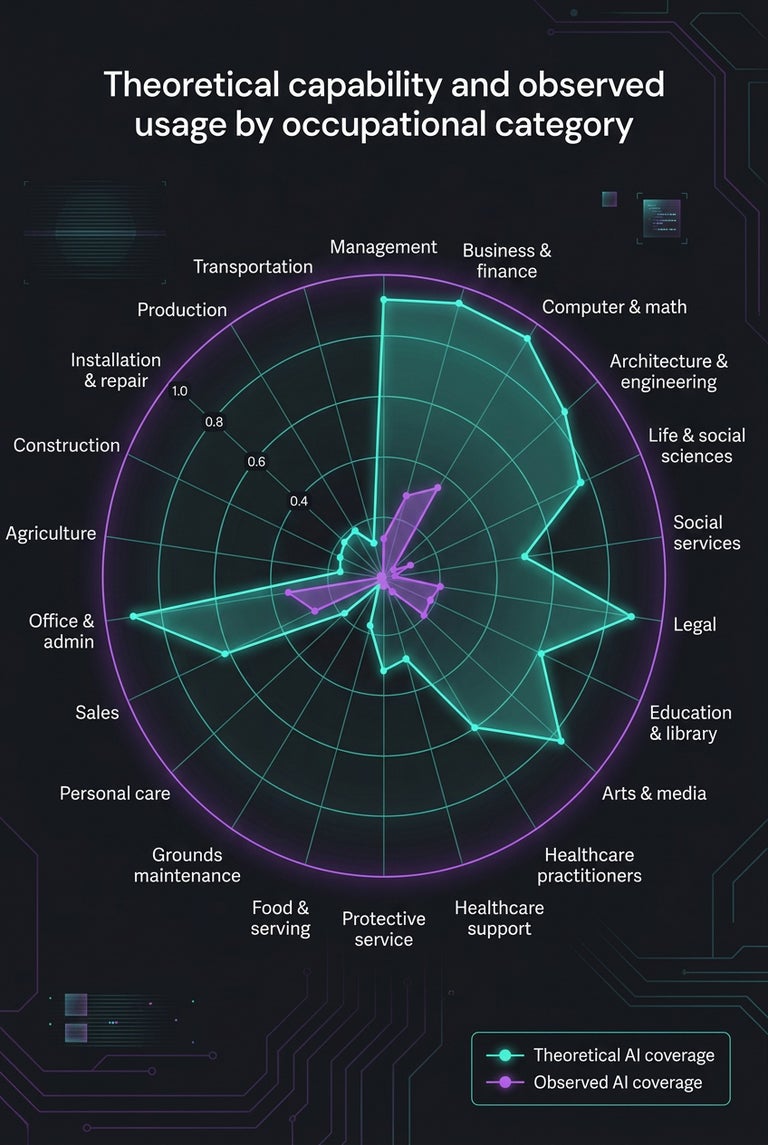
[source] *the teal bits are what AI could do, the purple bits are what it's actually doing.
Two key things:
#1: AI’s impact is slow burn
The forces that cause economic disruption are incredibly relevant to your life. Unlike COVID, which was a fiend fire of upheaval, things like AI in the workplace tend to change things from the inside out. Little by little, this slow burn goes unnoticed by most.
#2: We can only measure through ambiguity
The study acknowledges that the effects will be ambiguous. Of course they will be, this is AI we’re talking about!
No-one can predict how it will reshape work in the future, never mind forecast occupational risk and exposure in light of what AI could do – maybe - and what it does right now.
Key takeaway: Gradual, uncertain change = act early or lose career value.
Anthropic pulled in 3 data sources to measure occupational exposure, tapping into 800 occupations, its own usage data and task-level exposure from Eloundou (2023).
The study looks at what parts of your job AI can speed up, where demand is rising, and how that shift is already playing out in the real world.
Here’s what you need to know as a highly exposed, white collar tech worker.
#1: Your Job Isn’t Your Title – It’s a Bundle of Task Bricks
You’re not paid for your title, you’re paid for the tasks inside it.
Sounds glaringly obvious until you look at the data.
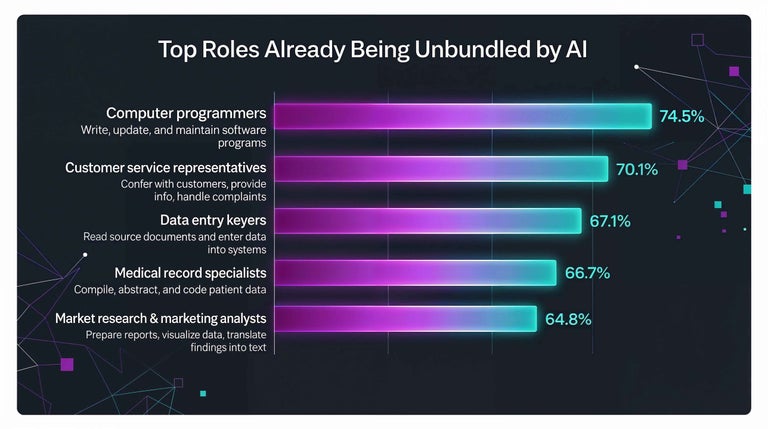
In computer programming, AI already covers up to 75% of tasks in the real-world. That’s 75% of a coders job that AI can manage. Already.
Everything from writing boilerplate code, debugging patterns, generating documentation – all of this predictable work that used to eat up a sizable chunk of your day…gone.
These tasks didn’t vanish, they just stopped being your differentiator.
The study says that the labor market is pricing work at the task level. This means your job isn’t evaluated as a whole anymore, it’s being pulled apart and valued brick by brick.
- What’s my next title step?
- Becomes…which parts of what I do are still hard to replace with AI?
If a huge part of your day is made up of tasks AI can consult on – or completely automate – then your value isn’t your total productivity, it’s what’s left after you’ve automated away all the easy work.
- If your work is predictable, modular – your leverage is shrinking
- If it’s mostly judgement, creation, ideas – your leverage is increasing
Two coders with the same title now, same years of experience but completely different results based on their task mix. They won't end up with the same trajectory.
Consider: If AI did 20%, 30%, half of your job tomorrow – would your role still exist in a meaningful way?
If you answered no, your tower is wobbly and you need to reorganize your task composition for this new measurement of job value.
#2: AI Isn’t Replacing Jobs – It’s Compressing Them
There’s been a lot of layoffs attributed to AI, but the data proves AI doesn’t take jobs.
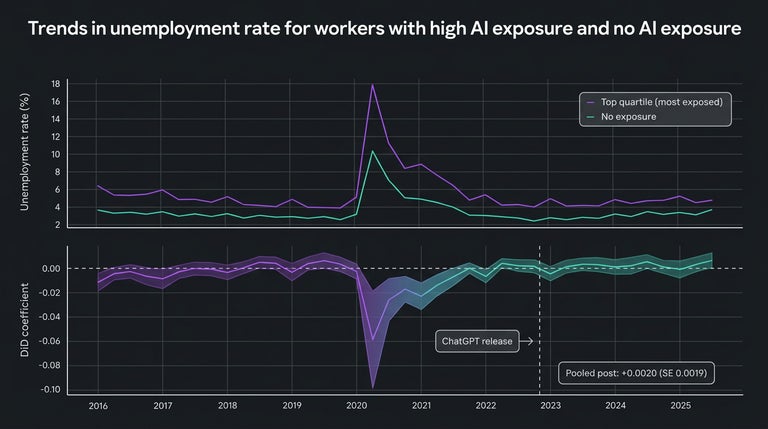
Anthropic found that there’s been no meaningful rise in unemployment – even in highly exposed roles (like programmers). People aren’t being dropped like flies, though the media loves to make it feel that way sometimes.
Still, something is happening. But what?
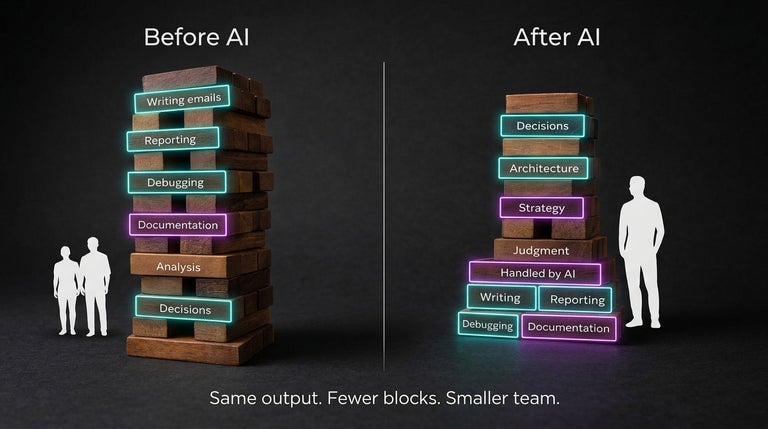
Jobs are being compressed. If you remove all the easy and medium task bricks in your Jenga tower, you’re left with way fewer bricks, and space to add new ones (AI skills).
So, the same work is getting done, but fewer people are doing it. When jobs get compressed, they also get the opportunity to expand in new directions.
That’s because AI strips out the scalable layers of your job – those boring repeating tasks, those modular, structured outputs and the parts that made it possible to hire, train and grow teams.
What remains is dense, hard and requires a smaller workforce to operate.
- It’s not 20 people doing easy and more difficult work
- It’s 5 people doing hard work, with their AI agents
Nothing looks broken, the team still exists and everyone is working. The jobs are still there – great! But in the background the headcount slowly reduces as the quality bar rises.
Implications are fairly brutal:
- You’re not competing with other people based on effort
- You’re competing with how many results you can create with AI as leverage
It’s not a matter of working harder. It’s understanding how much of your work you can compress using AI, and what that ALLOWS you to take on NEXT.
AI task compression means the baseline is so much higher for you, the margin for average is vanishing fast, and the ones who rise are literally the tech folks who figure out how to do more, with less.
Here’s a rubbery truth to chew on: If your role doesn’t expand as AI takes work off your plate, it’s shrinking. In a compressed market, shrinking roles don’t stick around for long.
#3: Don’t Worry About Firing – It’s Hiring That’s The Issue
You know who’s at risk with AI? Entry level tech folks.

Also, those among us who haven’t focused enough on gaining AI skills and learning how to use automation and augmentation as leverage. Or people who want a career move.
We know AI has completely changed what it costs to justify hiring someone.
The study shows us evidence of this change – entry into exposed roles for younger folks in tech has dropped by 14%. Companies don’t need as many people to do the same work. This is a market entry problem.
The reality is that if AI can do 30-50% of your job, why should you be hired to do the rest – unless you can operate well beyond that?
- Stepping-stone work is done, which means fewer entry points to tech jobs.
- Experience in one field won’t amount to entry-level work in another anymore.
- Experienced workers are anchored in tasks that are now automated.
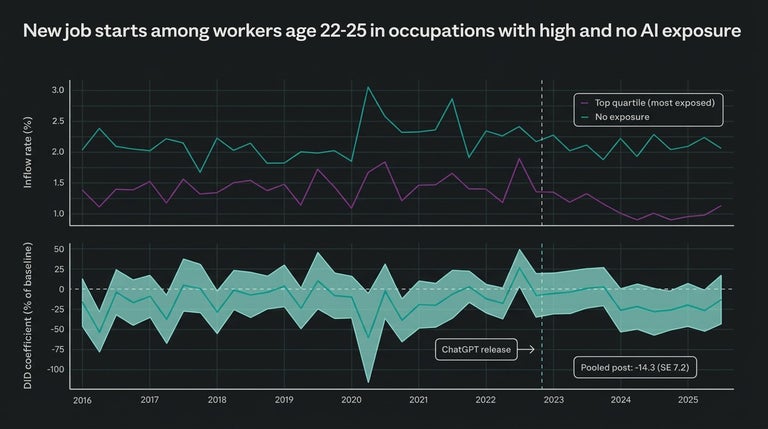
The pro workers have it rough – your market value resets down. There’s no more ‘reliable hands’ doing the predictable, structured work. And demand for people who can handle and operate the next level UP immediately will only grow.
- Know what AI brings to your job
- Know what you add to AI
We’ll see this amounting to massive hiring changes in the near future. Fewer roles justified by things like potential and experience alone – and more questions about what value can be brought to a role outside of full AI capability.
- Am I qualified?
- Becomes… do I create enough value beyond what AI already does to be WORTH hiring?
Without AI leverage, the struggle to get in – anywhere in tech – will be real.
#4: AI Will Target Your Job First – Not Weak Ones
Sure, AI clears away the low-skill work no-one really wants to do. But it’s a complete myth that it’s only coming for low-skill work.
This study proves the opposite is true!
The most exposed workers are highly educated, high paid and on average – earn 47% MORE than low exposure tech workers.
Knowledge workers, you’ve been warned.
AI could care less about how skilled you are – it looks for work it can fit into its systems. And that work is clearly defined, step-by-step, easy to measure, modular tech work.
Tech ALREADY works in clean units.
Some of our biggest software systems break the workday into tickets that can be solved. Every ticket is a task to be completed, and it’s highly likely AI can complete that task.
It’s high skill work, but it’s neatly structured FOR AI. So, your exposure is significant. AI is going to absorb parts of your job at lightning-fast speeds. It’s likely doing this already.
So, if you haven’t connected the dots yet – being senior doesn’t make you safe.
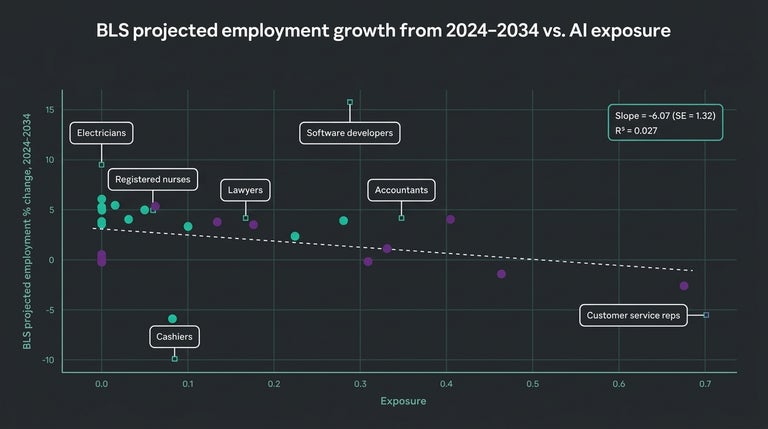
[source] *Don't panic this chart proves AI exposure has virtually no impact on employment growth.
If your seniority is built on clean skills like:
- Doing predictable work extremely well
- Executing patterns like a pro
- Producing consistent outputs…
AI doesn’t need to replace you, it just needs to match your patterns.
- How experienced am I?
- Must become ‘how much of what I offer can be clearly described, repeated and measured?’
Get into the dirty work:
Decision-making, conflict resolution, work that is about alignment, is unclear, complex, incomplete, context-heavy and entirely unable to be communicated to an AI.
This is really what will determine your exposure now. Ambiguous work will be the work that gets paid. No more ‘getting better’ at your job. You need to shift over to the dirty parts of your work where the long-term value lives.
Restacking Your Tower (Using AI in Your Work)
Sometimes it feels as though AI has been around forever.
Don’t let the internet or AI brain fry fool you, it’s brand spanking new. Anthropic is reminding us of this, in the loveliest way possible.
While Computer and Math roles have 33% AI real-world use, it’s theoretically possible that one day 94% of it will be AI. That’s the money gap folks.
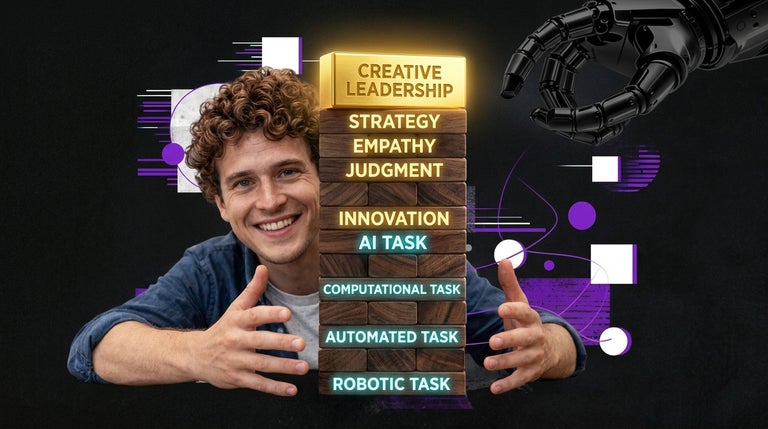
Every block that’s removed is a money gap.
It means the change hasn’t happened yet, but the direction is locked in. The market isn’t waiting for AI to achieve a 94% use rate, it’s preparing for it. Hiring, job expectations and role design – these are all precursors to full AI adoption.
You have a narrow window where you can still stabilize your Jenga tower before too many blocks are gone.
Keep these 3 things in mind:
- Rebuild your tower around the blocks that stay
Your job as it exists today, isn’t going to be the same for much longer. You must consider what’s left for you after AI has pulled out 30-50% of the easiest blocks. If a large part of your day is predictable, repeatable, and easy to define, those blocks are already loose.
Stable structures are built on the pieces AI struggles with, the decisions, trade-offs, and judgment calls. So, rebuild around those!
Your future role isn’t your current tower with a few gaps. It’s a smaller, stronger structure that still stands when the easy blocks are gone.
- Don’t stack your tower the old way
The study was pretty clear about what’s happening in hiring – access to tech jobs is getting harder, especially at the bottom. Entry-level hiring into exposed jobs is already showing signs of slow-down. That changes how you will stack your tower.
The old way was – stack easy, repeatable tasks, build experience and earn your way to harder work. Nix that logic, those loose blocks are what AI is pulling out first. Your focus needs to be on proving you can handle harder tasks, by leveraging AI for the easy ones. And augmenting with AI for the medium-level tasks.
You’re not going to be rewarded for how many blocks you stack. You’re rewarded for owning the few blocks AI can’t touch. That’s task advantage.
- Play both sides of the game
Most people in tech are still trapped inside their old towers, trying to hold things together. But you have the power to play both sides – you can BE the AI hand used for leverage instead of fearing the hand automating you into insignificance.
Your advantage is knowing which blocks can be removed, which need reinforcement and how to rebuild your tower with fewer pieces. That means thinking in systems – build repeatable sequences, test where AI can handle end-to-end work and know exactly where you need to step in to guide, and validate the process.
As the tower gets pulled apart, value shifts to the person who decides what gets removed, what stays, and how the whole thing is rebuilt.
The Anthropic study doesn’t show the end of AI, or a job market collapsing. Instead, it helps us understand that the tech market is being re-priced, task by task.
AI is moving blocks people. Enough to make the rules of the game obvious – your income isn’t tied to your title. It’s tied to what still holds value, once AI has taken its turn.
Stay paid by owning the blocks AI can’t replace, and building the AI that removes the ones that shouldn’t belong to you anymore.
In this version of the game, the tallest tower doesn’t matter. What matters is who’s still standing when the easy blocks are gone… and who got paid to remove them.
Similar post


Want to read more?
We have a lot more where that came from



 AI-first remote workers.