
Contents
- Superagents and The New Economics of Work
- The Age of The Superagent Achiever is Here
- What do Superagent Achievers Do Differently?
- Superagency: A Team of One
What if your next big promotion at work is not about raw talent or longer hours, but building an autonomous AI system that lets you excel like a team? This article explores the rise of the superagent achiever, why they’re becoming so valuable, and how the right kind of prolific builder can use AI to create team-sized results.
What happens when one person suddenly starts operating like a team?
When a solitary individual is so prolific that they can take on the kind of work that used to require an entire department – the economics of work change.
We’re seeing it in marketing and engineering, where those of us who started out building AI agents are now using them to write, plan, test, research and keep the momentum of work moving forward in ways that once took several different roles to achieve.
And it’s because of the rise of the superagent.
Isolated AI tools can be stitched together – and are becoming full-on coordinated autonomous AI systems. A connected set of AI agents can handle parts of a workflow together, functioning less like a task tool, and more like a workforce.
Or less like a copilot and more like an autonomous AI worker.
These superagents are end-to-end systems that do what you can do, at scale. And they’re sometimes built by the person doing the job.
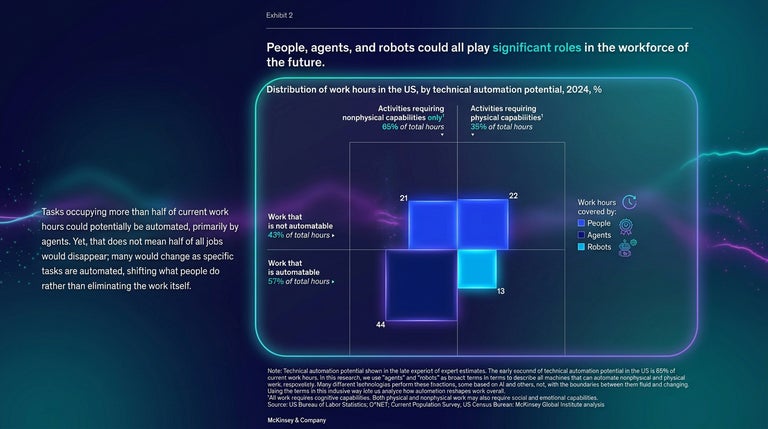
McKinsey says that it’s already possible to technically automate nearly half of all work hours, using AI agents. This agent-centric future is happening to superperformers first.
Because superperformers aren’t working alone anymore.
In today’s article, you’ll find out what AI superagents are, how they’re changing the economics of work, what superagent achievers do differently – and why you should switch to a coordinated system of autonomous agents to create team-sized results.
The future of tech belongs to those who learn to achieve as a team of one.
Superagents and The New Economics of Work
I’ve always been low-key obsessed with high-volume creators. History remembers the individuals who can create at near-supernatural levels.
Edison was a machine himself, not just inventing but an endless source of invention who, at the end of his career – had amassed 1093 US patents, having done hundreds of thousands of experiments in his 84 prolific years on this earth.

Then you have Isaac Asimov who produced 500 books and 9000 letters in his life, and Georgia O’Keeffe who created 2000+ paintings in hers.
These individuals were ideas-people first, and natural born superperformers. Folks who were driven to achieve their ideas, on their own terms.
They embodied traits like passion, discipline, persistence and a consistently high quality bar – which allowed them to surpass ordinary levels of daily performance.
For most of human history that special flavor of prolific has been reserved for the greatest of us (or perhaps the most mad). Now technology is making a version of it accessible to more people.
Superagents are democratizing the ability to create at extraordinary volume. And it’s changing the economics of work.
Bottom line: Superagents allow you to create more valuable work without needing more hours, or more teammates. They drastically increase opportunities for career expansion, and suddenly skyrocket your individual worth as an achiever.
How you might ask?
- Superagents change HOW MUCH you can do for your company: The average Joe or Jane is limited by the hours in their day, and their ability to focus. Building superagents changes your production capacity because it frontloads the work. That means you can do more work, and deliver more results for your boss, your team and your company in the same amount of time.
Anthropic says agentic systems allow for work across frontend, backend, databases and infrastructure. Fountain, achieved 50% faster screening, 40% quicker onboarding and 2X candidate conversations using Claude for hierarchical multi-agent orchestration. One person can do infinitely more using superagents.
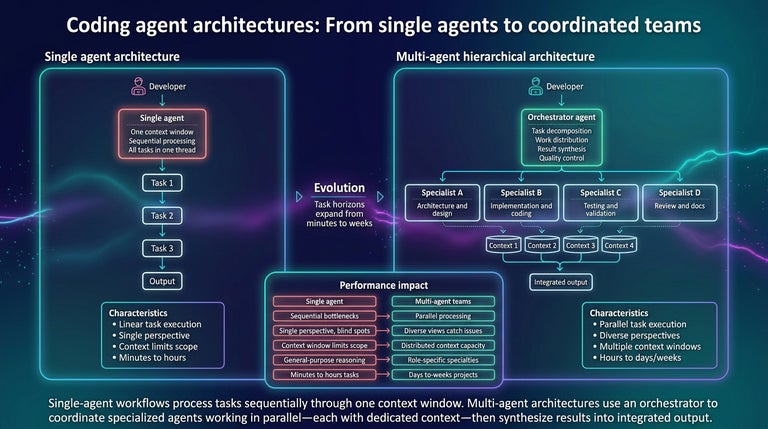
Economically speaking – you gain the ability to generate much higher value from the scarcest resource of all: your time.
- Superagents change your opportunity cost! Back in the old days a huge career opportunity often came at the expense of something else. Sure, take on that big project, build, or client… but something else had to shrink first. Superagents free you from that BS. They make it easier for you to use decision-making to handle scope, complexity and scale so you can go after bigger wins without becoming a burnt-out husk, an absent parent or a perennial social ghost.
Anthropic says 27% of nice-to-have tools wouldn’t have been built without agentic systems because of the cost involved. More features are shipped, more bugs fixed and more experiments are run per person. At Telus, a comms company, teams created 13,000 custom AI solutions while shipping code 30% faster. It saved 500,000 hours with an average of 40 minutes saved per AI interaction.
Superagents make it possible for you to keep up with your current work, AND step into bigger, better opportunities that will take you places in your career.
- Superagents change what you’re worth. When one person can reliably do the work of several people, supply and demand logic changes. That individual (you) becomes more valuable because they can cover more scope with less coordination cost. Companies can and should pay more for tech workers who excel with superagents. A superagent achiever is worth ten agent architects, and 1000 everyday prompters.
PwC found that workers with AI skills earn an average 56% wage premium compared to others without AI skills in the same occupation. Wages are rising 2X faster in AI-exposed industries everywhere. And this is just for skills, not advanced building-operating. The market demand for people who can build and run superagents is at an all-time HIGH.
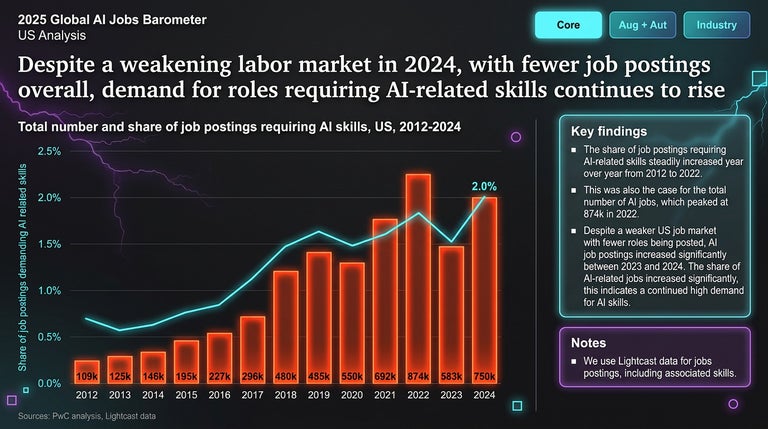
Less jobs but higher demand for specific AI skills = premium pay.
Financially speaking, the market will reward tech workers who can multiply their value, not just sell their time. The one-person team is the new standard for superperformance.
The Age of The Superagent Achiever is Here
Agents are the future, right?
Microsoft published an epic article about agents recently, asking companies if they’re prepared to use them. The research split organizations into 4 camps.
- The achievers - high in both strategy and execution
- The visionaries - have big ideas but suck at executing
- The operators - are strong executors but are strategically bankrupt
- And the discoverers - who aren’t good at strategy or execution
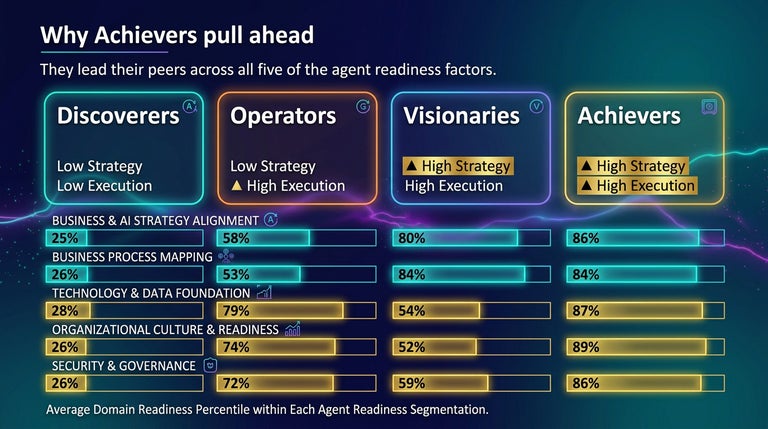
This framework is quite useful beyond companies. It also maps well to the people building end-to-end superagents.
Anyone can be a superagent discoverer. Plenty of folks are operators, and some are even visionaries! But a true superagent achiever is something else entirely.
It’s a person who has built an end-to-end autonomous superagent that reliably works in the real world – AND delivers a TON of value.
The difference is measurable achievement.
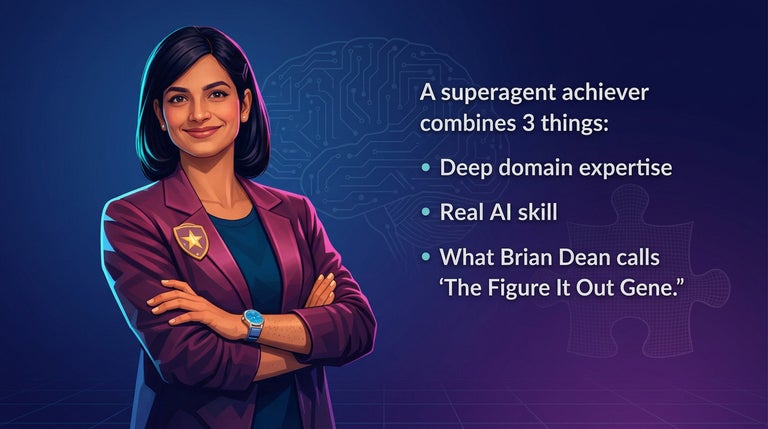
A superagent achiever combines 3 things:
- Deep domain expertise
- Real AI skill
- What Brian Dean calls ‘The Figure It Out Gene.’
AI has the ability to plug knowledge gaps. For prolific creators that are already driven to put stuff out into the world, AI is a gift.
Imagine what Thomas Edison, Isaac Asimov or Georgia O’Keeffe could have done with it. They were never slop merchants (those will always exist) - they were builders, thinkers, and original minds, driven by the need to invent, express, define, and change how the world is understood.
Superagent achievers are following in the footsteps of the prolific creators before them, using new technology to make bigger, braver, more meaningful things happen. And in the process, they are building HUGE careers.
We’re going to see this more and more.
The New York Times reported on Matthew Gallagher recently, and how he (and later his brother) used AI systems to create Medvi, a telehealth provider that is on track to make $1.8 billion in sales a year later. He created Medvi in 2 months.

I predict that in every field these superagent achievers will be the highest paid, most valuable people in the organization, if they don’t build organizations of their own.
What do Superagent Achievers Do Differently?
First AI took a bite out of your task list.
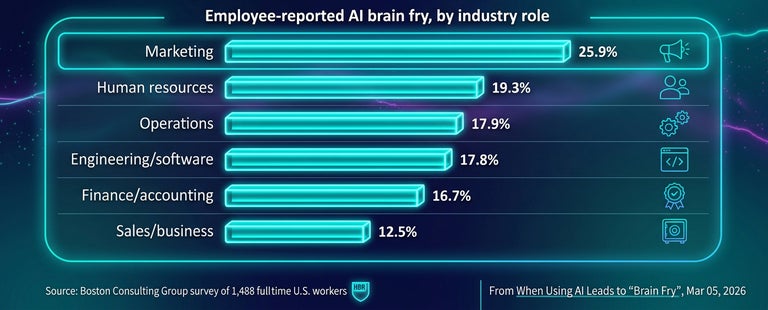
Then it turned half the internet into frazzled prompt jugglers with AI brain fry. Becoming a superagent achiever is the logical next step.
Here’s how these prolific achievers work differently – and how you can too.
Use AI to Handle Complete Workflows
So many people still only prompt LLM’s and call it AI use.
Prompting is a skill, but it’s a far cry from building, and a continent away from superagency. Bits and pieces of manual AI skill – or even a single agent - cobbled together can only get you so far.
It also leaves 95% of AI potential on the table…yikes.

Leonardo Gonzalez, VP at Trilogy’s AI Center of Excellence, calls it ‘giving your brain hands’ – “Let the model reason, and let the model act inside a bounded environment. A good agentic loop analyzes information, takes the next step, verifies the result, and continues until the task is done or a real boundary appears.”
So, you need to set up an autonomous AI system that will move an entire piece of work forward from start to finish. You put things in, and the AI does the work at every stage.
AI Aptitude Levels:
- One-off prompt: You ask AI for one thing and get one thing back. Example: “Write me a project update.”
- Chain prompting: You ask AI a series of connected questions, step by step, to build toward a better final result. Example: First you ask for research notes, then a structure, then a draft, then a rewrite in your tone.
- AI tool: You use a product with one clear AI function. Example: A meeting summarizer, coding assistant, or writing tool.
- Single AI agent: You create one agent to handle one repeatable job. Example: An agent that researches your competitors and creates a report every Friday.
- Multi-agent workflow: You connect several agents to handle different stages of the same job. Example: One researches, one organizes, one drafts, one checks, one formats. It’s an end to end AI system.
- A superagent: A central autonomous agentic system that acts as an intelligence layer for a multitude of sub-agents, to solve multi-step tasks. These AI systems tap into reasoning, extensive memory and are brilliant for long-term use.
The second last one there, is where things get interesting. You’re not just using AI to copilot a single task, you’re using it to carry out an entire process. If you haven’t built an agent yet, do it.
If you haven’t built a superagent yet – this is your sign to try.
And sure, there are other things involved like using front-end no-code tools for accessibility, but this – more advanced AI area - is where the magic lives. It’s how a superagent can turn a 4-day workflow into 15 minutes. Fifteen reliable, repeatable, scalable minutes! Imagine having the power to scale what you do like that.
Superagent achievers stop using AI as a one-step copilot helper and set it up to handle end-to-end flows of work. That’s how one person gets team-sized results.
And yes, one person can build a superagent.
Guide The Work Instead of Completing Every Step

You’ve probably read about orchestrators, operators and directors in AI.
The holy grail of a good autonomous AI system is that it does the work – you’re just there to guide it along, make decisions, check the quality bar, and fix things if it derails or needs another feature. Manual work is so 2022.
Superagent achievers haven’t just moved from doer to director. They’ve actively strengthened their positions as AI system owners who run these extensive flows – making them one person teams.
Your job isn’t to manually check-in and fix continually breaking agents, like in the days of 2024 and 2025 when visual agents constantly needed work. Now agents can fix themselves if there’s a human in the loop that builds them correctly.
In this position your job looks different:
- Your AI systems are purpose built for your goals
- You decide what excellence looks like
- You decide where people stay involved in the loop
- You review the final work, not every single step
- You improve the system, and fix it when it breaks
It’s a seismic shift from AI architect to superagent achiever. You don’t need to hover over your AI like it’s a junior intern prone to spilling coffee on important documents. You absolutely don’t need to micromanage every last thing.
Digital babysitting causes AI brain fry – working with superagents reduces cognitive labor and load. It’s only leverage when you (the person) can operate the system well.
Marketing, HR, Ops and Finance folks this is aimed at you! Software engineers are already aware that digital babysitting is a bad AI practice.
- Where should I use my own judgment?
- What decisions authentically need me?
- Which parts of this process should happen without me touching them?
- How do I make this system better every time it runs?
Don’t try to personally carry every step of the job. You need to design systems to do that work for you – while you do direction, standards and decisions.
Make The Work Simpler and Smarter (Not Busier)
This is a big one – the biggest one, really.
If you’re not a software engineer, (or one who works with AI) then you’ll find that AI can quickly over-complicate things. A lot of AI looks impressive, but is about as useful as a bag of wheat crackers to someone who is gluten-intolerant.
Scale can get out of control, real fast. AI will always suggest more dashboards, tools, tabs, half-finished outputs, refurbished prompts and harder ways to do easy things.
Superagent achievers have finesse in one area – the simple and smart solution.
They’re allergic to unnecessary code, clutter and overbuilt ideas. AI is used to reduce moving parts, not multiply them. It’s used to find elegant solutions to problems, not just go with the AI recommended route to solve problems.
This is where subject matter and domain expertise wins.
Superagent achievers ask:
- Can this workflow be cleaner?
- Can I use fewer tools?
- Can this run with fewer handoffs?
- Can I make the result more predictable?
- Can I make this easier to repeat next week?
Advanced AI doesn’t mean complicated AI. The best superagent systems are insanely simple on the outside and whip smart on the inside. The complexity is handled so well by the system – you just know it came from the builder, not the model itself.
Supreme superagency should make your work feel easy, calm, trustworthy, reliable and simple to scale. This is the most difficult and most bankable problem in agentic AI.
People know this is the way to get ahead. In a recent LinkedIn poll we ran on our page, we asked “A peer got promoted for using AI. You…” and 70% of all respondents said they would immediately learn their stack.
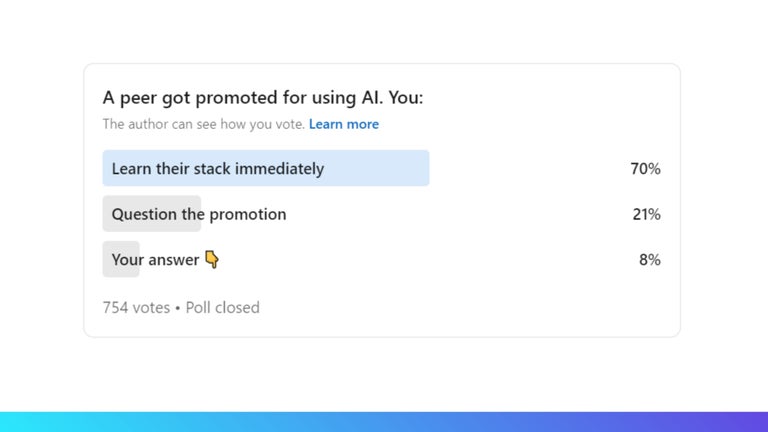
Deep down, everyone gets it.
Anyone can stitch some agents together, but it takes real strategy and execution (the primary traits of an achiever) to do this in a way that works.
A clever stack is great, but it means nothing without a clever process flow that reliably works and scales. Any product builder will tell you that here, less is WAY more.
So, use AI to build cleaner, smarter autonomous systems that make good work easy to repeat. After all, your system is only as good as your end result.
Superagency: A Team of One
The truth is that very few people will become superagent achievers.
And that’s fine.
This kind of work favors the people it always has – the builders, prolific creators and folks with a genuine itch to make things better, solve bigger problems, and keep going when something doesn’t work for the 50th time.

AI certainly didn’t invent that type of person, it just gave them more hands.
Advanced AI use is hard, and superagency is harder. But now, the right people can use it to make their work bigger than it used to be.
That means setting up their AI to handle end-to-end workflows, because investing time in the right place matters for career growth.
It means guiding the work, instead of glomming onto every step – because judgement, quality control and system design is where the real career leverage lives. And it means making the work simpler and smarter – because prolific people want to do their best, and then better than that – again and again.
That’s the promise of this new superagent economy. One person, with the right autonomous AI system behind them, can now do work at a phenomenal scale that once needed an entire team.
And the people who are passionate, disciplined and determined enough to build these transformative AI systems won’t just do more.
They’ll scale their worth.
Because when an individual can create team-sized results… bigger opportunities and a life less ordinary will find them.
Similar post


Want to read more?
We have a lot more where that came from



 AI-first remote workers.