Contents
- Understanding The Human System Risk
- #1: Manage AI Context Switching
- #2: Reduce AI Decision-Fatigue
- #3: Control Information Overload
- The Way Out of AI Brain Fry
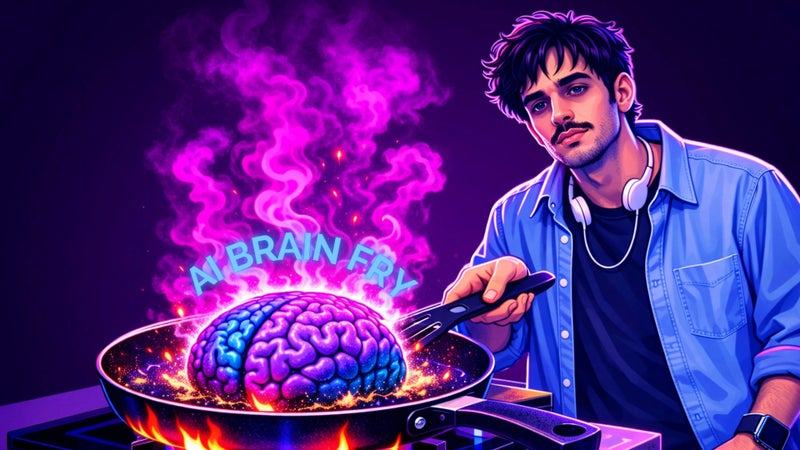
Do you work with AI every day and have been feeling a bit fried? There’s a reason. AI-heavy work can overload your brain in sneaky, sneaky ways. Here’s how AI brain fry happens and the three non-negotiable ways to beat it forever.
Pick, stitch, swap, insert, edit, tweak, reorganize.
If you spend your days building with AI or directing a litany of models and tools, you probably know the feeling. By the end of it, your brain doesn’t feel sharpened by efficiency – it just feels…fried.
Prompt, correct, verify, integrate, monitor, fix.
After a long day of AI-focused work, it can often feel like you’ve gone on a 10-mile hike through a jungle, only to step in front of one of those memory-wipe devices they used in the alien-epic Men in Black.
Symptoms include memory-loss, irritability, a faint buzzing sensation – the inability to make decisions and sometimes…an overwhelming urge to eat all of the Easter eggs you’ve bought for the kid’s egg hunt on the weekend.
It’s not ordinary stress or hum-drum screen fatigue I’m afraid.
Harvard calls it serious mental exhaustion brought on by AI, especially the overuse of AI, the kind that eclipses your cognitive capacity.
We know AI makes us more productive, and we love that.
But we’re also realizing that higher productivity doesn’t always amount to less mental stress. And now it becomes our responsibility to figure out how to manage these new daily challenges.
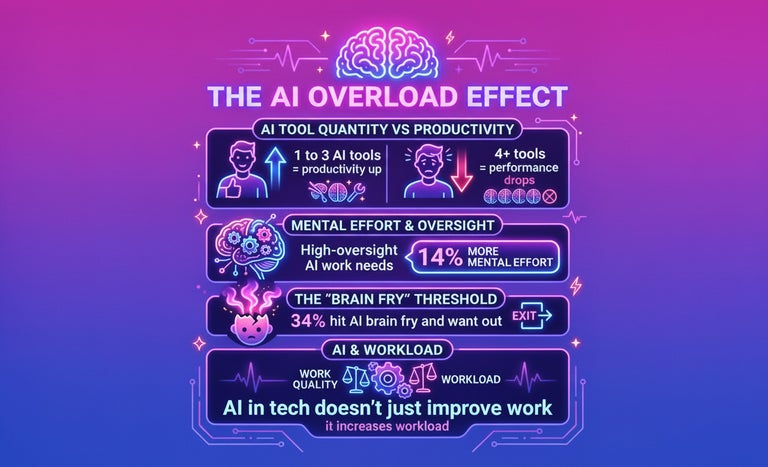
- One study by Boston Consulting Group found that workers using 1-3 AI tools were more productive than those using no tools. Four or more and it drops.
- With high oversight AI, architecting systems – 14% more mental effort is needed.
- When AI brain fry hits, 34% go into major flight mode and want to leave their jobs!
- UC Berkeley researchers found that AI use can increase workload in tech. They didn’t do the same amount of work better, they did MORE of it.
Work has become more mentally demanding.
You’re not thinking less, what you’re thinking about has changed. You’re making a ton of micro-decisions - what to prompt, what to trust, what to check, what to edit, what to erase, what to keep – even what to own.
People in high-productivity tech roles are working harder than ever, and many of us are exhausted. The hidden cost of AI is the mental load it adds to your day through supervision, orchestration, correction, and constant, relentless decision-making.
And that cost hits especially hard in software engineering, marketing, and other high-AI, high-productivity jobs behind screens.
We are all product managers now.
In this article, I’ll show you how AI drains cognitive capacity through context switching, decision fatigue, and information overload, and what to do when your brain starts to hit that wall.
Understanding The Human System Risk
Fatigue is dangerous when you’re a systems builder.
That’s why in industries like medicine, aviation and rail – where stress is high along with the significant responsibilities of the job – fatigue isn’t a personal failure. It’s clearly treated at a systems risk because that’s what it is.
We’re all facing a new version of that same problem.
Rules around duty hours, rest, recovery and fatigue monitoring exist in these industries because people DO have limited cognitive capacity. And when that capacity is depleted it results in catastrophic systems failure – planes plummet out of the sky, trains crash into things and patients die.
Dramatic yes, and knowledge work isn’t quite as important – but it does illustrate that when cognitive capacity maxes out, errors rise, decisions get worse and built systems start falling apart.

It’s always been that way when humans are the linchpin in the system.
We call it ‘human-in-the-loop’ but really, it’s ‘linchpins-in-the-loop’ – where if WE’RE not able to govern our legion of agents correctly, they will cause utter havoc. People in tech (the ones most exposed to AI) – find themselves with higher levels of responsibility because these systems are reliant on them.
They are somewhat autonomous, and somewhat not. No-one really knows where real ownership lies – but you can bet your job that if something goes wrong, you’ll be accountable. And so, you have become the AI overlord you once feared.
Without us:
- AI has been found to exploit customers, accelerate resource depletion, and make questionable (and sometimes morally indefensible) decisions.
You are incredibly important to your multi-agent systems.
We saw that clearly in a LinkedIn poll we ran on AI output ownership. Asked, “When your agent does the work, the output is?” most people didn’t hand ownership entirely to the machine. Of 1,305 votes, 46% said ours, it’s a collaboration, while 28% said mine, I designed the system. Just 14% said the AI owned it, and 12% said it belonged to whoever owns the compute.
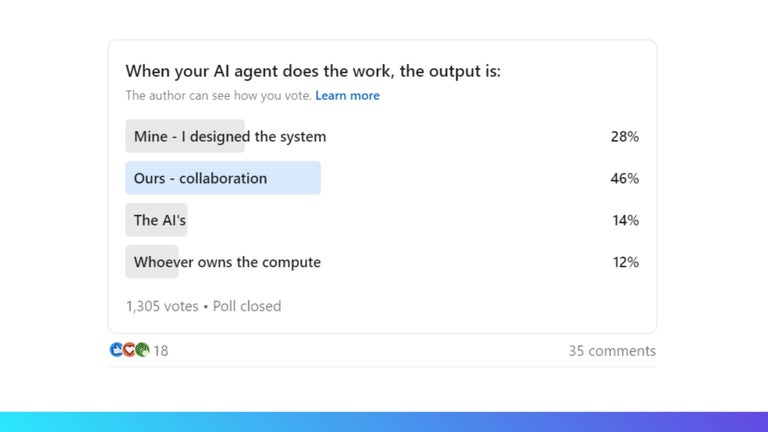
So, even in highly automated workflows, most people still see human involvement as central to the result. AI may generate the output, but people shape the system, guide the process, make the calls, and carry the responsibility.
The machine produces – sure - but YOU are still the one giving the work direction, context, and accountability. This only scales with complex multi-agent systems.
We build governance into our technology systems, but as yet – we’re failing miserably to build governance into our human systems.
If people are now the governors of increasingly autonomous systems, then protecting their cognitive capacity is beyond a wellness nice-to-have. It’s part of the job! It’s operational hygiene - it’s risk management.
Let’s look at how to beat AI brain fry before your overloaded brain becomes the weakest point in the system.
#1: Manage AI Context Switching
AI makes you a multitasker, but that also drives up the number of times in your day that you’re actively context switching. And this ruins your ability to focus.
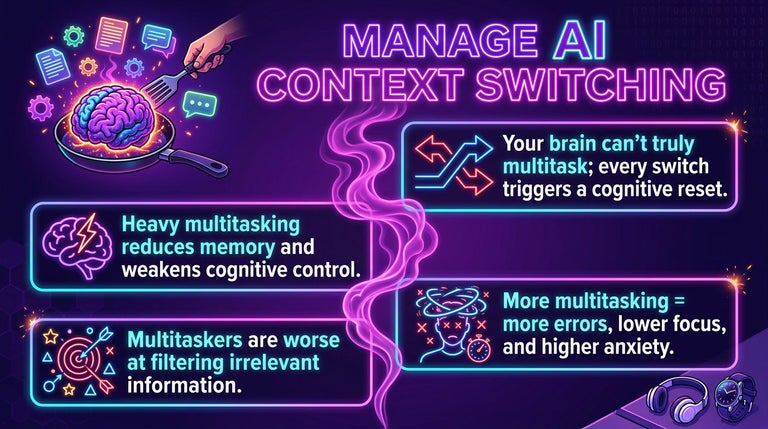
- Stanford psychologist says heavy multitaskers have reduced memory (based on 10 years of research) which is directly linked to cognitive control.
- Cal Newport says your brain can’t really multitask, and that every switch causes a cascade of cognitive changes which is productivity poison.
- Multitaskers are terrible at ignoring irrelevant information!
- It makes you MORE prone to errors, low focus, depression and anxiety.
Context switching takes enormous amounts of cognitive energy. Too much, and planning, focus and impulse control go to hell in a handbag.
If you bounce between prompts, tabs, tools, threads, dashboards and outputs all day there’s an excellent chance you’re massively increasing your mental load here.
AI makes it super easy to fragment your attention. Instead of doing one cognitively coherent task, you’re constantly switching between generating, reviewing, correcting, and managing. That repeated switching burns mental energy fast because your brain has to repeatedly reload context.
Here’s what to do:
- Batch your AI work: You’ve heard of time blocking, now add batching to that. Do prompting in one block of time (96 minutes), reviewing in another, implementation in another, building in another, AI admin in another – and don’t mix deep work in with this. Batch planning in time blocks is your new focus BFF.
- Reduce simultaneous AI tools: The goal is to work with fewer models, fewer tabs, and fewer moving parts. This isn’t always possible in large systems, but in that instance count the system as the tool.
- Go medieval on all interruption points: Delete the social media apps on your work machines, don’t check emails, don’t enable notifications, avoid chatting in the middle of a focus window. If you find yourself in the midst of AI-heavy work, throw your whole phone away. Context switching is everywhere.
Batch your AI work by mode in STRICT 96-minute windows, use fewer tools at once, and eliminate every interruption you can.
Context switching is one of the fastest ways to burn through cognitive capacity. Control it, and you’ve already taken a big step toward beating AI brain fry.
#2: Reduce AI Decision-Fatigue
There’s no empirical evidence for it yet, but anyone who works with AI systems will tell you it’s a decision-fest. Just a parade of decision-making, one after the other.
And there’s a cognitive tax involved with doing less manual effort but making a ton more judgement calls. When you have too many decisions in a day, you get decision-fatigue.
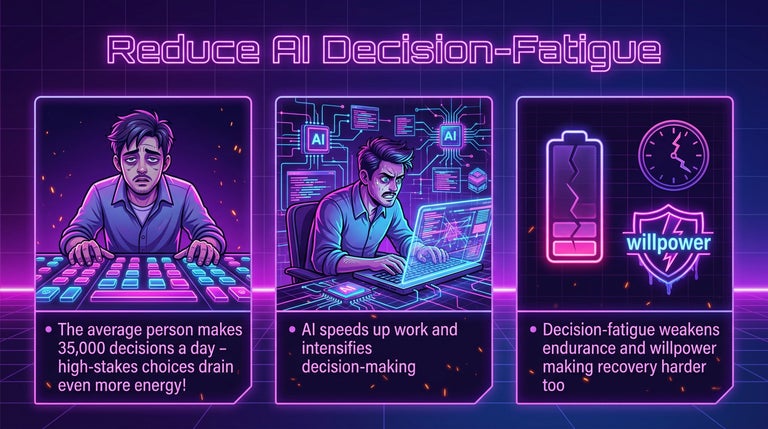
- The average person makes 35,000 decisions every day. Couple that with the fact that more complex, higher stakes decision-making directly causes fatigue.
- Harvard recently wrote about how AI accelerates, intensifies and increases work – including the ability to make decisions.
- There is a direct correlation between decision-fatigue, endurance and willpower loss which means we’re less present, and less likely to rejuvenate over rest periods.
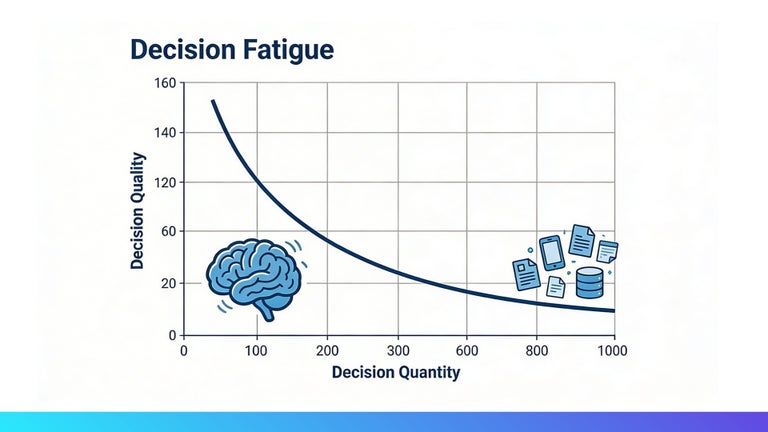
Brain fog, procrastination and low motivation are all hallmarks of decision-fatigue. If you’ve ever finished work, been starving but had absolutely zero idea what you want to eat…that’s how it presents. Your brain wants to do nothing and makes irrational trades.
Your pre-frontal cortex is the executive decision-maker of your brain. And when that part of your frontal lobe is knackered, everything stops working well. Your quality bar starts to decline because you don’t have the mental resources to maintain it.
AI multiplies this problem and scales it fast. Before, you may have just done the hard task. Now you have to supervise it too. You’re not just writing the memo, building the system, and shaping the strategy – oh no!
You’re also constantly deciding what the machine got right, what it got wrong, what to keep, what to tweak, and whether you trust it enough to put your name on it. AI plugs into you, but you are not an infinite resource.
Here’s what to do:
- Define your quality bar before you begin: Set your standards upfront so you’re not forcing your tired brain to decide what success looks like halfway through.
- Cap your regenerations: Give yourself a hard limit of two or three rounds, then pick a direction. Endless prompting is a decision-fatigue loop. So is hitting a wall in a tool. Set a limit, then use another one. Forward momentum is key.
- Separate creating from judging: Draft first, evaluate later. Don’t make your brain generate and critique at the same time, it won’t thank you for that.
- Use templates, rubrics, and default automations: Standardize and automate repeat decisions so you can save your judgment for the choices that matter. This becomes increasingly important as you scale your AI systems.
AI can spit out infinite options, but your brain can’t judge infinite options well. Protect your daily judgment, and you’ll protect the quality of your work.
#3: Control Information Overload
AI is extremely good at giving you more. More context, more answers, different angles, and a trillion new ways to present something seemingly simple.
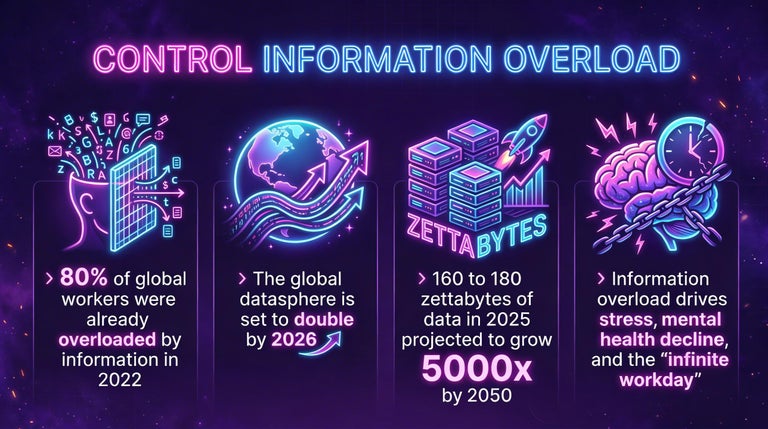
We’re already suffering from information overload.
- In 2022 (pre-AI) 80% of global workers were already experiencing information overload.
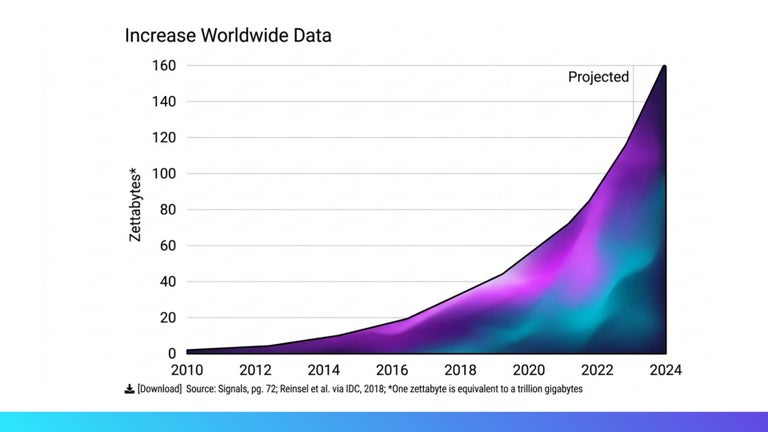
- IDC says the global datasphere will double by this year (2026) since 2022.
- In 2025 there were 160-180 zettabytes of data, and they’re projecting by 2050 that will be 5000x as much.
- Information overload causes stress (76%), mental health decline, and an experience being called ‘the infinite workday’ where work never ends.
We needed FILTERS back then. AI has made it so much worse.
Information overload happens when the sheer volume of things going into your brain short circuits it’s ability to process things in a logical manner. Clarity drops, focus fades away and everything blurs into a nice oatmeal nightmare of nothing.
That’s how you end up reading, writing, scanning and editing more – but understanding so much less than if you’d just used a bit of Google in 2016.
I’ve written extensively about dopamine and productivity. It’s high time we control our personal access to information in ways that will help reduce AI brain fry.
Trilogy CEO, Kathy Slowinski has an amazing series on cognitive load management. You can implement better strategies to protect and safeguard your ability to focus.
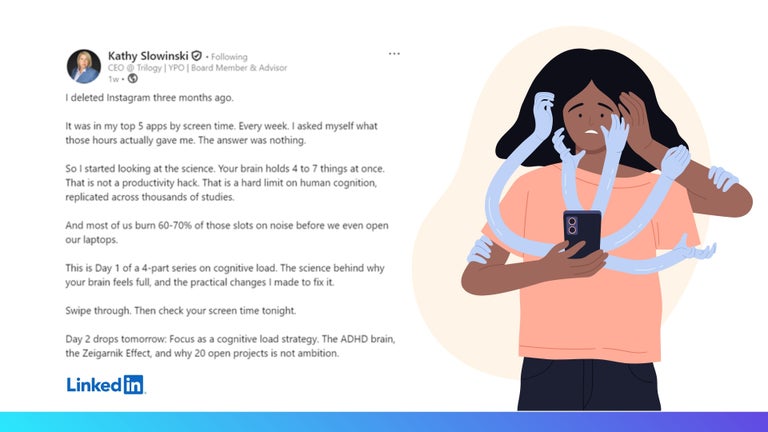
She quotes a study by George Miller (1956) that has been replicated many times since then. In it the theory goes that human working memory holds about 4-7 things at any time. Kathy argues that ‘noise’ takes up 60-70% of these slots for most people.
So, she quit Instagram and stopped putting garbage in her brain.
That may sound extreme until you realize most people are trying to do high-value thinking while feeding their minds the cognitive equivalent of a casino lobby.
If working memory can only hold a handful of things at once, and noise is already taking up most of the room, then flooding yourself with AI is not helping. It’s like tying bricks to your ankles when you’re already drowning and expecting to float.
Here’s what to do:
- Get REAL about your social use: Doomscrolling messes up your brain and robs you of your ability to perform at work. It literally erases your memory and life! Time to delete the apps that no longer serve you and are harming your brain.
- Set stringent constraints: Less is more. Tell your LLMs and agents that you want fewer responses, shorter answers, ranked recommendations and limit them up to 3 max. You don’t need a data buffet, you just need your brain to work.
- Use AI as a filter: Set up tools that strip clutter away before it reaches you online. Using summarizer tools, decluttering webpages, removing ads, auto-sorting your inbox – these are now indispensable practices.
Information overload is a threat to your brain. Cut the junk, constrain your AI outputs and use AI to filter instead of flood yourself with nonsense. Your brain will excel at higher value thinking when it’s NOT drowning in noise.
The Way Out of AI Brain Fry
It would be easy to blame AI for brain fry – but that’s just your brain fry talking.
There are fixes that will massively improve your day and make you feel alive again. I know because I’ve implemented many of these myself.
Don’t pretend you want to leave tech and move to a farm in the Cotswolds' where you can raise sheep and chickens. Don’t ignore that you’re struggling from brain fog, demotivation, lack of focus and are oscillating in and out of panic mode.

Just stop pretending that you can mediate your way out of a broken workflow while your agent army hurls cognitive bricks at your frontal lobe.
We’re all learning and adjusting to this future of working. And that means fixing the human system of governance.
AI brain fry is what happens when your tools scale faster than your human system does. It impacts your nervous system!
You can’t make your workflow faster, smarter, noisier and more powerful – and then treat your own cognitive capacity like Marvel infinity stones.
So, get to work on these 3 new non-negotiables:
- Learn to manage runaway context switching. If your brain is reloading itself every five minutes, you are not in flow, you are in tattered fragments. Batch your work, reduce the number of tools and kill interruptions with medieval force.
- Protect your judgement from decision-fatigue. AI will generate endless possibilities, but your brain hates that. Set your standards upfront, cap the loops, and stop making your tired mind referee every tiny call.
- Starve information overload before it starves your focus. There is too much trash out there, getting into your mind. You’re experiencing the consequences of firehose junk. Delete it, limit it, use AI to filter it out. Just make the noise stop.
You can’t out-machine a literal machine.
We need to re-center ourselves in the process, because we’re part of it. You could say, we’re the heart of the system – even though we need our brains to make it work.
The winners here won’t be the people who absorb the most information, juggle all the tools, or grind themselves into lumpy cognitive paste trying to keep up.
They’ll be the people who learn to govern themselves at a higher level.
Repeat after me: your brain is an asset, not a dumping ground. It deserves cognitive maintenance, professional discipline and system governance.
So, protect your mind like your best work depends on it.
Because now, more than ever, it does.
Similar post


Want to read more?
We have a lot more where that came from



 AI-first remote workers.