
Contents
- The Bent Keys Holding You Back
- #1: Meaning: Why Work Feels Hollow (Even When Your Busy)
- #2: Capability: The Widening Confidence Gap
- #3: Momentum: Pay Progress Matter!
- You’re Not Ready for This AI Reality Check
Do you love your job? It matters. Research says people who do are happier, more successful and enjoy better health than everyone else. It got me thinking – and then digging into the data.
Toyota has been around a long time – nearly 89 years.
They weren’t always as efficient as they are now. Once upon a factory line, stopping production cost thousands of dollars a minute.
It was almost unthinkable to do it.
Then one day, a factory worker pulled the andon cord, which brought the entire line to a screeching halt. A slightly bent key was the cause. At first, leadership was furious – but then they saw the wisdom of the act and enshrined it as their operating policy.
If something is even slightly off, it means there’s a deeper misalignment in the system.
It became known as the Bent Key Principle – in great systems, you don’t ignore the bent key – you straighten it out before it jams the whole machine.
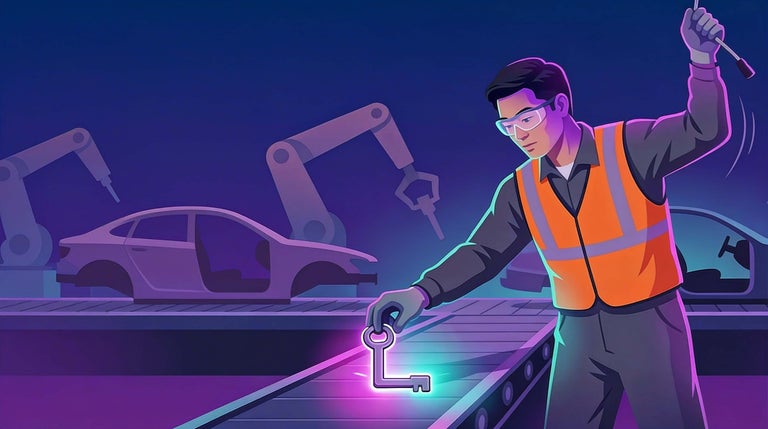
Now think of work as the machine that drives your career.
According to ADP’s People at Work 2025 report:
- Globally, only 19% of people are fully engaged
- Just 24% feel confident they have the skills to advance
- Nearly 75% leave their company without ever being promoted
- And more than half of people working 2+ jobs are living paycheck to paycheck
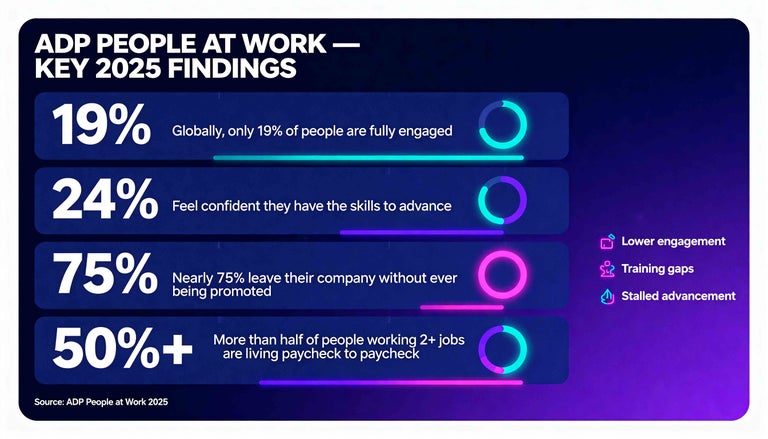
Taken on a global scale, this is a massive systems issue. Workplace engagement is low, mobility is at a crawl and financial stability is volcanically eruptive.
That is to say, non-existent.
But the machine isn’t broken – because many people (though a rarer bunch) do love their jobs. They earn well, are promoted often and are lousy with skills.
Good news!
Glimmers of hope exist to overcome the obviously bent keys keeping people from loving their work.
In this article, I’ll apply the bent key principle to your career – showing you how small, daily frictions compound into autonomous disengagement, and how restoring capability can change the way work feels.
We all deserve to love the work we do.
As a cherry topper I’ll refocus on how AI, when used correctly, will automate boring work, sharpen your confidence, and reopen upward mobility in ways that weren’t possible a few years ago.
Falling back in love with your work isn’t about staying on that production line.
It’s about straightening your own keys with AI.
The Bent Keys Holding You Back
Small problems compound.
- The promises of forward-progress that never happen
- The increasing workloads and diminishing paychecks
- The strange feeling that no-one really knows what the next step is
It’s not hard to get discouraged and slip into a passive state of keeping the production line running, no matter what. After all – stopping it has risks.
When the andon cord was pulled at Toyota, stopping the line might have seemed minor (the tiny bent key stashed in the control panel) – but it was a harbinger of bigger issues.
They sacrificed the short-term financial loss, for much more down the road – realizing that solving these issues early was the secret to staying on track.
The secret to efficient, high-quality systems.
In the same way, these little bent keys add up in your work, eventually resulting in a catastrophic career failure. They are the reason you fall out of love with your job.
You sacrifice long-term success, for short-term comfort.
The science of loving your work boils down to a few simple things we must have at all times. These are non-negotiables.
At Toyota they practice Jidoka – automation with a human touch. They use machines to detect and flag these little mistakes. You don’t need AI to point yours out.
So, lets break down the three major forces that determine whether you love or just tolerate your job – meaning, capability and momentum.
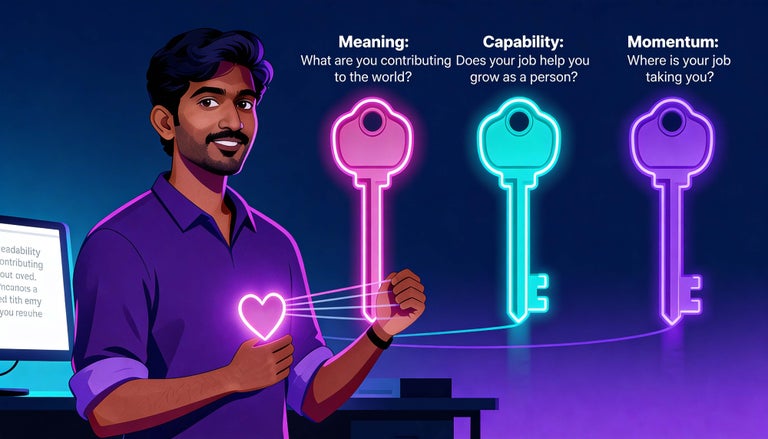
#1: Meaning: Why Work Feels Hollow (Even When Your Busy)
What are you contributing to the world?
Everyone’s always busy because work never ends. We somehow forget this in our day to day – racing towards deadlines that often carry no significance.
Based on the ADP People at Work Report – 81% of people aren’t engaged in their jobs.
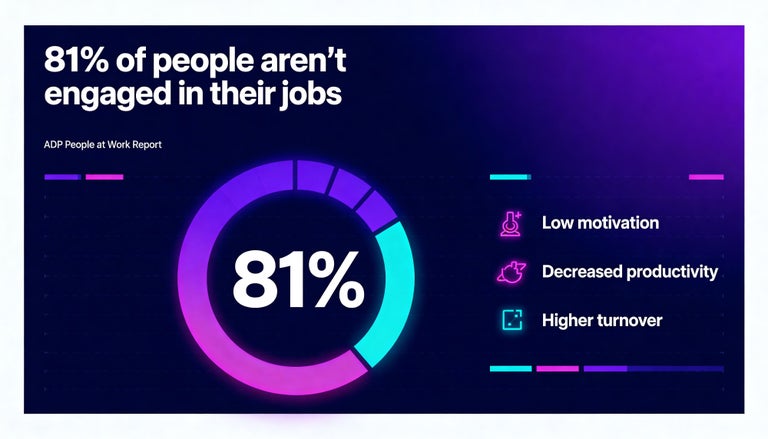
That’s because somewhere along the way they stopped feeling connected to what they were producing. Your job is one of the best places to find meaning in your life.
It gives you structure and direction and the opportunity to commit time and skill towards doing something bigger than yourself.
But for meaning to be present you need:
- To see / experience the IMPACT of your work
- To feel ownership over the results
That’s right folks, if your job lacks autonomy, responsibility and impact – you’re not going to find much meaning in it.
Translated into common bent keys this presents as:
- Meddlesome overbearing managers who like to control (micromanage) you
- Endless paperwork and no way of experiencing your metrics
- Teams that are demotivated, disconnected and unsupportive
I find meaning here in my position at Crossover because I know for a fact that my work helps connect exceptional people to jobs that change their lives for the better.
A couple weeks back I interviewed Jose Monteiro who found us on LinkedIn, was hired as an AI Innovation Manager – then was promoted to SVP of Software Engineering just 18 months later.
Work feels hollow when you can’t see your unique impact.
- 9 in 10 workers will sacrifice 23% of their lifetime earnings for more meaningful work. That says a lot.
Meaning is a lever we all need to pull. A key we all need to turn! That’s why autonomy matters so much.
When you control your environment, your schedule, and your output - when you can trace your effort to a visible result – that’s when engagement rises.
It’s no coincidence that regions leading in workplace flexibility also report higher engagement. Where autonomy expands, ownership expands. Where ownership expands, meaning follows.
The bent key isn’t that you don’t care. It’s that too much busy-ness has separated you from your contribution. Straighten that - restore autonomy, restore impact - and something powerful returns.
Not motivation to work…meaning in your work.
#2: Capability: The Widening Confidence Gap
Does your job help you grow as a person?
We all want to feel capable at work. Not just competent but capable of becoming more than we are now.
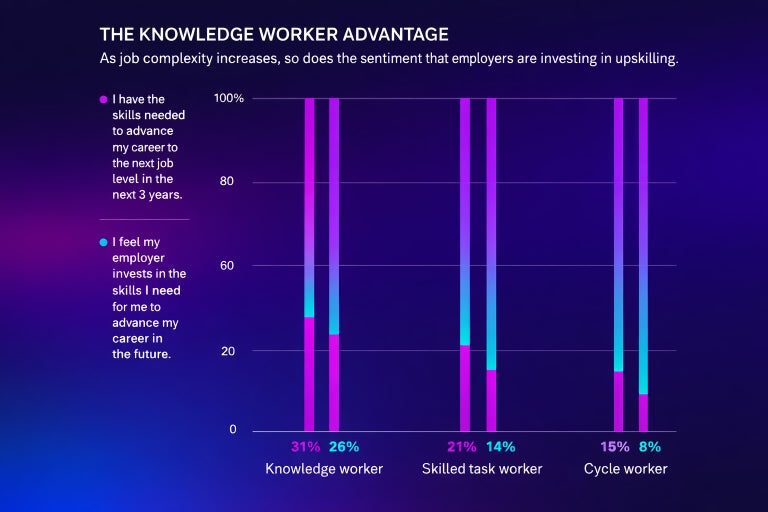
But according to that same report, confidence in career growth is pretty fragile. Even among knowledge workers - the most advantaged segment - only 31% feel they have the skills needed to advance over the next three years.
So, 7 in 10 knowledge workers aren’t sure they’re future-ready.
This echoes a poll we ran on LinkedIn a while back.
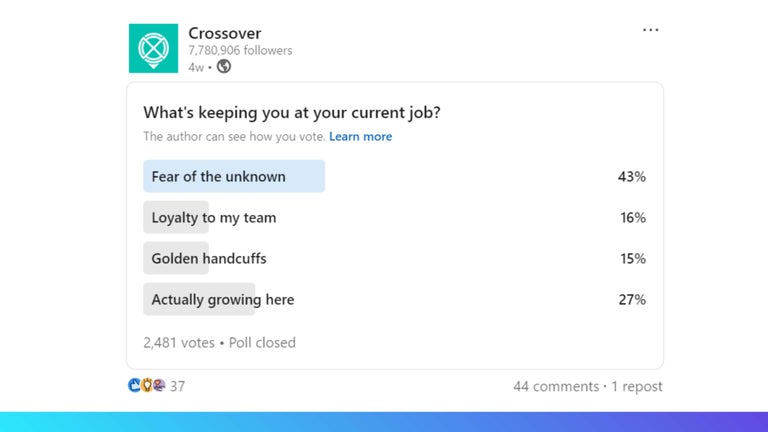
We asked our community, “What’s keeping you at your current job?’ And the overwhelming majority said, ‘fear of the unknown.’
That’s 43% of 2,481 respondents who would rather stay put in general discomfort, than face the reality that they might not be ready for what comes next at work.
That’s the confidence gap in action.
We all know skill-building has gone gangbusters since AI hit the market, and we’re all afraid we don’t know enough to be who future employers need us to be. Scary!
Every single one of us is fighting a battle on 2 fronts – how we do our jobs well now, and how we’ll do our jobs well tomorrow – based on this blistering pace of change in tech.
Unsurprisingly, India leads the way in skill-building as 37% of people feel they have the skills they’ll need. Contrasting this with the United States 22%, the difference is vast.
It’s not a cultural gap – it comes down to self-belief, having time to invest in your skills – and being allowed to do that while you’re at work.
For capability to be present you need:
- A job that allows you to learn, build and stretch
- A team that encourages growth at work, not just after hours
Capability is the second bent key.
It looks like:
- Doing the same boring, monotonous tasks month after month
- Being too overloaded or time-poor to invest in skill-building
- Being discouraged from experimenting because it’s too risky
To stay capable, you have to keep learning. When a job traps you in maintenance mode, it doesn’t just limit your skillset - it chips away at your belief in yourself.
And without belief, growth feels dangerous instead of exciting.
Straighten this key and ambitious potential returns.
#3: Momentum: Pay & Progress Matter!
Where is your job taking you?
Meaning keeps you engaged and capability keeps you confident. Momentum is the thing that really determines how satisfied you are with your job.
According to that ADP’s People at Work 2025 report, more than half of workers globally are living paycheck to paycheck. Nearly a quarter are juggling multiple jobs to make ends meet.
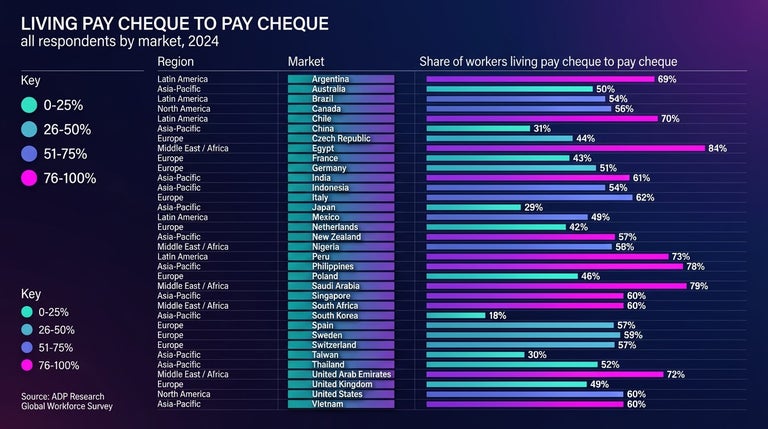
The reality is that more people live paycheck to paycheck in the US than they do in India. Pay is by FAR the #1 driver of job satisfaction that exists.
When your income barely covers your expenses, work stops being about growth and becomes about survival. The psychological bandwidth required to innovate and experiment just isn’t there. You’re too focused on stability.
It’s hard to love your job, when it doesn’t pay. That’s not a superficial belief, it’s a structural need.
The data reveals interesting regional contrasts. In several markets, including India and Egypt, workers strongly agree that advancing their careers means leaving their current employer.
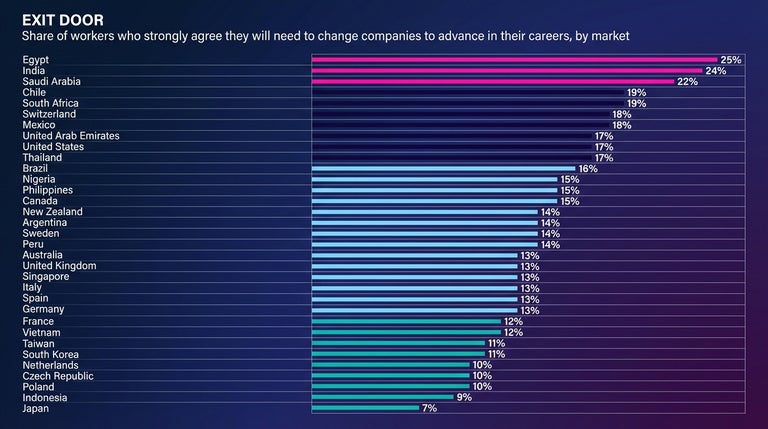
At the same time, satisfaction with pay is comparatively higher in India than in many Western economies. That combination matters.
When pay feels aligned with contribution, and when upward mobility feels inevitable, momentum builds. When pay stagnates and advancement feels blocked, it stalls.
Momentum is the third bent key.
It looks like:
• Promises of promotion that never happen
• Pay that fails to keep pace with responsibility
• Career ladders with oh-so-many missing rungs
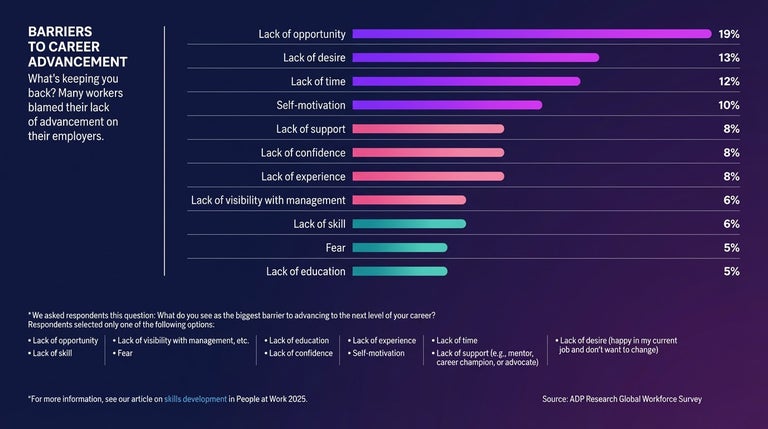
Working longer and harder means nothing if you don’t get ahead. Running in place will absolutely exhaust even the most highly trained marathon pro.
No-one falls in love with a treadmill job.
When pay stagnates it sends a clear message: your value is capped. Momentum is the financial proof that your growth matters.
Straighten that key – and work will feel directional instead of limiting again.
You’re Not Ready for This AI Reality Check
AI-forward people love their jobs more than you do.
It’s not because they’re lucky, have superb managers or work fewer hours. It’s because they use AI to fix the three things that make work worthwhile: meaning, capability and momentum.
Look at India.
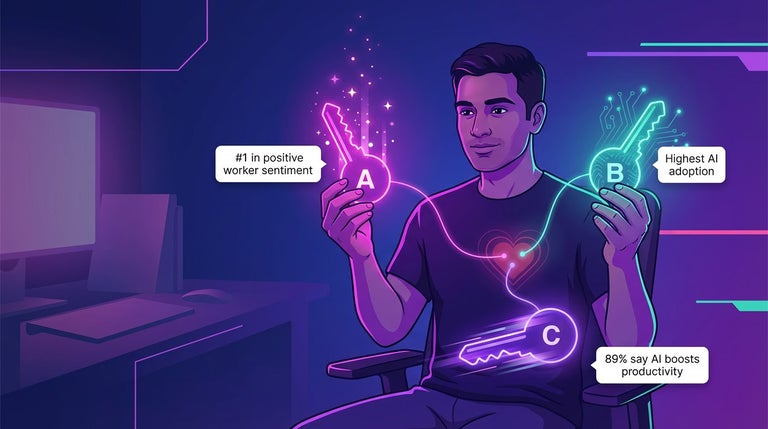
They’re a real-world case study in how AI can help tech workers fall back in love with their jobs again.
India leads the world in overall positive worker sentiment, scoring roughly 77% on the Global Talent Barometer - higher than any other country surveyed.
At the same time, it has the highest global AI adoption rate.
Now add this - Randstad’s 2026 Workmonitor found that 89% of Indian employees say AI has boosted their productivity, compared to 62% globally.
So, nine out of ten workers feel more valuable because of AI.
What could be happening here?
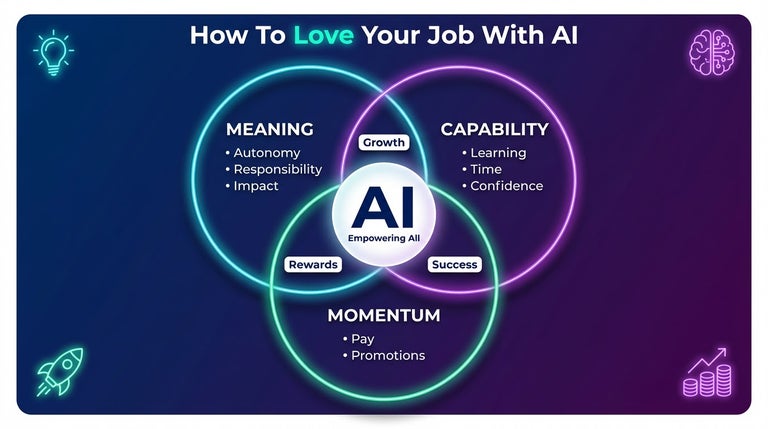
- Most people don’t hate their jobs – they hate the admin. The parts of their work that make their job feel meaningless and empty. Think formatting, summarizing, emailing, drafting, organizing…the list is endless. AI removes that layer. Instead of that trash, you get to do more decision-making, problem-solving and creativity. That means more contribution and more end results.
AI straightens the bent key in your day by removing the parts of your job that separate you from meaningful impact.
- The biggest fear in 2026 isn’t AI replacing you, it’s being left behind by someone who knows how to use it better. AI-forward workers don’t wait to learn, and they don’t wait on training budgets. They tap AI for skill acceleration, to break down complex topics, improve writing & analysis and to prototype like the wind. AI is an always available tutor, mentor and second brain.
AI straightens the bent key in your day by accelerating how fast you can skill-build and become capable in your current and future roles.
- If your pay and progress stagnate, you won’t love your job for long. AI increases your ability to create results, to meaningfully contribute and to reach for more. All of this is leverage that improves negotiating power, promotional potential and earning capacity. As you do bigger, better things so momentum builds. AI moves you from a treadmill job to a trajectory job – it takes you places.
AI straightens the bent key in your day by amplifying your contributions and your reward potential.
There’s a reason folks in India love their jobs. It’s not because AI is trendy, it’s because it gives them the power to fill their days with meaning, compound their skills faster and turn great effort into tangible pay which benefits their lives.
It’s happening – have you figured it out yet?
AI helps you leverage your time, learning and income – and leverage is what transforms a job from something you tolerate, into something you love.
The real question isn’t whether AI will change your career.
It’s whether you’re using it well enough to love your work again.
Work with people who love their AI jobs.
Similar post


Want to read more?
We have a lot more where that came from


![Crossover’s Basic Fit Check [Official AI Screening Guide]](https://assets-us-01.kc-usercontent.com:443/7beb5311-75a4-0049-50f5-8f58fd55aba7/90bfc8de-1a38-4802-8432-c063c215e90a/BasciCheckGuide.jpg?fm=jpg&auto=format&w=500&h=500&fit=clip)





 AI-first remote workers.