Contents
- The Comfort Zone That’s Costing You
- Limiting Your Growth with the Threat of RTO
- The In-Demand Tech Talent You’re Chasing Off
- Flexibility is The New Corner Office
How global can your startup be if your remote team lives within driving distance? Local remote isn’t real remote - it’s just hybrid in disguise. Founders clinging to location-bound hiring think they’re playing it safe, but they’re quietly sabotaging their shot at global growth. The best tech talent already knows - freedom scales faster than your office ever will.
Startup founders just LOVE to brag about being fully remote.
But if everyone on your team still lives within door-dash distance, you’re not global -you’re just WFH with extra steps. Top tech talent already knows the difference.
They’re chasing authentic freedom, total flexibility, and fat paychecks untethered to zip codes - while your startup clings to comfort zones disguised as innovation.
Here’s how your remote work policy endangers your startup’s growth potential, and how to reconsider an assumption that brands your company as a B-player in an A-player world.
As co-creator of Crossover’s Radically Remote Newsletter, the world’s largest remote work community on LinkedIn - understanding what the top 1% of global remote workers want is my job.
Andrew Allen and I set out to give uniquely talented tech people in India, Africa, South America and Europe a voice, because the best people don’t live down the road from your office. Ever.
The Comfort Zone That’s Costing You
According to The Flex Report, 67% of tech companies under 100 employees are fully remote. Startups it seems, thrive when flexibility is center stage.
The label ‘fully flexible’ includes fully remote workers and workers given the freedom to choose, as 88% of Small Tech workers do. But there’s a concern here not being cited: local remote work.
What happens to fast-scaling startups who identify as fully remote, but also have offices?
The ability to grow into a Big Tech company, and evolve from fully remote, to structured hybrid is preceded by this glaring red flag. These startups want to keep their options open, and so they limit hiring to local only.
When employees work from home, it’s easier to impact widespread – and sudden - change. It seems like a win-win. On one hand, top talent flocks to work at fully remote companies.
On the other, if problems ever arise because of scale, they can switch to a hybrid model. Taxes are simplified, perks are easy – it’s a comfort zone few Startup founders can resist. But there are hidden costs to this ‘fully remote work’ policy that you might not be seeing.
In a recent poll by Gusto of 1300 business owners, 35% of them that launched in 2023 chose the fully remote model.
It’s become common knowledge among tech workers that joining a startup is a sure-fire way to stay remote. What a betrayal then, when these startups grow and local remote starts looking more like hybrid work to their top talent.
Limiting Your Growth with the Threat of RTO
Not all remote work is created equal and in-demand talent is taking notice.
Tucked between the horrors of hybrid inflexibility and in-office work lurks this ‘safer’ remote option. And it exposes your startup as a second-tier company.
One that isn’t brave enough to embrace the proven competitive edge and enhanced innovation of fully remote, work from anywhere companies.
Local remote work is the worst.
It takes the freedom of 100% remote, and adds steel strings. If your remote work policy is ‘fully remote’ but local-only – you’re on a slippery slope. And while your C-Suite are patting themselves on the back for being progressive and not forcing people back to the office (yet), it’s transparent to A-players.
Local remote work at best, is a hybrid harbinger.
At worst – a crack in the door that allows in-person office work to become the standard as your startup scales. You’ve created a comfort zone for leadership that will negatively influence your top remote workers. Remote with the threat of RTO might as well be a banner that says, ‘stay away!’
The In-Demand Tech Talent You’re Chasing Off
For a startup, motivated talent is how you build something big.
There’s no resource as important – so attracting the right people is key. Knowing how to create a remote work policy that doesn’t drive top tech talent away, is key to cohesive teams that won’t abandon ship at the first sign of rough waters.
There’s one segment of talent in tech who can afford to be picky about where and how they work: the global top 1%. And with borderless tech hiring on the rise, the startups with a global mindset will be the ones to secure and retain them. Gartner’s 2023 CEO Survey noted that this trend has doubled over the last three years.
Not all remote workers work from home.
Infact, many of them prefer to work away from home – or at least – to have no restrictions on how they work. In a recent poll on LinkedIn, 68,470 Crossover respondents answered our question: “Would you rather work globally remote or locally remote (WFH)?”
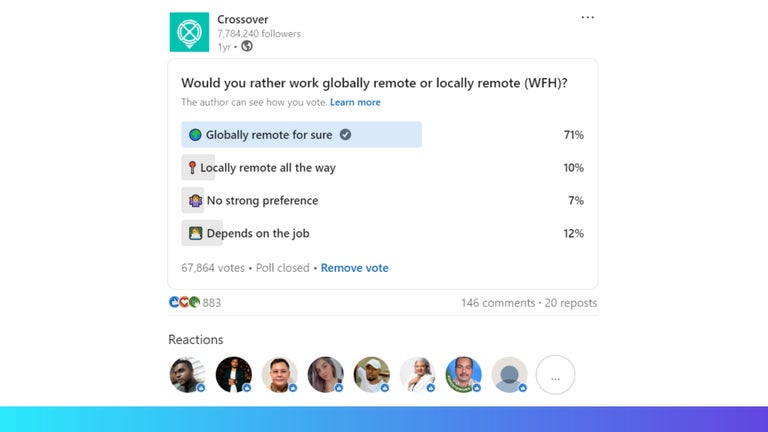
While the great remote work debate has migrated well beyond ‘where’ people should work to how, knowing what top performers look for in remote positions is key to recruiting the best talent.
Remote work is not an interchangeable term for work-from-home. As the poll has proven, increasingly - remote workers insist on ‘fully remote’ as the baseline definition. One with no office strings attached – even if they are procedural.
With 71% of respondents saying that globally remote is best, and only 10% sticking with locally remote – remote employers need to reevaluate what matters most to their top workers.
Working remotely isn’t just an excuse to stay home and work in comfortable pants and slippers. It’s a way to dial into true freedom, higher pay and a level of flexibility that top performers want in their lives.
In an age of return-to-office mandates, quiet quitting, secret layoffs and fierce tech competition due to the AI boom – startups considering remote options should heed this warning.
The best talent wants the most freedom.
Flexibility is The New Corner Office
Top global talent don’t want to feel tricked by a poorly documented remote work policy that says ‘fully remote’ but means locally remote.
They don’t want to be restricted by startups who promise freedom and then change course after years of dedicated service. In the UK, 94% of people surveyed said flexibility is the most sought after and highly valued benefit that exists in the workplace.
Flexibility beat bonuses, unlimited annual leave and paid overtime. For top tech talent, it spells freedom in so many ways.
- Freedom from location: Top talent doesn’t want to live in an overpriced city to be near their offices, for no reason. The occasional meetups don’t justify forcing people to be location-bound. They want to travel, and they want to live close to friends and family.
- Freedom from location-based pay: If you’re not going to pay them what they’re worth, they’ll find an international job that will. Somewhere that doesn’t erroneously adjust pay based on where someone happens to live, but rather on the value they bring to the job.
- Freedom to work asynchronously: Being in the same time zone is convenient, but unnecessary for productive work. Allowing top talent total flexibility in when they choose to work is how you hand their lives back to them. Now that’s a perk!
- Freedom to gain international skills: When you’re not hiring with a location-bound mindset, you will expose your team to greater diversity, different ways of getting things done and levels of innovation a local team simply can’t produce.
According to the US Career Institute, only 16% of US companies are fully remote. Even though Pew Research states that one-third of Americans could work remotely full time.
And with a projected 5X more people working remotely in 2025 since the pandemic, that’s no minor demographic. How many of those jobs are work-from-home masquerading as work-from-anywhere is anyone’s guess.
One thing is for certain. The tech talent with the most experience, in-demand skills and desire for work-life balance will always choose globally remote.
Because remote flexibility is the new corner office.
So, be cautious when seeing local remote as a useful compromise and a better alternative to hybrid or in-office models.
See it for what it is – a roadblock to tapping into the true power of remote work. And a flashing red light, warning top talent not to invest time or energy in your local startup.
Similar post


Want to read more?
We have a lot more where that came from


![Crossover’s Basic Fit Check [Official AI Screening Guide]](https://assets-us-01.kc-usercontent.com:443/7beb5311-75a4-0049-50f5-8f58fd55aba7/90bfc8de-1a38-4802-8432-c063c215e90a/BasciCheckGuide.jpg?fm=jpg&auto=format&w=500&h=500&fit=clip)




 AI-first remote workers.