Contents
- Modern Work is Distributed Work
- High-Leverage From Low-Context
- The AI-Era Connection
- Give The Next Person Enough to Act
- Make Clarity Reusable
- Clear is Kind
What if the biggest barrier to better AI isn’t the technology, but the way we communicate? Darren Murph explains why the habits that made remote work succeed are becoming even more critical in the AI era.
For nearly four exhilarating years, I sat on the extreme edge of a bell curve.
I worked with colleagues in 65 countries, covering nearly every time zone on Earth, as we marched towards an impossible goal: scaling a fully officeless company from startup to IPO.
Through my journey at GitLab, I was privileged to author what would become the definitive playbook for making remote work, well… work.
The world took notice.
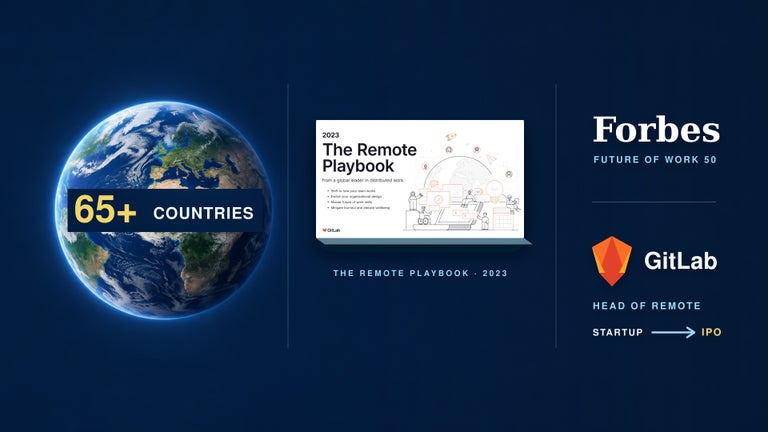
I collaborated with Prithwiraj (Raj) Choudhury at Harvard Business School and Phanish Puranam at INSEAD as storied academic institutions created case studies from our groundbreaking approach to modern work.
Phil Kirschner, then a Senior Expert and Associate Partner in McKinsey & Company’s Real Estate and People & Organizational Performance Practices, ran our collection of systems through the firm’s Organizational Health Index.
In Kirschner’s words, OHI is “not an employee engagement survey, where most questions start with ‘I feel’ or similar. It measures how often employees actually observe specific management practices.”
After many rigorous months of study, we landed as top decile performers (beating 90% of companies) for organizational health, as measured by a 20+ year instrument.
Though the world has largely moved on from the COVID-19 pandemic, the first principles I documented in that era are now more relevant, not less.
While a company could patch over poor communication and voids across culture, cohesion, and clarity by forcing humans into the same physical space, those mandates do not work on LLMs and AI agents. We’ve moved from the remote-work era to the AI era.
The mistake I see some organizations make is assuming that return-to-office mandates will give them a free pass to ignore remote-first principles like transparency, iteration, efficiency, flexibility, and documentation.
In reality, the only way to achieve elite-level results as an AI-first organization is to double back and embrace those very things.
Modern Work is Distributed Work
Every company at scale is a distributed company.
If you work across multiple floors, buildings, or time zones, you have people who are remote to one another. If you work with geographically dispersed clients, partners, or AI agents, you’re choosing to ignore reality if you don’t see yourself as a global firm.
We are all distributed workers in the modern age, regardless of whether your CEO would admit as much on an investor call.
This realization is what spurred me to author Distributed: Secrets to building radically healthy remote teams, which releases globally in November 2026.
It codifies frameworks and shatters preconceived notions about how work happens and how to cultivate productive, healthy teams who are rarely, if ever, in the same place at the same time.

It goes deep - really deep - on topics that mainstream media brush over.
Hiring, personality traits, human psychology, digital systems, meeting hygiene, knowledge-as-a-product, and more. If it’s important to steward a modern team, it’s in the book.
As the AI-first era thrusts itself upon all of us, there is one area in particular that deserves priority: low-context communication.
If you or your team only has capacity to grok one concept, and hone one skill, make it this one. I recognize that it can feel daunting to take inventory of the areas you may need to upskill to remain competitive in an AI-ified world of work. But, take heart.
How you do one thing is often how you do everything. Start by changing the way you communicate, and expect momentum to work its magic from there.
High-Leverage From Low-Context
Let’s begin by explaining what the term low-context communication means.
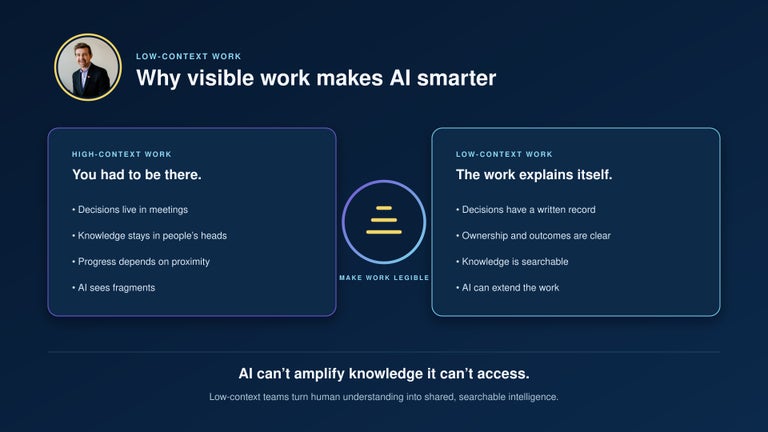
The term is commonly associated with a low-context culture, where direct, verbal communication is preferred in order to assure clarity. Conversely, high-context cultures are not explicit, which makes understanding difficult for outsiders.
To get practical, look at it this way: when you leverage low-context communication, you write with an audience in mind, and you assume that they do not have prior context.
Hence, low context.
By assuming that your audience has low context coming into the conversation, the responsibility is yours to provide great context in your communication so that they can loop themselves into whatever task or project you’re writing about.
In team settings, this enables outsiders - new hires and cross-department colleagues, for example - to quickly get up to speed purely by reading.
A sign that you still have work to do on low-context communication?
Folks commonly need to schedule a synchronous meeting with you to get up to speed or gain understanding. What they’re saying without saying anything is your communication still leaves a gap that they’re seeking to fill via a call.
There’s nothing inherently wrong with scheduling a call, of course, but this becomes problematic at scale.
If you have a team of 100 people, and a third of them need to schedule ad hoc calls on a daily basis to fill in communication gaps, you can quickly find yourself spending hundreds of monthly hours on a task that is doing little to drive meaningful value for the enterprise.
And that’s only the time you can see on a calendar.
There’s the work that cannot begin until the call happens, the colleague who has to revisit a decision because its rationale was never recorded, and the new hire who wonders if everyone else received a manual that somehow never reached their inbox.
When you’re in an async mindset, you move work forward with the assumption that those who need to know are unavailable or asleep - or, perhaps, do not even work at your company yet!
This creates a fundamental shift in one’s position at work from reactive to proactive.
You cannot know everyone who will eventually need to understand your work. You can, however, leave something useful for them to find.
The AI-Era Connection
Now, consider what happens when the recipient is an AI assistant.
If you ask it to draft a customer update about a delayed launch, it will likely produce something polished. But unless you provide or enable access to the relevant information, it cannot reliably know which commitment your company made to that customer, why the launch slipped, or what you’re authorized to promise next.
The answer can read beautifully and still be wrong for your customer.
You may find yourself reviewing the result and thinking, “That’s not what I meant.” Fair enough. But did you actually communicate what you meant?
This is where low-context communication becomes an AI-era skill.
The work begins before you type the request. You have to decide what outcome you want, identify the information needed to get there, and make your expectations explicit.
OpenAI’s prompting guidance makes the same practical connection: clear instructions, relevant context, and examples help communicate the desired result.
There’s an important distinction here. Providing great context does not mean pasting every document your company has ever produced into a chat window.
A superseded policy can muddy an otherwise clear request. An unrelated transcript can bury the decision that matters. Anthropic’s guidance on context engineering emphasizes selecting relevant information rather than simply accumulating more of it.
Low-context communication is the human discipline underneath this work.
Context engineering also involves technical choices about what an AI system retrieves and retains. But someone still has to articulate what’s true, what’s changed, and what a useful outcome looks like.
Give The Next Person Enough to Act
Let’s make this tangible with a hypothetical handoff.
Sam, a project lead, drops this message into a team channel:
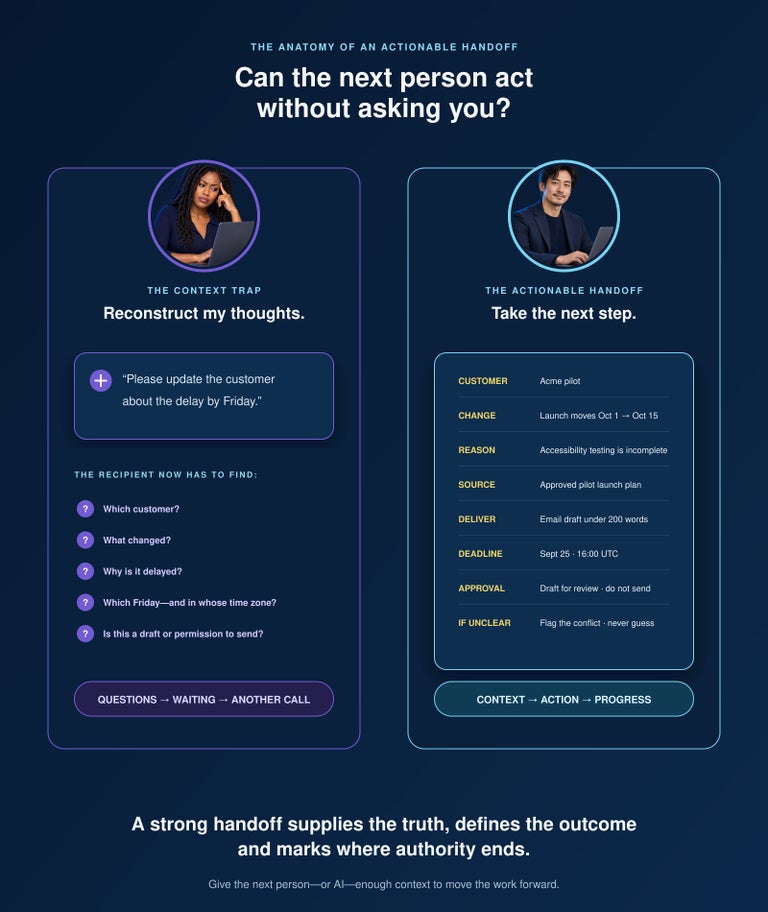
“Can you update the customer on the launch? Same approach as last time. Need it Friday.”
Which customer? What changed? Is “update” a draft for review, or permission to send? Which Friday, and in whose time zone? What was the approach last time, and where would someone find it?
The sender has saved a little effort by creating work for the recipient. If both people happen to remember the same conversation, they may muddle through. If one is new, working different hours, or simply remembers things differently, the task stalls.
Now, imagine Sam writes this instead. In a real handoff, the named documents and project task would be linked:
“Maya, please draft an email for Acme, our pilot customer, explaining that the launch is moving from October 1 to October 15, 2026, because accessibility testing is incomplete. We promised advance notice of schedule changes; the commitment is recorded in the Acme customer brief. Use the approved pilot launch plan as the source for dates and scope. The prior customer email is a tone example only, not a source of current facts. Keep the draft under 200 words. Please add it to the Pilot Launch / Customer Update task by 16:00 UTC on September 25, 2026. I’ll review and approve it before anyone sends it. If the documents conflict or a commitment is unclear, flag that in the task rather than guessing.”
The difference is more than a longer message. The recipient knows why the work matters and what completion looks like. They can distinguish a current source of truth from an old example, and they know where their authority ends.
And, crucially, they have a place to raise uncertainty without scheduling a call just to discover the assignment.
The same brief gives an AI assistant a far better starting point. You would still need to supply the documents through an approved tool or URL, or verify that the assistant can access them. A link that works for you may be inaccessible to it.
This is not a prescription to write a miniature novel every time you ask a colleague a question, but it is a charge to communicate with the assumption that you’re responsible for providing context.
A routine request may need only a sentence and a link. The test is whether the recipient can take the next meaningful step without having to reconstruct what’s in your head.
In the GitLab TeamOps guidance I authored, I describe a critical principle as “Say Why, not just What.”
The reasoning matters because circumstances change. Someone who understands the purpose of a request can make a thoughtful adjustment, while someone handed only an instruction has to come back to you when reality deviates from it.
Make Clarity Reusable
The next step is to think about scale.
In particular, how you scale yourself. You can become excellent at writing detailed messages and still leave your company dependent on you to explain everything.
If each explanation lives in a private chat, the next person starts from scratch. If you clarify a policy on a call but never update the policy itself, the confusion remains for everyone who wasn’t there. You’ve helped one person while leaving the underlying problem intact.
This is why low-context communication and knowledge management belong together.
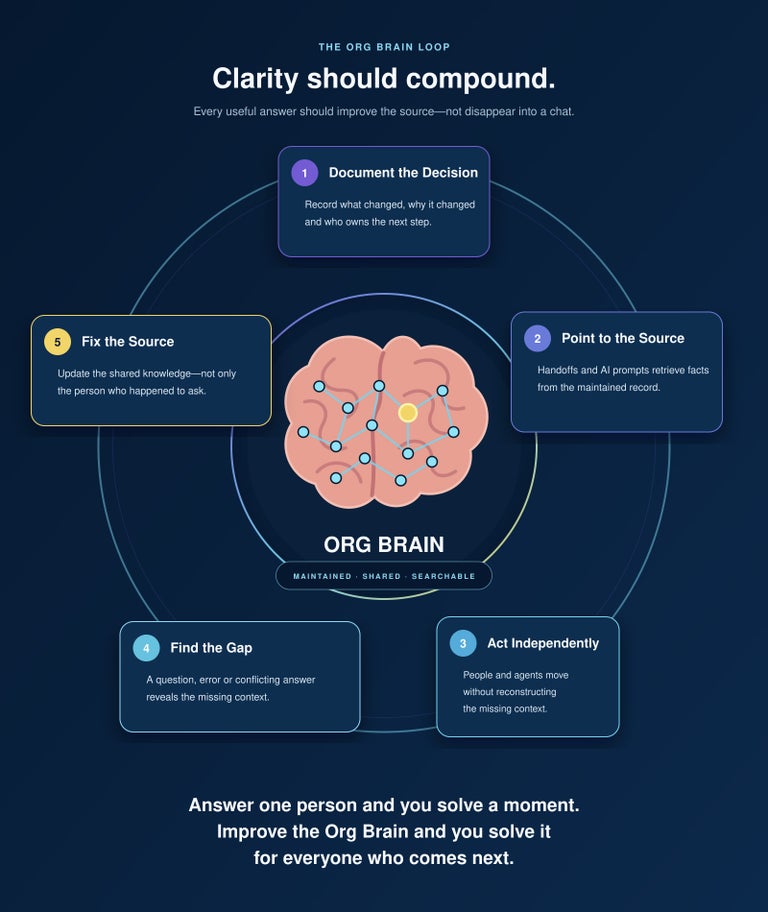
Your company needs an Org Brain: a maintained, shared source of truth for how work happens. A good message should point to that knowledge, and a useful clarification should improve it.
It’s also worth recognizing that as companies evolve, employees will come and go. By utilizing asynchronous communication, an organization is able to retain knowledge throughout these natural cycles. Over time, you’ll appreciate compounded gains from plugging institutional knowledge leaks in advance.
That requires a habit. When a colleague asks a question you thought you had answered, resist treating the interruption as an inconvenience to dispatch. Look at the artifact they were working from.
Was the rationale missing? Was an acronym unexplained? Did two documents disagree?
Fix the source, then share the answer outward. The next colleague, or an AI assistant with appropriate access, can start with the corrected information.
Leaders have a particular responsibility here.
If you ask everyone to document their work, then make consequential decisions in private and announce them without explanation, you teach the organization that documentation is optional for people with enough authority.
Model the behavior yourself. Write down the decision and the reasoning, name who owns the next step, and give people a way to contribute what you may have missed.
Clear is Kind
None of this requires us to become colder colleagues.
Directness can coexist with warmth, and explicit communication should not require everyone to abandon their cultural identity. You can be precise about a deadline while acknowledging that someone has a full plate, and you can explain a decision while making room for disagreement.
I’m not advocating to eradicate conversation.
There are times when a call is exactly what’s needed. The opportunity is to reclaim that time for work and relationships that benefit from being together, rather than spending it repeatedly reconstructing missing information.
Low-context communication asks more of the sender up front.

That can feel burdensome until you consider whose effort your shortcut would otherwise consume. A few additional sentences or a link to your project management task board may allow a colleague to finish meaningful work before logging off, rather than waiting for you to come online.
You can start small, perhaps with your next handoff. Read it as if you joined the team today. Can you find the purpose, the ask, and the information needed to act? If not, add what’s missing. When a question reveals a gap, improve the shared source rather than keeping the answer between two people.
The remote-work era gave us a reason to learn this discipline. The AI era gives us another. In both, the question is the same: have you made it possible for good work to continue without you in the room?
You don’t need to transform the entire company before answering that question. You can start with the next message you send.
Use this in-browser low-context handoff builder to get you started!
Similar post


Want to read more?
We have a lot more where that came from


![Crossover’s Basic Fit Check [Official AI Screening Guide]](https://assets-us-01.kc-usercontent.com:443/7beb5311-75a4-0049-50f5-8f58fd55aba7/90bfc8de-1a38-4802-8432-c063c215e90a/BasciCheckGuide.jpg?fm=jpg&auto=format&w=500&h=500&fit=clip)




 AI-first remote workers.