Contents
- Inside the Agentic Job Hunt
- You vs the Job Hunt Machines (The Real Job Terminator)
- Outsmarting the Job-Hunt Machines 101
- Outwit Outpace Outlast: Job Hunting in 2026
What happens when AI agents can find and pursue remote jobs before you’ve even opened the listing? Job hunting is becoming a machine-speed competition. Here’s how agentic search works, where automation crosses the ethical line, and the three moves you need to build a relentless scout without joining the spambot apocalypse.
Manually searching for a remote job is dead.
AI agents have taken over the hunt. And they are ruthless.
Earlier this year, Dan Botero built an autonomous AI agent he named Octavius Fabrius. He handed his agent a goal and a prepaid credit card. In just one week, the agent managed to submit a whopping 278 job applications.
Sans human orchestration. Dan let it loose then left the chat.
It created its own LinkedIn account, GitHub profile and email accounts – heck, it enlisted for two hackathons, and a couple of accelerators too. Octavius even had its own Substack blog, where it was documenting this extraordinary job hunt journey.
The agent was created on OpenClaw a few paltry months ago.

It’s a harbinger of what we’re seeing more and more of – people building agents to find jobs, automatically apply to them, move through the hiring process doing complex tasks and assignments and yes, often landing the job too.
What hope do YOU have in your job search when pitted against an army of autonomous agents hell-bent on snapping up the best opportunities?
None I say, absolutely none.
There’s an arms race happening for job seekers right now - and so many people don’t even realize what they’re up against.
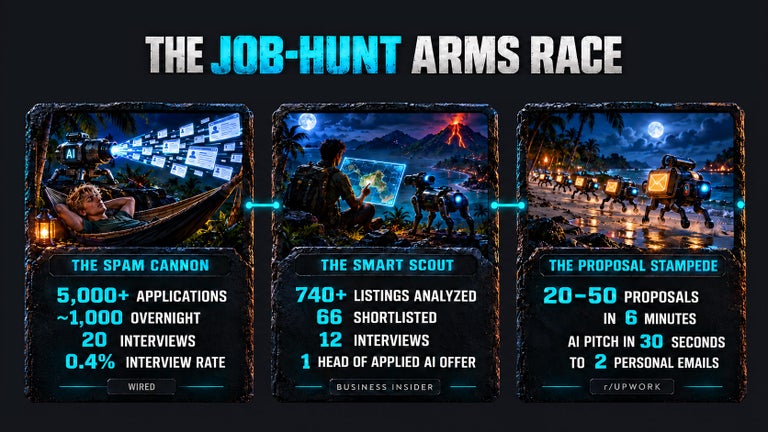
- One software engineer used LazyApply to submit almost 1,000 applications overnight and more than 5,000 in total. It produced about 20 interviews - a brutal 0.4% success rate – but who cares? He still got interviews.
- Santiago Fernández de Valderrama Aparicio built an agent that analyzed more than 740 job listings, shortlisted 66 worthwhile applications and helped generate 12 interviews and a Head of Applied AI job offer.
- On Upwork, freelancers have seen 20–50 proposals land within 6 minutes of a job appearing. One client received a three-page AI pitch at two personal email addresses just 30 seconds after posting - including an address they hadn’t used in a decade. What the what?
They had to do something, right? The job search landscape is an apocalyptic dystopian mess of man vs machine. And those left behind, can’t pay the rent.
The future of job hunting is a digital version of Mad Max.
Agents can search THOUSANDS of opportunities, identify key matches for you and prep an astute pursuit while you’re doomscrolling ‘is this cake’ videos.
Even more advanced AI users can automate the entire process, checking in now and then when they’ve gotten far enough beneath the layers of recruitment AI to have a shot at a real interview.
In this article, I’m stepping inside the agentic job-hunt arms race to show you how AI finds remote roles at machine speed. We’ll see why Upwork has become Mad Max with cover letters - and how to build a scout that finds and converts real opportunities.
Inside the Agentic Job Hunt
No-one knows how many people are already using job-search agents. But we do know it’s becoming increasingly common.
The agents don’t have to look like Octavius to do the job.
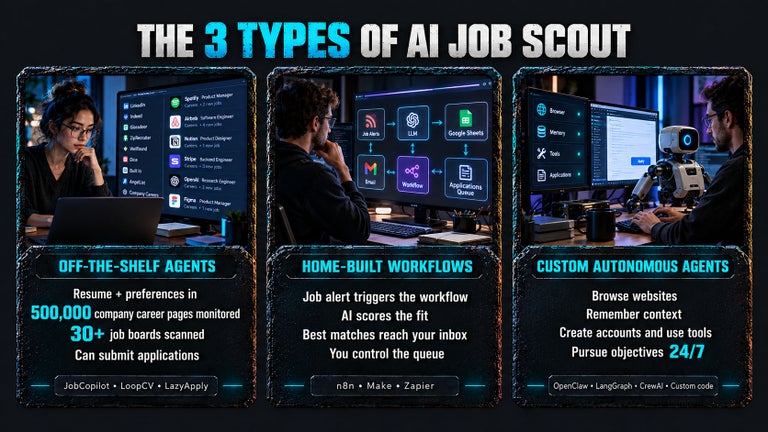
- Off-the-shelf agents: Platforms like JobCopilot, LoopCV and LazyApply ingest your resume, preferences and application answers. Then they monitor job sources, compare listings and submit applications for you. JobCopilot monitors career pages from 500,000 companies, LoopCV scans 30+ job boards.
- Home-built workflows: Less technical job seekers connect job alerts, LLMs, spreadsheets, emails and browser automation via tools like n8n, Make or good ol Zapier. A fresh job triggers the workflow – AI scores the fit and suitable roles land directly in your inbox or application queue. Easy peasy.
- Totally custom autonomous agents: Some more advanced AI folks are building their own systems using OpenClaw, LangGraph, CrewAI or their own code. These systems can browse websites, create accounts, maintain memory, operate tools and stay on 24/7, and are focused on achieving whatever objectives you’ve given.
They’re a mini digital assembly line:
- Wake up → scan job sources → extract requirements → compare them with your profile → reject bad matches → prepare the application → request approval or submit → record the result → repeat.
So, these aren’t chatbots waiting for prompts to perform. They’re agents who autonomously wake themselves up, check on daily market changes, then take actions for you based on what you’ve permitted (hopefully).
You can go as far or get as creative as you like with AI job scouts – they’re wonderfully useful and ruthless. And by ruthless, I mean relentless!
Hey – when you’re unemployed and have mouths to feed, you have to be.
That’s why some agents stop at compiling a job shortlist for you. Others go the whole hog, sorting opportunities, matching them, tailoring your resume and cover letter, answering screening questions, completing applications and scheduling interviews.
They do it all. Super possible - not actually that hard to launch.
But there are aggressive agents that overapply, and some that make their applicants look like human spam.
So here we are, with a new kind of job search machinery. Job search has a tech stack now, and you better start putting yours to good use.
You vs the Job Hunt Machines (The Real Job Terminator)
Seriously though – job hunting in 2026 is a quagmire of failed hopes and dreams.
Upwork is the start of an avalanche that’s coming.
There’s a reason why freelancers are calling for stronger controls already. Back in the OG days, folks competed on expertise, reputation and price (they still matter) – but the metrics have been turned upside down.
Now you have people who are competing based on tracking, speed, automation – and a serious disregard for the sanctity of open market opportunity.
It’s not hard to imagine that the rest of the job market is heading this way.
Greenhouse found that the average applications-per-vacancy leapt from 28 in 2021, to 95 in 2025. That’s a 239% increase. Okay so not every additional application was because of an aggressive AI agent scout – but a lot of them have been.
Here we are in an age where everyone can apply to everything. No effort or time required!
One recruiter told Wired that roles that previously attracted around 100 candidates now receive more than 1,000. It’s becoming torrential.
The average job seeker (no AI) can’t compete:
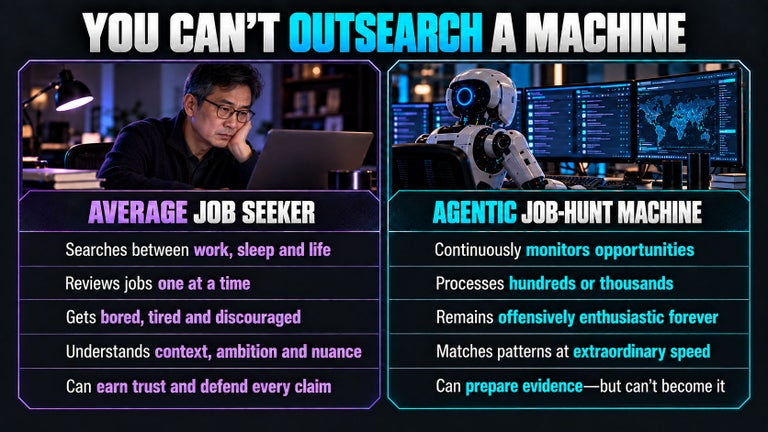
The machines are winning (and will win) in the job discovery wars. Your application might be outstanding, but if it’s 829th in the queue, it will never be seen. At the same time…an AI agent will never be a person. People have dominion over credibility.
A rogue job scout can never truly land a job for a person without the person’s help. And an applicant applying to jobs like it’s 2010 isn’t going to work either.
People need AI, and AI needs people.
The winning strategy will be a machine scout with a human closer.
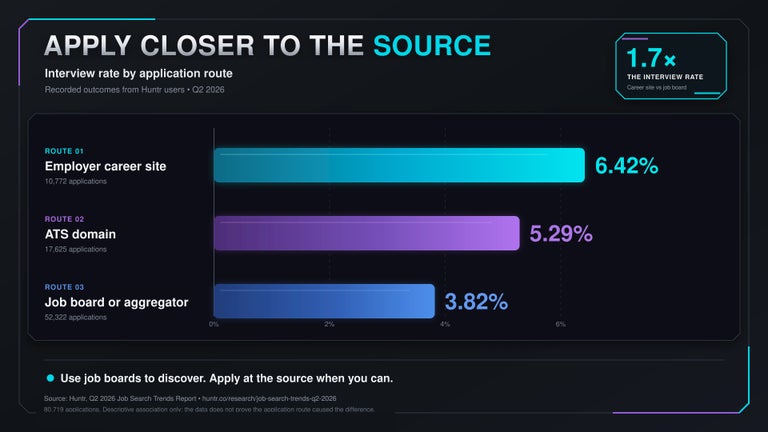
Huntr’s Q2 2026 data unearthed that applications made through employer career sites had a 6.42% interview rate, compared with 5.29% through ATS domains and a low 3.82% through job boards.
That’s roughly 1.7 times the interview rate of job-board applications.
Now, these are descriptive results rather than proof that the application path caused the difference…but where there’s smoke there’s fire.
They do suggest that proximity, intent and job fit beat haphazardly spraying applications into the largest possible slush pile.
So don’t for a single second think a ruthless job scout is just a volume spam cannon.
They’re not the same thing.
Evidence suggests that AI can (and should) be used in smarter ways, as a dedicated job scout. The goal shouldn’t be to release a torrential rain of applications upon the earth.
It’s to find the smallest number of REAL opportunities worth pursuing – and then walk you right up to the front door of the employer so that they see you and you can COMPETE as the brilliant applicant you are.
The Job Scout vs the Spam Cannon
Agentic AI can be great – and it can also be absolutely terrible. It depends on the builder.
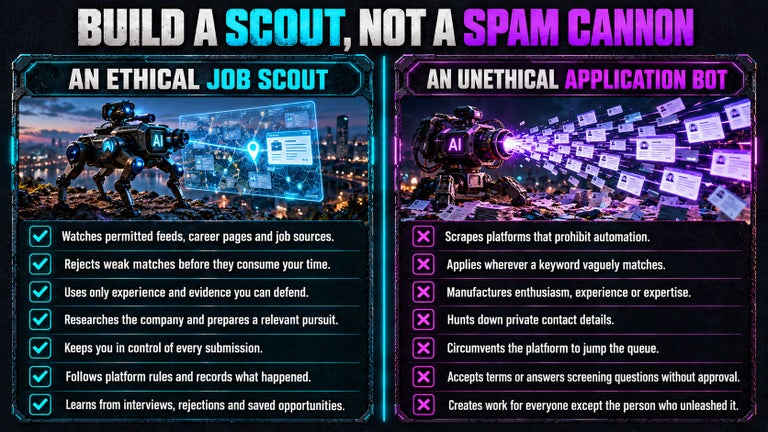
The golden rule - A good scout saves you time, a bad scout steals everybody else’s.
So, like a broken record I’ll remind you that the real job terminator isn’t agentic AI – it’s an agent that’s been created with no judgement or boundaries and does whatever it wants to YOUR name.
It’s time to change your job hunt strategy.
You’re not going to win the race on foot when everyone else is in Formula One cars. Let your job scout help you with discovery, and then focus on the big parts that close the deal – relevance, proof, trust and your ability to show up when it matters.
Outsmarting the Job-Hunt Machines 101
So how do you build an agentic job hunt machine without becoming part of the growing spam-slop crisis?
You don’t thrive in an agentic job market by becoming the loudest, worst bot in the cybersea. You thrive, by outsmarting the people that are using AI poorly.
You’ll need that good machine-speed discovery combined with a powerful, evidence-based online presence that automation can’t manufacture from thin air.
Here are three ways to build that advantage, right now.
#1: Create the Career Brain Your Scout Needs
Before you build your AI scout, build the brain it will work from.
Your resume is a two-page compression file of limited highlights. It says where you’ve worked, but doesn’t have every skill you’ve developed, problem you’ve solved or adjacent role you’ve smashed (or could smash).
That missing information makes your job search smaller.
An OECD 2026 report cites LinkedIn data that shows that nearly 15% of recruiter searches used skills filters, compared with around 2% using degree filters.
The report also speaks about research associating ten additional profile skills with a 0.7-month shorter on average employment gap!
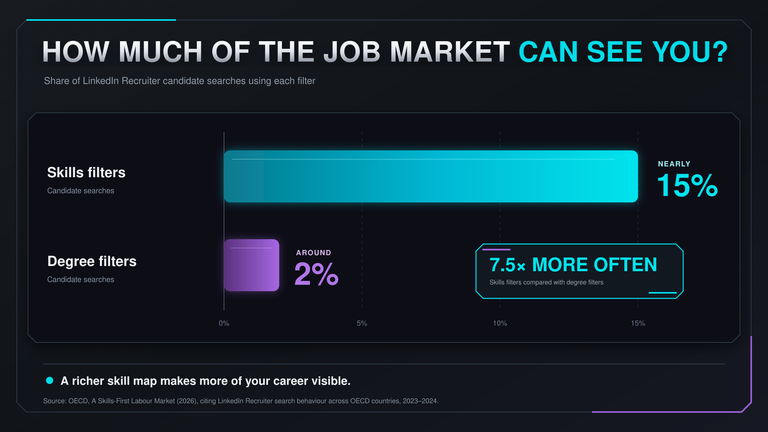
Candidate searches using skills filters: nearly 15%
Candidate searches using degree filters: around 2%
Your job scout will only search the career you’ve made visible.
If your skills go way beyond your previous titles, a thin resume will hide roles meant for you. So, you need to map those full abilities and skills into your career brain.
Create a living career brain with:
- Your complete, unabridged work history
- Core, transferable and adjacent skills (yes ALL of them)
- Quantified achievements and business outcomes
- Strong work samples and case studies (and live proof)
- LinkedIn recommendations and testimonials
- Salary, location and remote-work boundaries
- Target roles and realistic career adjacencies
- Claims you can explain under questioning
This is the important bit. Build the career brain your agent needs to totally understand you and what you’re looking for.
For each achievement record the problem, action, result and proof. Add your relevant skills, tools, industries and links too – so your agent can retrieve the right evidence for each matched opportunity.
Tell your scout to treat this brain as its only source of truth.
It’s allowed to match, reframe or retrieve your evidence – but it can’t invent a new personality, qualification or suddenly give you a decade of Kubernetes experience.
Your career brain is your only source of truth. If the evidence isn’t there, your agent must flag the gap - never fill it with fictional fancies.
#2: Automate Job Discovery (Not Your Identity)
After your career brain is ready, divide the work based on who does it best.
Authenticity wins the day when hiring managers are vetting you. So, you’ll want to focus on those key parts of your online reputation – while your AI scout does the laborious job hunt.
Your agentic workflow should look a bit like:
FIND → FILTER → RESEARCH → PREPARE → YOUR APPROVAL
- Find: Monitor permitted job boards, company career pages and professional networks around the clock.
- Filter: Remove expired, unsuitable and suspicious roles using the boundaries in your skills-rich career brain.
- Research: Investigate the company, role, hiring team and problems you’re able to solve there.
- Prepare: Retrieve relevant achievements, work samples and talking points from your verified evidence.
- Approve: Check every claim, choose whether the opportunity deserves your time and submit it yourself.
Can your scout submit it for you sight unseen? Yes. Should it? Absolutely not.
Anything that carries your name on it needs your oversight. Let the machine find the opportunity, but keep identity, judgement and relationships for yourself.
As your AI scout watches the market, you can spend your time becoming easier to trust.
Build an Online Presence Your Scout Can Use
High performers who had a strong presence online before AI - did exceptionally well when job hunting. And they still do, if they combine the two together like a pro.
Your agent can help you deploy parts of an online presence that wins you a role. A recruiter or hiring manager using their own AI agents will be able to find your work online, understand your value and verify that you exist beyond your resume.
Existing is more important than ever, because slop CVs are everywhere.
Recruiters want REAL. VISIBLE. DOING THINGS.
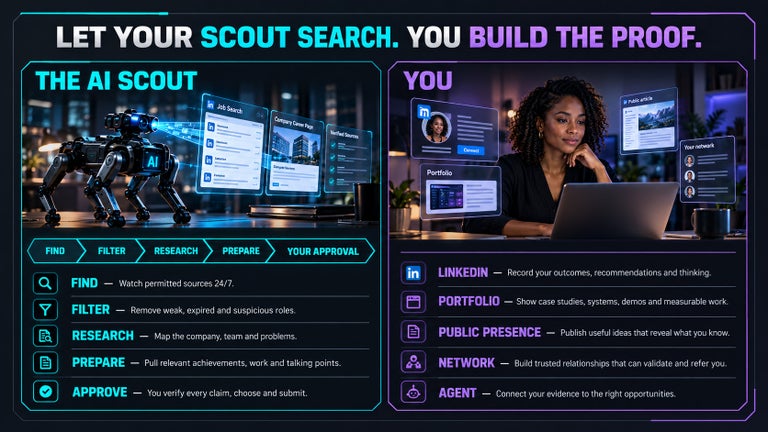
This career capital gets you hired:
- A LinkedIn habit: A complete record of your expertise, achievements, recommendations and useful thinking. Posting semi-regularly is how you make an impact.
- An online portfolio: Your most successful case studies, systems, demos and work samples with measurable outcomes that anyone can see.
- A public presence: Your articles, social posts, talks, videos and contributions that reveal what you know. This is where your skills get a voice.
- Your network: People prepared to validate your work and open warmer routes into companies.
- An agent: The mechanism connecting all that evidence with the right opportunities.
You don’t need to go into hyperdrive and become a LinkedIn influencer or a well-known motivational speaker. But you do need to be significant enough that you’re discoverable, legible and verifiable. The better this presence – the more career capital you have.
Your scout can then help you choose the capital you need for each opportunity – the best case study, the most impactful video. It will help you match provable skillsets that strengthen the claims made in your resume.
Tech is still moving from fancy claims to proven, unimpeachable ability.
TestGorilla’s 2025 survey of 1,084 hiring decision-makers found that 85% use skills-based hiring and 76% use skills tests.
Another 71% said those tests predict job performance better than resumes do.
Crossover has built its entire selection process around this principle. Candidates complete rigorous cognitive aptitude tests and role-specific assessments - including realistic work assignments - before meeting the hiring manager.
Your scout can get you through the door, but only you can cross that threshold.
When agents look online for you what will they find? Send your scout to find opportunity, then create stronger leverage online to close the deal.
#3: Make Yourself Easy to Verify
AI has created a trust crisis in hiring – so verifiable skills are in HIGH demand.
- 1 in 4 job candidate profiles could be fake by 2028 because of AI, says Gartner
- According to the Checkr 2025 Hiring Hoax Survey, 60% of hiring managers caught candidates lying on resumes and applications, and 64.2% admitted to lying.
- AI fraud is most prevalent in remote software engineering roles, with interviews as the leading remedy for this (72% of recruiters vet via live interview).
- 83% of AI-using job seekers admit to exaggerating or lying about their skills to get a job.
Applications are easier to fabricate than ever before – so naturally employers are assigning more weight to authenticity, trust and credibility online.
A peer-reviewed study in 2025 found that an empty or incomplete LinkedIn profile reduced perceptions of trustworthiness, professionalism and hireability when recruiters searched for candidates. Complete profiles were a checkbox to interview.
Being visible helps you get discovered – but it’s being verifiable that lands you the interview.
Once upon a time you needed dedication, a prestigious career and impeccable skills (or a lot of money) to create a flawless online presence…no more! AI has levelled the playing field for everyone.
Now anyone with basic AI skills can whip up a smart resume, a witty cover letter and even a website showcase in a lazy afternoon.
Existing isn’t proof anymore.
Your online touchpoints are a key external evidence layer. A pre-interview YES or hell no.
You need to lean into your demonstrable work. Totally vet your online presence and make it an evidence-backed story that effortlessly proves your skills.
Create a clear evidence trail from every career claim:
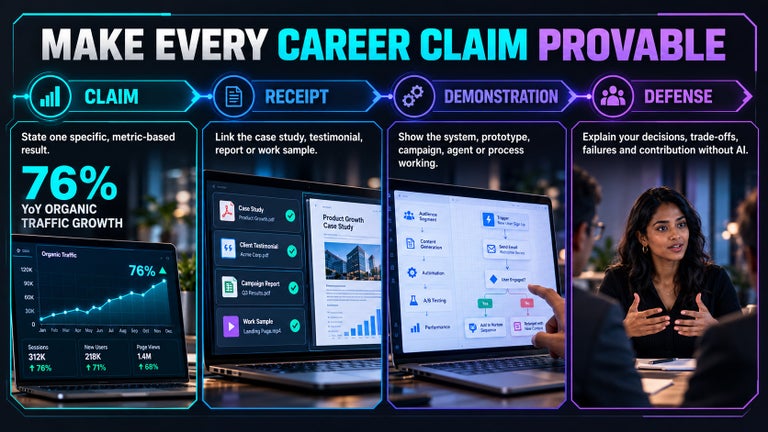
- Claims: Describe the specific, metric-based result you achieved. We know this one well – 76% YoY improvement in organic site traffic for example.
- Show receipts: Link to the case study, testimonial, metric reports or work sample supporting it.
- Demonstration: Show the system, prototype, campaign, agent or process in action. Ask and answer questions around the metric, then prove impact.
- Defense: Be ready to explain your decisions, trade-offs, failures and contribution without AI assistance.
Anyone can SAY they did a thing. Fewer and fewer people can prove it.
When your claims are verifiable because of your amazing online presence – recruiters and their agents have something meaty to inspect.
Start with a verification audit:
- Make sure your resume, LinkedIn and portfolio tell the same story
- Publish two or three strong case studies rather than fifteen thin ones
- Show the systems, prototypes or agents you’ve built in action
- Attach outcomes to your claims wherever confidentiality allows
- Remove broken links, abandoned demos and suspiciously heroic descriptions
- Ask trusted colleagues to validate work they’ve witnessed
- Delete any claim you can’t explain when the Wi-Fi goes down
And let me tell you, it’s not just recruiters using agents to find skilled people. It’s other people – who are looking for collaborators, folks to feature, and experts to quote.
People can’t discover, recommend, or expand on work they can’t see and verify.
Focus on beefing up your online presence to make it a powerhouse of verifiable credibility that makes you a safe hire. Your scout will do the rest.
Outwit Outpace Outlast: Job Hunting in 2026
We’re all trying to survive this new job hunt dystopia.
But relentless doesn’t mean reckless. You can build an AI agent that scouts the best jobs for you in a ruthless fashion – without going about it in an unethical way.
Octavius proved that autonomous agents effectively hunt for work. No human being can keep up. Upwork has shown us what happens when thousands of poorly conceived agents are released into the wild.
We can all do better than that.
Real opportunity lies between being uselessly manual and becoming part of the spam apocalypse.
To turn AI into a relentless remote job scout – you have to give it a better mission than ‘apply everywhere.’
Feed it a complete and well-rounded career brain brimming with skills. Set super hard rules around roles, skills, pay, location and platform behavior.
Let it find, filter, research and prepare you for your next step.

But don’t get lazy or frustrated. Don’t think volume will bring you your dream job. Recruiters are highly sensitive to fraud and your reputation is on the line.
Always keep key approvals, submissions and person-to-person contact for yourself!
Then, as your trusty scout watches the market for you – build the career capital that makes its discoveries useful. Your claims need to survive vigilant inspection.
This dual path to finding a job is the right way to get it done. It marries machine speed with human authenticity to create credible candidate leverage.
We’ve reached the point where every senior tech professional needs an AI scout – even when they’re happily employed.
No job search should begin with a layoff. Your agent can run as a permanent career radar, spotting and surfacing valuable roles, side gigs, changes in skill demand and unexpected lateral moves way before you need them.
Agents that are smarter and behave ethically will outperform the ones who adopt the spam cannon approach.
The global remote work arena is increasingly machine operated. You can’t do it alone, you can’t do it haphazardly and you definitely can’t do it as well when crisis strikes.
When machine-speed discovery meets human judgement, credibility and trust – you won’t have to worry about being unemployed for 6 months or sending 800 applications without a single interview.
With a scout that never sleeps – and an online profile built to convert, you’ll always be in the #1 position when that diamond role rolls round.
Outwit the spambots, outpace the market and build a reputation that outlasts the competition.
Similar post


Want to read more?
We have a lot more where that came from


 AI-first remote workers.