Contents
- 6 Ideas on Remote Work AI for Ambitious Tech Pros
- Part 1 – AI’s Only as Good as the Company Beneath It
- Part 2 – Remote Work Built The AI-Ready Company
- Part 3 - AI Adoption Is a Human Problem
- Part 4 – Rise of The AI Superuser
- Part 5 – AI Changes the Shape of Teams and Careers
- Part 6 - Ruined for the Ordinary
- Unlocking Your Own AI Superuser
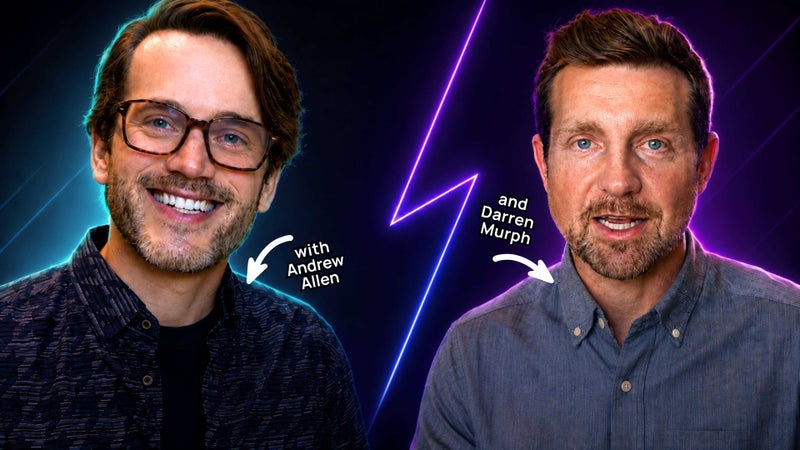
What makes a remote worker dangerous with AI? Andrew sat down with the oracle of remote work himself to find out what happens when remote expertise meets advanced AI leverage.
Darren Murph helped define the first era of distributed work.
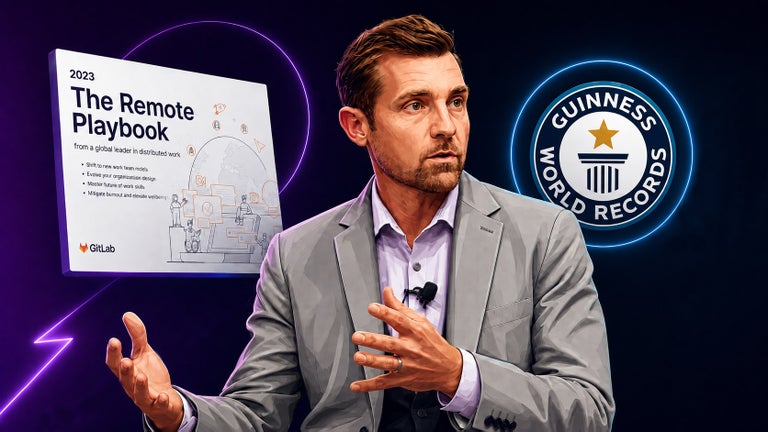
As GitLab’s Head of Remote (and the first person ever given that title), author of The Remote Work Playbook, and a Guinness World Record holder for the most blog posts ever written (pre-AI) – he’s spent years studying how extraordinary remote-first companies work.
Now, he believes those same companies are best positioned for the AI era.
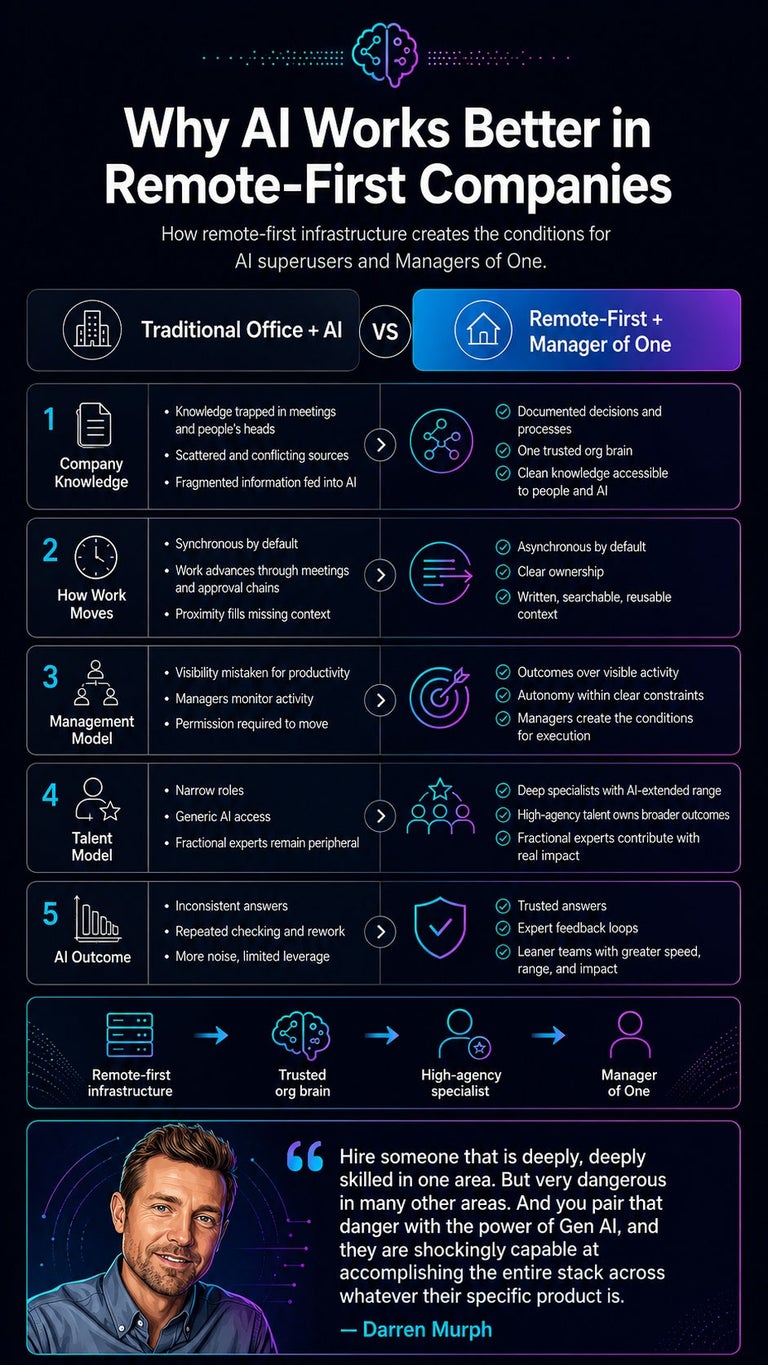
AI is exposing everything from scattered knowledge, undocumented off-the-cuff decisions, unclear ownership and rampant mistrust – everything traditional workplaces have been able to hide…until now.
Meanwhile, remote companies solved these issues early.
We learned to document knowledge like explorers in a new land, figured out how to communicate asynchronously and learned to trust our global colleagues without incessant micromanagement.
That uniquely autonomous ecosystem has created a new kind of high performer.
Darren calls them the Manager of One – a specialist with deep expertise, high agency and enough AI prowess to become dangerous across far more of the work stack. And by dangerous he means remarkably effective.
The good news is that it’s not a closed club. Any remote worker can be a member – if you understand the conditions required to become a Manager of One.
In this powerhouse interview, Andrew Allen sits down with Darren to explore why AI is underdelivering at the office, what remote companies understand that others don’t, and how ambitious remote professionals can build the skills to succeed in this exciting new era of AI-forward distributed work.

This is the future of living we’ve all been waiting for. Here are the main lessons Darren and Andrew discuss in the interview.
6 Ideas on Remote Work & AI for Ambitious Tech Pros
What if AI isn’t the main character – you are?
Most AI advice these days begins and ends with the same monotonous dialogue about the tools invading human spaces, minds and careers.
Like us, Darren sees beyond that. He starts with the company, the culture and the high-performing person using AI to crush it at work.
That changes everything!
When you’re back at the center of the story – a path unfolds – one we all have to walk. One Darren has walked extensively himself.
Now Head of Culture at Lovie.co, he is more qualified than most to explain what happens when remote work and AI collide, and what that means for the future of work.
Darren’s experience points to 6 defining ideas about where distributed work is heading and who will succeed inside it.
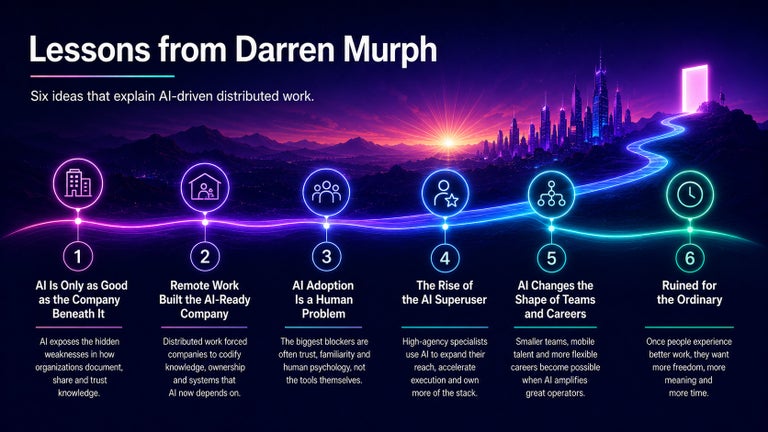
1: AI is Only as Good as the Company Beneath it
AI can’t create order if it doesn’t exist. It amplifies the documentation, human processes and knowledge systems at work inside the company – whether they’re brilliant, or a total shambles.
2: Remote Work Built the AI-Ready Company
Remote-first companies had to make work visible so it could be done. Decisions had to be documented to be used, and shared sources of truth created to keep teams moving. Those key principles now provide the infrastructure AI needs to deliver on its promises.
3: AI Adoption is a Human Problem
AI adoption doesn’t have much to do with difficult technology. Instead, it’s about leaders retreating to familiar habits when AI challenges their sense of control, trust and professional identity.
4: The Rise of the AI Superuser
High performers who work remotely are getting the most out of AI. The Manager of One is a deeply skilled specialist who uses AI to work across more of the stack. AI expands their expertise far and wide, way beyond what was possible before.
5: AI Changes the Shape of Teams (and Careers!)
AI allows smaller teams and solo operators to produce a LOT more. Leaders are more hands-on, talent goes mobile and careers swell beyond traditional roles and company structures.
6: Ruined for the Ordinary
Once people experience truly autonomous work, better systems and super-control over their time – the old model becomes darn-near impossible to tolerate. The end goal of AI-driven distributed work isn’t to create more, it’s to build a better life on your own terms.
Let’s unpack the 39 lessons behind these 6 ideas, and what they mean for remote workers who want to become a Manager of One.
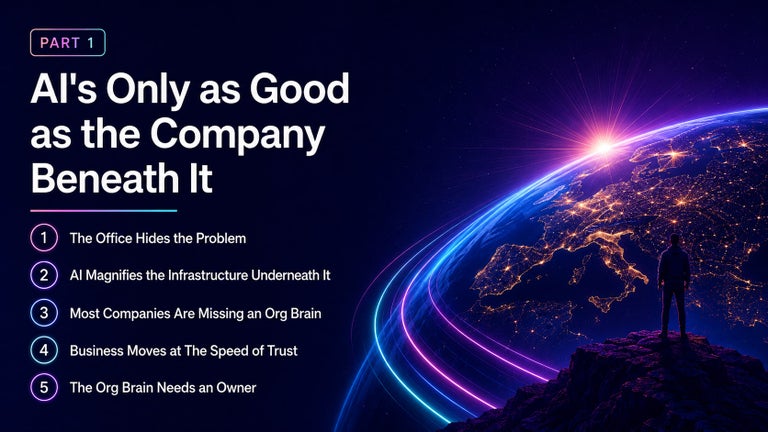
Part 1 – AI’s Only as Good as the Company Beneath It
AI can make any company better. Just add it as a layer of intelligence and enjoy the endless benefits. So many people still believe that this is a singular truth.
Darren doesn’t. In the interview he warns us that AI can’t magically rescue a company from itself and the way it already works.
It can only interpret, accelerate and amplify the knowledge systems that lie beneath it. For most companies this means trouble, for some it spells disaster! For a select few, it means record-breaking growth, in the blink of an eye.
Either way the truth remains – AI’s only as good as the company beneath it.
1. The Office Hides the Problem
Why doesn’t AI work as well for office-first companies?
“Organizations put [codifying how work happens and where work happens] on the back burner or ignored it entirely and used the office as a crutch. They’re really regretting that now in the world of AI, because if they’re layering these tools onto really shaky infrastructure, not a lot documented, all they’re getting are inferior answers and hallucinations.” – Darren Murph
For a long time, the office has allowed companies to function with weak infrastructure – substituting people for more efficient ways of working. By trapping information in conversations and endless meetings, bureaucratic red tape and a lingering mistrust of their hired workforce – it’s a place where a lot of dysfunction can be hidden.
Locking expertise and decisions inside individual heads has never been a great way to grow fast. When something goes wrong at the office, it’s the desk drive-by, team standup or conference room meeting hub that patches the gap.
Proximity at the office is often the accepted stand-in for expertise. Because of this a lot of office-based companies never codified their work. Decisions and accessible knowledge never made it to the page.
AI is now exposing the cost of this glaring infrastructure issue.
2. AI Magnifies the Infrastructure Underneath It
What happens when advanced AI meets a badly organized company?
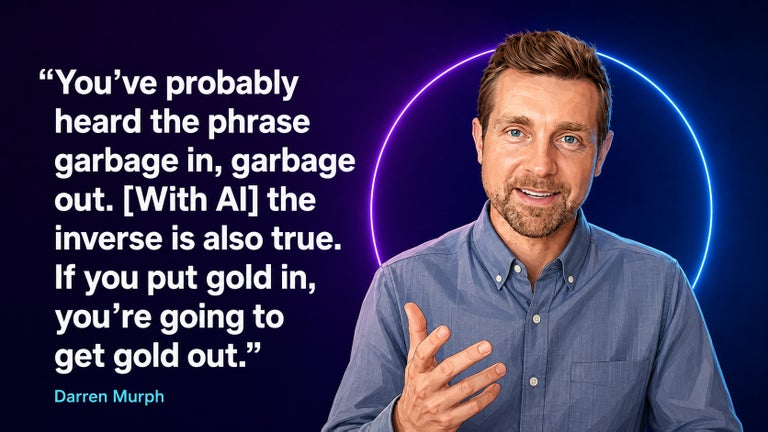
“You’ve probably heard the phrase garbage in, garbage out. But the inverse is also true. If you put gold in, you’re going to get gold out.” - Darren Murph
AI doesn’t show up on your company doorstep pretrained in how your company works, how each person in your department thinks and how everything fits together. It can only read the information, systems and processes available to it.
In a lot of cases…there’s not a lot to go on.
When this extremely important knowledge is in bits and pieces, is outdated or is valiantly contradictory – AI doesn’t clean it up for you, like a digital maid. It just builds crumbling walls on top of a suspicious structure, then plasters and paints over the flaws.
Before you’ve realized what’s happened, those weaknesses are returned at blinding speed, dressed in answers convincing enough to look usable (they aren’t).
It’s the reason why so many companies that have invested heavily in AI, are seeing disappointing results. They literally built the house without fixing the foundation.
With weak infrastructure, your company is going to produce faster confusion, greater mistrust and super pricey disappointment.
Know how your company works before betting your career on how it uses AI. Don’t chase AI skyscrapers inside an organization whose foundations are already collapsing.
3. Most Companies Are Missing an Org Brain
Can your company answer its own questions without asking its people?
“For organizations that didn’t do the hard work of building structure and clarity, if they’re just layering on these AI note-takers, but not being thoughtful about where this information goes, they’re not actually building what I call an org brain, this kind of collective brain that the entire organization can tap into. It just becomes chaos and noise in a different form.” - Darren Murph
In the interview Darren describes an ‘org brain’ as the collective intelligence of a company – organized so both people AND AI can find, understand and trust it.
It’s not a wall cabinet brimming with old documents in plastic sleeves. It’s not a comprehensive Google Drive of meeting transcripts. And it’s definitely not an AI note-taker dumping raw text into 10 separate, unconnected platforms.
A real org brain needs structure and access.
It has to have clear sources of truth, current information and consensus on where important knowledge should live. Without that – companies are just building bigger haystacks. When the time comes to find the needle, they’re lost.
It doesn’t serve anyone to focus on volume.
You need the ability to find – and contribute to - the right information, at the right time for the ultimate goal of driving work forward. No blockers.
4. Business Moves at The Speed of Trust
Is AI useful if nobody trusts it?
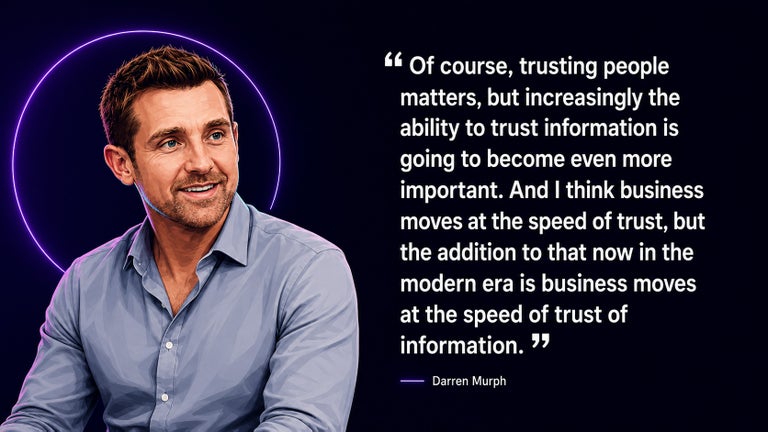
“Of course, trusting people matters, but increasingly the ability to trust information is going to become even more important. And I think business moves at the speed of trust, but the addition to that now in the modern era is business moves at the speed of trust of information.” - Darren Murph
AI can only exert influence and create leverage when everyone trusts the knowledge behind the results.
It’s no secret that people distrust AI – what with its rampant hallucinations, inaccuracies and ability to go off on tangents on a whim.
If every single answer has to be checked against a stack of conflicting documents, a policy from the early nineties, and an employee who worked at the company (but has since moved on) 4 years ago – then efficiency is lost.
AI becomes an additional workload, instead of lightening the existing one. They’ve proven AI easily cranks up your workload if it’s used incorrectly.
Andrew believes it’s part of the same trust issue:
“I find myself wondering if it's the same a variation of the same thing. The idea of this core trust issue. How do I trust something that I can't see? How do I trust something that I can't micromanage being at the at the root of why some of these companies are able to see other companies succeeding and yet unable to replicate those successes because of what they're unwilling to give up.” - Andrew Allen
It’s true, companies resist remote work because leadership can’t see that the work is happening. Now, many are resisting AI because they can’t personally control every step behind the results. Oof.
If you can’t build systems that make trust possible, AI is never going to work for your company. It will only ever add to the workload.
Make sure that your company is building trusted systems that people can act on autonomously, so that you can use AI to its maximum potential.
5. The Org Brain Needs an Owner
Who’s responsible for keeping the company’s intelligence…intelligent?
“Surely that is important enough to have someone, whether it’s a chief AI officer or a head of remote or a chief documentation officer, someone that is looking after this incredibly precious resource, which is the collective intelligence of the entire organization.” - Darren Murph
Interestingly an org brain can’t be everyone’s responsibility and nobody’s job. Someone has to own the sources, keep the intelligence fresh and current, and decide what people and AI can trust.
The title matters far less than the accountability factor. Without clear ownership – collective intelligence can descend into collective clutter.
Ambitious tech pros would do well to work in companies that treat knowledge as infrastructure, not digital admin. Your personal AI advantage is fused to the quality of information someone should be responsible for protecting.
There’s a nice twist to this story – the companies that ARE best prepared for this AI future, are the ones who already learned how to work outside of the modern office.
Because they had to.
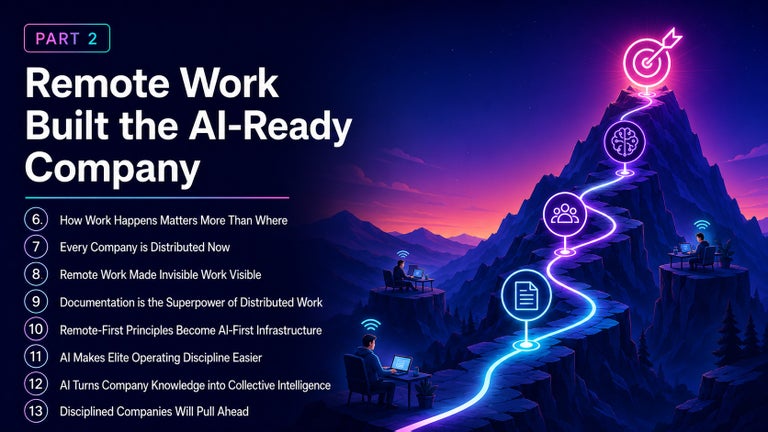
Part 2 – Remote Work Built The AI-Ready Company
Remote-first companies spent literal years building the operating discipline AI rewards now. Clearer systems, stronger autonomy and fewer dependencies on office proximity gave distributed teams an early advantage.
Darren’s argument is that AI has turned that advantage into infrastructure.
It’s not a coincidence that the companies that learned to operate well remotely are now streaking ahead with AI.
The head start is because they built AI-ready companies.
6. How Work Happens Matters More Than Where
Who cares where work gets done.
“Why does how work happens matter more than where it happens?” – Darren Murph
A bad company still hobbles along whether it’s remote, hybrid or office-based. Location really doesn’t do anything to fix murky ownership or tenuous systems. Any company can be poorly structured and unable to tap into the raw power of advanced AI.
Working in a well-run remote company gives you a major AI advantage, just like working in a disorganized company that can’t make AI work will harm your career.
Judge a remote role by its operating system – not its location policy.
7. Every Company is Distributed Now
Is an office-first company even office-based anymore?
“It's really built on this thesis that in the modern era, every company at scale is a distributed company, whether they want to identify as such or not. Even if you have two offices, let's say one in Sydney and one in Los Angeles, those offices are remote to each other.” - Darren Murph
Hot take – all companies are distributed companies.
Teams split across offices, floors, regions, departments and time zones still depend on efficient distributed systems. As Andrew points out in the interview, you can work one floor away from someone you’ve never met.
Companies that outright dismiss remote-first practices are often more distributed than they want to admit (or even realize). They just don’t have the infrastructure to do it well.
Remote-first practices matter everywhere – remote company or not.
8. Remote Work Made Invisible Work Visible
What changes when the office can’t fill in the gaps?
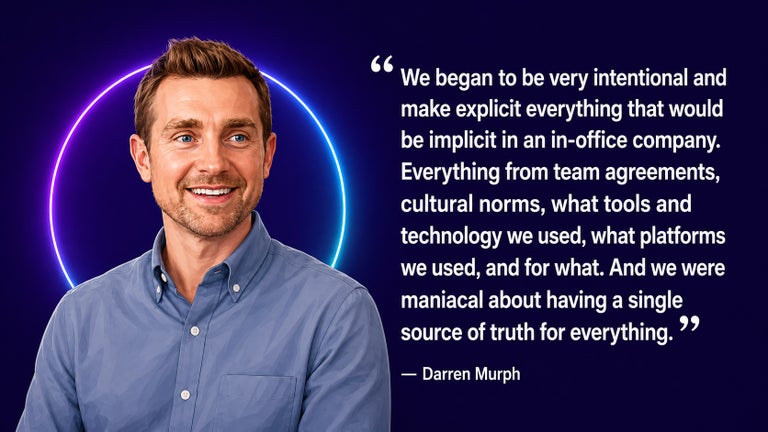
“We began to be very intentional and make explicit everything that would be implicit in an in-office company. Everything from team agreements, cultural norms, what tools and technology we used, what platforms we used, and for what. And we were maniacal about having a single source of truth for everything." - Darren Murph
Embracing distributed work urges teams to think about, discuss and align cultural norms, tool choices, responsibilities and decision-making – the kind that offices regularly leave unspoken.
When you pull the mechanics of work into the light and it becomes visible in all of its glory – it suddenly becomes easier to improve, expand, update and yes…automate.
Codifying work meant improving:
- Async communication
- Written context
- Single sources of truth
- Outcome-based management
Make your decisions and progress easy to follow, visible work always travels further and does more.
9. Documentation is the Superpower of Distributed Work
When everyone has access, anything is possible.
“In a distributed team, documentation is the lifeblood, it's the superpower of any distributed team. You have to write these things down if you want to scale them across time zones and countries.” - Darren Murph
Great documentation lets knowledge travel freely without meetings, memory or Mohindra from IT. That means your impact continues even when you’re not online, and you’re not working.
Because your work becomes reusable, searchable and easier to transform into things that matter.
Take documentation seriously, it will make you more valuable than the person everyone has to interrupt to get bits of knowledge from.
10. Remote-First Principles Become AI-First Infrastructure
Why do remote-first companies get more out of AI?
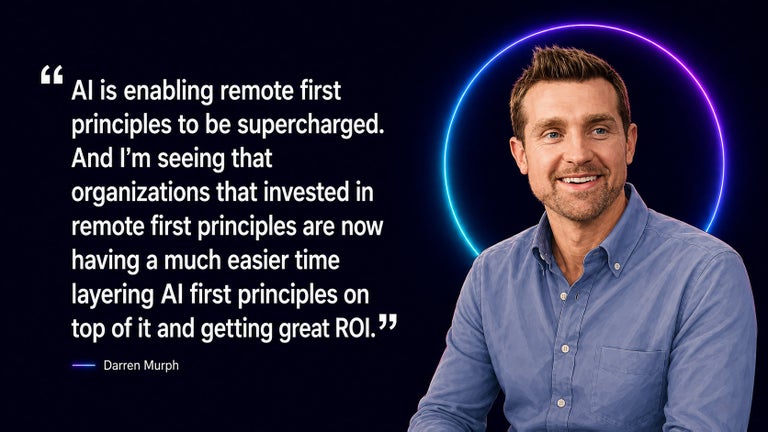
“AI is enabling remote first principles to be supercharged. And I'm seeing that organizations that invested in remote first principles are now having a much easier time layering AI first principles on top of it and getting great ROI.” - Darren Murph
Quite incidentally, the same principles that make remote work companies great, also make adding AI significantly easier.
AI demands the same things distributed teams need to function well – codified processes, accessible know-how, reliable sources of truth to draw from and crystal clear ownership.
As it turns out remote companies were winning this war long before AI made it an essential practice. That’s why you often find remote company systems are faster and more accurate when automation is applied.
The habits necessary for first-class remote work are core AI skills.
11. AI Makes Elite Operating Discipline Easier
What if excellent workplace habits don’t require significant effort?
“To boil it all the way down, it's just so much easier to be an elite company now.” – Darren Murph
Once upon a time, elite operating discipline required extreme admin - comprehensive manually taken meeting notes, meticulously drafted and shared agendas, intricate knowledge updates and reporting – and action items born from extensive analysis.
AI can do all of that automatically now, capturing and organizing information with far less manual effort from you or your team. All that remains is your quality bar.
Use AI to remove operational drag (not the discipline that makes your work excellent).
12. AI Turns Company Knowledge into Collective Intelligence
What becomes possible when company knowledge stops vanishing?
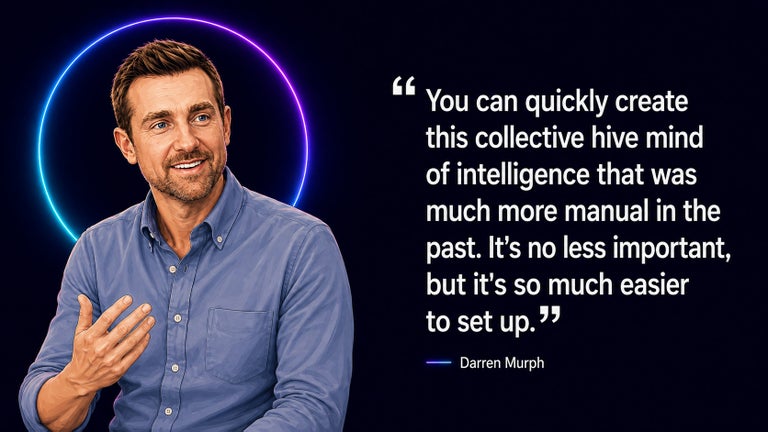
“You can quickly create this collective hive mind of intelligence that was much more manual in the past. It's no less important, but it's so much easier to set up.” - Darren Murph
We call it a second brain, Darren calls it an org brain.
It’s what happens when meeting decisions, expertise and project context flows into a trusted knowledge hub. Then one person’s expertise becomes available to everyone in the company, at any time – on demand.
AI can automatically:
- Capture your decisions
- Organize personal and team knowledge
- Summarize your activity
- Retrieve context
AI can stitch together the hive-mind intelligence across departments and make it usable at speed. But this only happens when the system is intentionally designed that way!
When you work inside a company contributing to a collective intelligence, you and your team get smarter with every goal you achieve.
13. Disciplined Companies Will Pull Ahead
What separates companies experimenting with AI from those succeeding with it?
“The most disciplined, the most intentional companies are always going to run circles around those that are less efficient.” - Darren Murph
Sure, AI absolutely makes your systems faster, but it doesn’t solve the problem of consistency. Without people buying into AI and using the tools correctly, setting clear behaviors and aligning on processes, it can only go so far.
Genuine advantage comes from a lethal combo of modern technology and old-school operating discipline.
Choose companies where AI is embedded in how work happens (not where), to get the most out of your distributed job.
Remote companies built the best infrastructure, but that alone won’t pull off successful AI transformation – no, no! The real challenge, is getting your people to trust it.
Part 3 - AI Adoption Is a Human Problem
A lot of people aren’t sure about AI. And it’s not because the tech is so hard, nobody knows what’s going on (though experts love to claim that’s the case).
AI adoption stalls for profoundly human reasons. Fear, comfort and control keep pulling companies back toward the systems they already know and use.
Darren insists that transformation fails when leaders treat psychology as a side issue.
Technology can be life-changing, but people still need to understand it, trust it and see themselves inside the change it brings. A lot of the time, they don’t.
AI adoption succeeds when people trust positive change enough to leave the familiar behind.
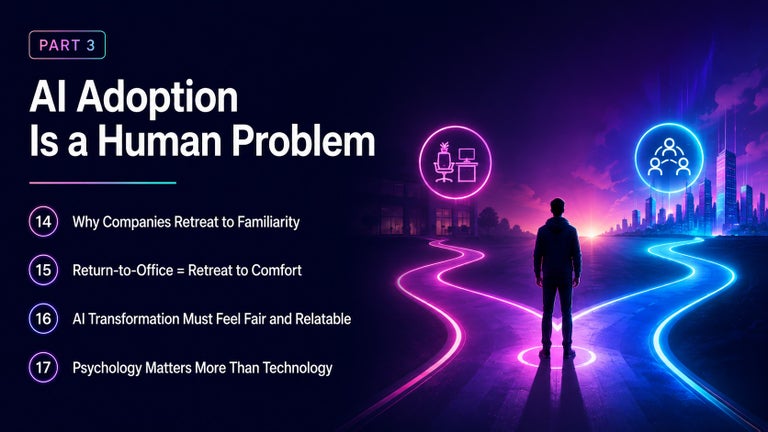
14. Why Companies Retreat to Familiarity
Why do companies abandon progress they fought hard to achieve?
“Turns out there's an actual phrase for this, complexity theory, which essentially states that humans can only stay in a state of uncertainty or chaos for so long before there's an involuntary reflex to go back to the last known state of familiarity, even if in their logical mind they know that it's going backwards and not making progress. Because they will still choose comfort over uncertainty and progress.” – Darren Murph
In the interview, Darren explains the concept of complexity theory – a baffling pattern that emerges when folks know the old way is worse - but they still retreat to it.
Uncertainty can last too long, and it bothers people. When it does, familiarity can feel like a safer bet than ongoing improvement and a never-ending learning curve.
The step back isn’t always a logical one – it’s more a psychological reflex.
Transformation on this (forgive me) unprecedented scale, has a lot of drawbacks. The new system can be working okay, but causing issues. People reach their tolerance limit, and without support, clarity or leadership – they head for the hills.
Look at companies rejecting or turning away from AI. Examine them to understand whether the decision was grounded in evidence or the need for leaders to return to what they already know.
15. Return-to-Office = Retreat to Comfort
What if return-to-office (RTO) was never really about collaboration at all?
“It explains so much about why companies are saying we’re going to go back to the old way in the name of culture and collaboration. It’s not that. It’s in the name of comfort and familiarity.” – Darren Murph
Darren applies this psychological reflex directly to RTO.
After years of disruption, a ton of tech leaders returned to the last operating model that felt coherent. They wanted their people back in buildings, working visibly, where they could control things directly – because they were there.
Comfort is a red flag if you want to become a highly paid, AI-fueled remote leader. It’s where progress goes to die.
So, consider RTO mandates carefully, they could be a barrier to progress in your tech career.
16. AI Transformation Must Feel Fair and Relatable
Why do folks feel threatened by an AI rollout?
“Make remote and AI feel relatable. Make it feel fair. Give people enough clarity so that they can feel certain about it. That's why this isn't working in the organizations that it’s in. It really has nothing to do with - is remote good or bad, or is AI good or bad. It works in the right construct.” – Darren Murph
Darren tells Andrew about Dr David Rock’s SCARF model, which neatly explains how workplace experiences can influence people towards either reward, or threat.
Three dimensions become particularly important during AI transformation:
- Certainty: Folks need to understand exactly what’s changing, why it’s changing and what happens next.
- Relatedness: They need to connect the technology to their real work and recognize a place for themselves inside the future being presented to them.
- Fairness: And they need confidence that AI isn’t being used to secretly ferret away opportunity or move the goalposts without warning.
When all 3 of these are threatened, resistance is quite predictable. The tech workforce at large isn’t necessarily rejecting AI itself.
They may be reacting to a botched implementation that makes the future feel confusing, alien and totally stacked against them.
Don’t judge AI based on the tools being rolled out. Judge it by whether you’re being given enough clarity, context, direction and agency to use it well.
17. Psychology Matters More Than Technology
What if the most difficult part of AI transformation has nothing to do with AI?
“What I'm starting to see here is the human psychology of all of this is actually way more important than the technology side of this. The implementation of it and the narrative around it is so important because it's being rolled out to humans, not to robots.” - Darren Murph
It’s true - your AI tech can be on point, but the transformation can still fail miserably.
Darren says that above all, people need the WHY explained to them. They need AI to feel relatable, fair and certain enough to engage with – rather than defend themselves against. Don’t forget, every other news outlet is saying ‘AI will take your job.’
A lot of companies misdiagnose the whole issue. They see hesitation as resistance to innovation, and in response they pile on even more tools, intensifying pressure and yet another training session.
It’s the lobster in the pot syndrome – only they’re slowly boiling away their workers’ desire to use AI in any form.
You can’t expect a technical response to magically fix a psychological threat.
Your AI advantage grows fastest inside companies that treat adoption as a people problem - not another software rollout.
But once the conditions are right…the advantage does shift to the people who know how to turn AI into exceptional personal leverage.
That’s where you come in.
Part 4 – Rise of The AI Superuser
Some remote workers are taking AI to new heights.
While everyone else aimlessly stacks new tools and pumps out work – these high performers are doing something way more valuable…they’re becoming dramatically more effective at work.
AI superusers use their expertise to steer technology, instead of letting the technology steer their work. The difference is career-defining, that’s for sure.
Darren says that AI rewards people who already know how to think, make good decisions and work fast without waiting for constant direction.
We of course, agree.
That’s why so many AI superusers are high-performing remote workers.
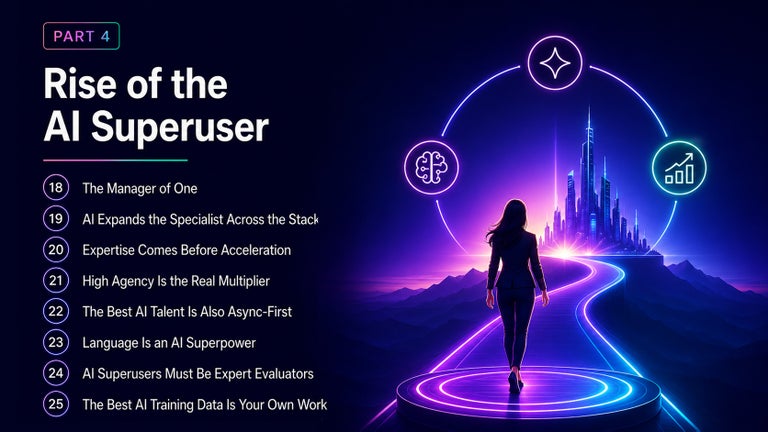
18. The Manager of One
What happens when a single person operates like an entire team?
“One of the cultural underpinnings [at Lovie] is this concept of a manager of one, which is you hire someone that is deeply, deeply skilled in one area. But very dangerous in many other areas.” - Darren Murph
At Crossover, we’ve spoken about superagent achievers, extreme autonomy being an essential precursor to AI excellence, and what it takes to stay on top of AI progress.
The Manager of One isn’t any old trad-manager who has no team. And it’s not a generalist who is given AI and asked to be vaguely competent in 40 new areas.
Darren outlines this modern maverick clearly – it’s a high-agency specialist whose depth gives them supreme judgement – which AI can then extend across more of the work.
This person is self-directed. Self-governing. And extremely self-motivated.
They may be a world-class engineer, or designer, or writer – but capable enough in adjacent disciplines to realize big ideas, without constantly handing them between siloed and slow departments. They don’t need permission to build, they just do it.
A capable Manager of One has become one of the most in-demand people in tech right now because they use AI to its maximum potential. Conditions come together to create an AI superuser.
19. AI Expands the Specialist Across the Stack
What happens when an expert can touch nearly every part of the company?
“And you pair that danger with the power of Gen AI, and they are shockingly capable at accomplishing the entire stack across whatever their specific product is.” - Darren Murph
AI gives specialists serious reach.
It helps them research, prototype, analyze, communicate and execute across the stack – while their core expertise tells them what good looks like! AI literally removes the distance between the idea and the end result.
Use AI to extend your expertise beyond your job description, and make an impact in other parts of your company.
20. Expertise Comes Before Acceleration
Can AI make you exceptional in work you’ve never mastered?
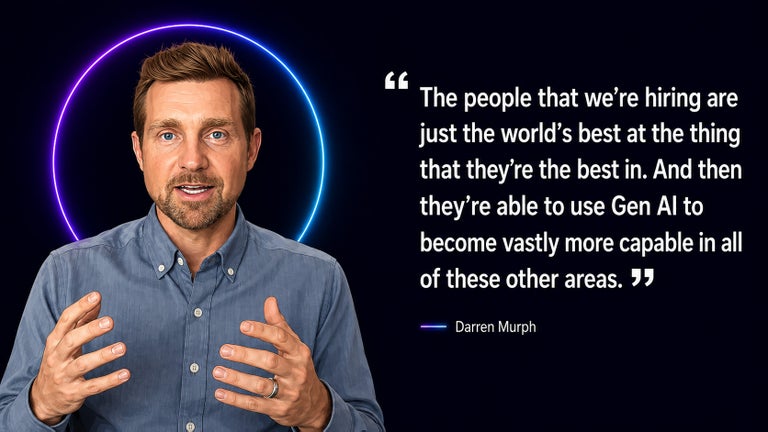
“The people that we're hiring are just the world's best at the thing that they're the best in. And then they're able to use Gen AI to become vastly more capable in all of these other areas.” – Darren Murph
Make no mistake, a Manager of One is powerful because their expertise is #1. They’re not a shallow generalist, it’s their specialist knowledge that gives them the edge.
It means they can:
- Direct AI with laser precision
- Spot weak work as it happens
- Evaluate the results (& improve them)
- Make stronger decisions
AI doesn’t manufacture what you know... it takes what you know and runs wild with it. Go deep first so that you know what excellent looks like.
21. High Agency Is the Real Multiplier
What if AI users can’t thrive unless they have total autonomy?
“If you if you hire high-agency people and you give them lots of autonomy to run really fast, and you give them great tools, lots of freedom - amazing things can happen.” - Darren Murph
High agency folks don’t need someone telling them how to execute.
Every layer of permission or approval just gets in the way. Pair this acute autonomy with AI and you get a multiplying effect. More, faster, bigger ways to act and make things happen in the world. Even if it means failing fast.
It goes the other way too – less agency means blockers multiply. So, make sure you’re on the right side of how you use these amazing tools.
Stop waiting to be managed, and see how far unrestricted AI will get you.
22. The Best AI Talent is also Async-First
Why does async thinking matter when you’re using AI?
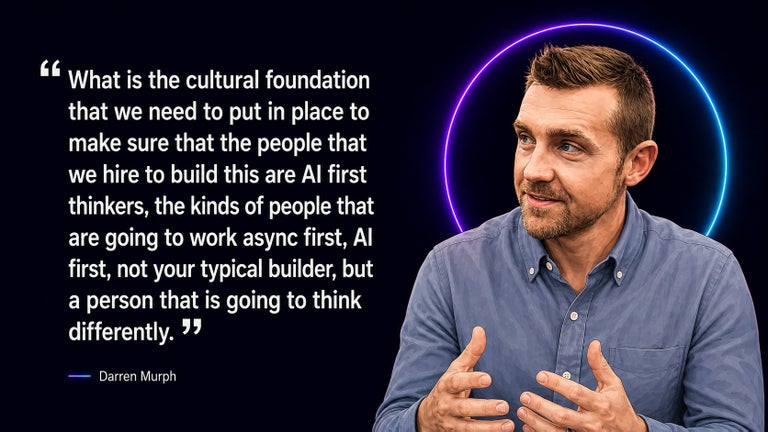
“What is the cultural foundation that we need to put in place to make sure that the people that we hire to build this are AI first thinkers, the kinds of people that are going to work async first, AI first, not your typical builder, but a person that is going to think differently.” - Darren Murph
Companies want remote-first Managers of One – they’re a rare breed. Darren’s sketched out what this ideal AI talent looks like and brings to the table.
These tech pros:
- Think asynchronously and autonomously
- They always document useful context
- They experiment without never-ending supervision
- They work beyond narrow role boundaries
- They are comfortable owning larger outcomes
Async-first people in tech already know how to structure information so work can continue without everyone being present. That same clarity makes them outstandingly effective with AI.
Learn to create work that people and AI can understand, continue and improve without needing you in the room.
23. Language Is an AI Superpower
What skill has the most value when you’re talking to machines?
“I think one of the dark horse superpowers of the next era is an expert command of language as it applies to prompting. Now, you're not just communicating to humans, you're communicating to LLMs. Take some time to research, learn a new audience. Then get really, really good at prompting and be able to convey what you want in a way that it will be most likely to deliver the output that you want.” - Darren Murph
Prompting is a machine language skill. Anyone can do it, few do it well. When you know how to express intent, context, constraints, rules and quality with enough clarity that machines can act on it without error – you have something special.
Language is an operating skill, so treat your LLMs like an audience that demands a specific kind of communication from you, and you’ll excel.
24. AI Superusers Must Be Expert Evaluators
What matters more than generating an impressive-looking answer?
“Become an expert evaluator. Whatever you get back, you're still going to need to validate. You still can't trust it entirely. Just like if you got work back from an agency or a colleague that you hadn't worked very long with before, you would still want to evaluate that work.” - Darren Murph
It’s never been easier to produce polished slop. But just because it looks good doesn’t mean it’s useful, accurate or holding any actual value.
AI superusers need to know how to evaluate output, based on their expertise. Understand what to question, test, remove, add and expand. Gain the ability to recognize when good isn’t good enough.
Hone your evaluation skill – generation creates options, but judgement creates value.
25. The Best AI Training Data is Your Own Work
What if you could clone yourself over and over again?
“The last step is building a skill for yourself. And so, I've spent a lot of time actually building a library of skills. I have enough written work that I can put all of that into an LLM and say, build a skill for the Darren Murph voice. There’s a lot of digital documentation that have your fingerprints on them. That is incredibly valuable.” - Darren Murph
Your work is your most valuable training data. Emails, articles, code, documented decisions and your completed projects – this is how your AI will understand how you think, and where your quality bar lies.
But feeding your AI inputs is only the start of your training journey. Creating feedback loops is how you’ll go from a 10X remote worker to a 100X operator.
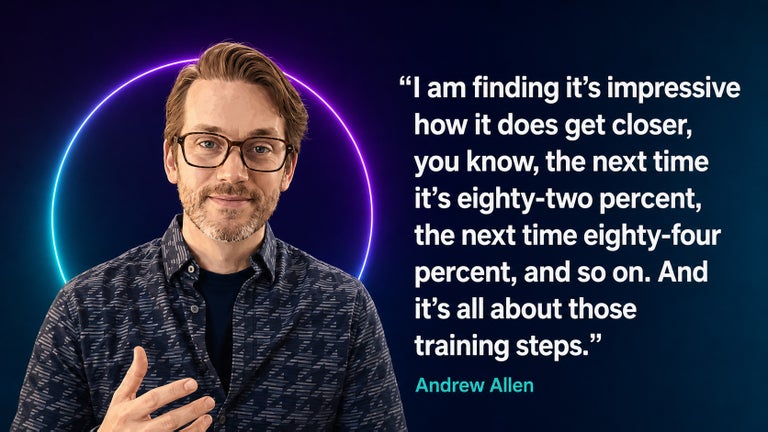
“Here's what I published. I want you to analyze the differences and understand that everything I changed was something that you failed at and figure out what you need to update your skills so that you'll get that right first time, next time. I am finding it's impressive how it does get closer, you know, the next time it's eighty-two percent, the next time eighty-four percent, and so on. And it's all about those training steps.” - Andrew Allen
Every edit, correction or update will train your AI. Refining your work via these tools is key – so that you inch closer to quality with every cycle. Eventually, instead of imitating your tone, it will compound your judgement and start really acting as your clone.
Treat your best work and every edit you make as training data for a system that should become more like you over time.
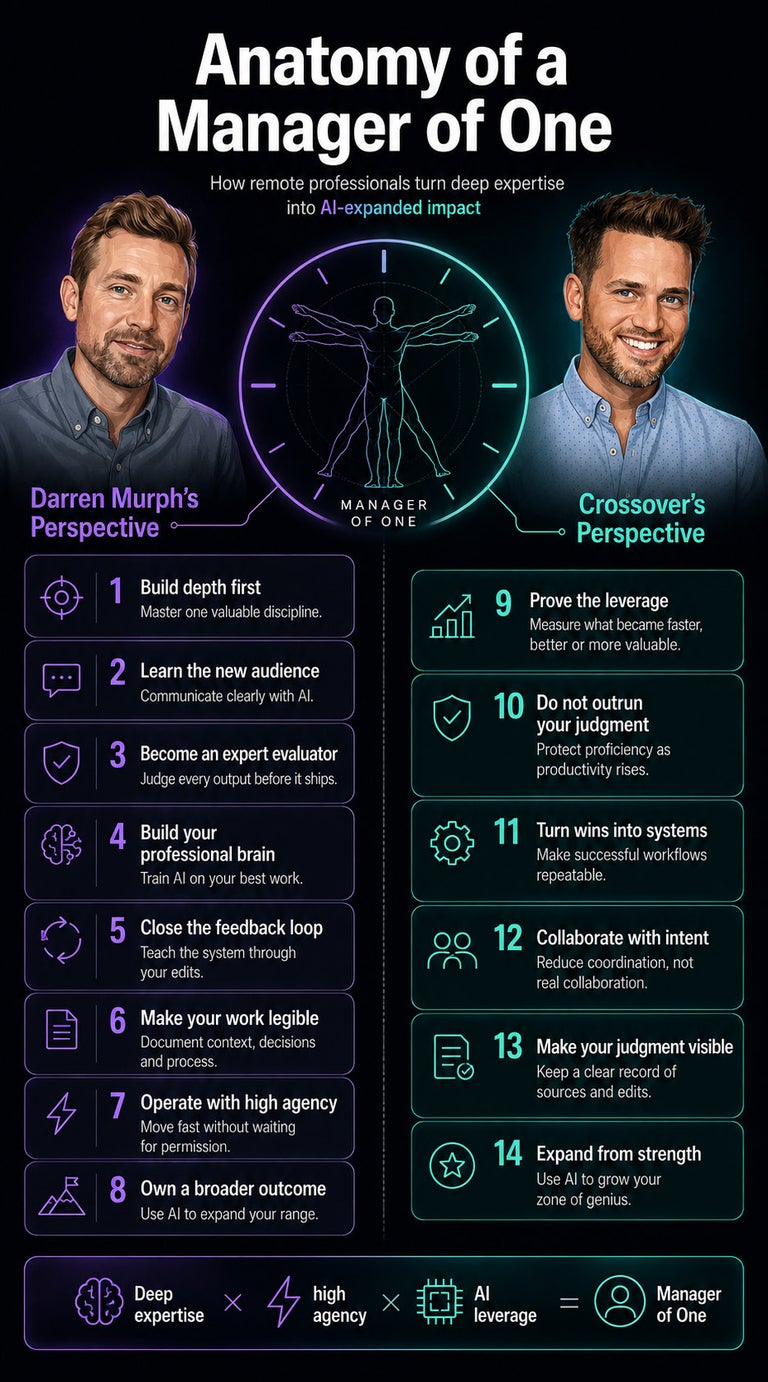
Here is the anatomy of an AI-powered Manager of One.
And you better believe - when one person can suddenly shoulder the work of many, the shape of teams, careers and companies changes around them.
This is what is happening.
Part 5 – AI Changes the Shape of Teams and Careers
There’s no denying it – AI has changed the way we work.
It shrinks the inimical distance between an idea, and the person capable of shipping it.
Small, lean teams can now move with the lightning speed and scope of teams 10 times their size. Leaders can stay directly involved in their nuts-and-bolts work, and solo workers can deliver impact that once needed a ton more support.
Darren believes that AI is fundamentally changing how teams are (and will be) built, how careers unfold and who exactly gets to create (and earn) in this future of superusers.
AI gives ambitious tech pros more ways to lead, build and earn beyond one job title.
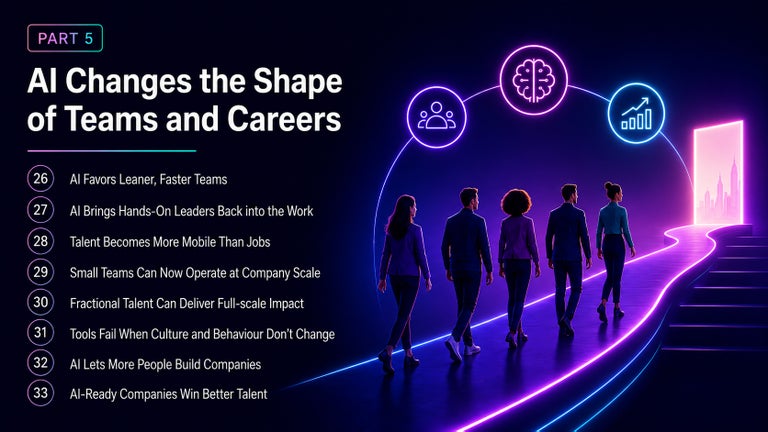
26. AI Favors Leaner, Faster Teams
What changes when a small team can create BIG results?
“It enables us to run a lean team that goes really fast, and we have a lot of fun. Lots of experimentation, lots of agency, lots of freedom. It's a glimpse into the future.” - Darren Murph
Lean teams have always been popular in tech, but now they’re lean without the size reduction drag on their end results.
Managers of One allow teams to stay as small as possible while super-expanding what they can accomplish. That means fewer handoffs, faster decisions and less people to coordinate. They also get to experiment quickly, before an opportunity disappears forever.
It’s your job to find roles where small teams (made up of Managers of One) are trusted, have supreme ownership and aren’t choked into mediocrity by micromanagers. The only thing better than 1 AI superuser, is a team of them!
27. AI Brings Hands-On Leaders Back into the Work
Does AI make hands-on leadership fun again?
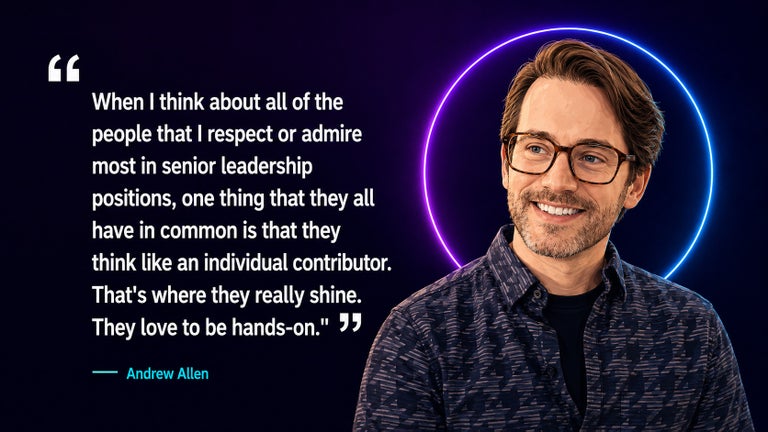
“When I think about all of the people that I respect or admire most in senior leadership positions, one thing that they all have in common is that they think like an individual contributor. That's where they really shine. They love to be hands-on, they're really good at what they do, and they're also good at, you know, strategic vision, leadership, and all those things that they need to do to steer. But they don't just want to steer, they actually want to row.” - Andrew Allen
Traditional job hierarchies force leaders to choose between being the visionary who shapes the strategy – and doing the work. AI squishes these roles together.
Senior tech pros can have the blue-sky idea, while sticking close enough to the product to know pretty much everything about it. And have a hand in it, on every level.
Build a career where leadership doesn’t force you to choose. Instead, it expands your influence and increases your contributions for higher impact work.
28. Talent Becomes More Mobile Than Jobs
Why should your expertise belong to only one company at a time?
“Look at talent mobility as an example, it has been really difficult for fractional and part-time individuals to deeply invest in a company and make an impact. You're full time or bust for the most part.” - Darren Murph
Darren speaks about meaningful influence at work here, and how for most of our modern working lives, that has meant decades of full-time commitment to one job. Anything less than that has kept talented folks on the outskirts of impact.
These days, AI and distributed infrastructure shake things up – making expertise a lot more portable.
Experienced tech pros can contribute deeply across many projects, companies and industries now, without having to squeeze their careers into one overly rigid job jar.
Think of your own expertise as a mobile asset, not something permanently attached to a single employer, job, or industry. Talent travels in the AI era.
29. Small Teams Can Now Operate at Company Scale
How big does a team need to be before it builds things of measurable value?
“You're going to have a lot more solo builders that are able to do things by themselves or in a small team that would have been impossible just five years ago.” - Darren Murph
AI drastically lowers the cost of realizing an idea – and turning it into a tangible product, service or company. Everything from research, strategy, marketing, development and ops is available to you now, and doesn’t need a dedicated hire right away.
One ultra capable AI superuser can test an idea before assembling a corporate army around it. The Manager of One can act as a high-performing employee, a fractional pro or a solo founder.
Don’t wait for a large team before proving that your idea has merit. Build it yourself and prove that it does. Then scale!
30. Fractional Talent Can Deliver Full-scale Impact
Can fewer hours create MORE value than a full-time job?
“I'm fractional with Lovie, but I'm making way more of an impact than I could in a full-time role without the help of Gen AI and without the culture of this being acceptable. There's infrastructure that enables people to plug in with fewer hours, but with way more impact now." - Darren Murph
In the old trad-work days, fractional arrangements were measured by the hour – which limited the impact a specialist could make. But now, with trusted knowledge, async workflows and advanced AI – a single superuser can influence strategy and execution without having to spend every work hour on one company.
Your future earning power doesn’t depend on the hours you put in, it depends on the quality of impact you can deliver.
31. Tools Fail When Culture and Behavior Don’t Change
Why doesn’t buying better AI = a better company?
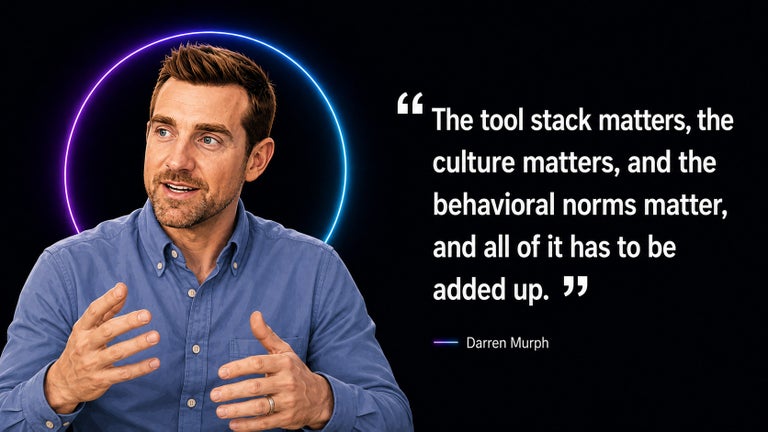
“The tool stack matters, the culture matters, and the behavioral norms matter, and all of it has to be added up.” - Darren Murph
You might be an AI genius trapped in a company with a poor culture that hoards information, blocks autonomy and rewards outdated behavior.
The best tools in the world can’t compensate for that.
You can only go so far without the freedom you need to innovate. Tech works when the team around you habitually documents their practices, shares context and trusts each other to use AI well. Buy great software, sure. But make sure the team around you has embraced true AI transformation if you want to get ahead.
Choose companies that genuinely change their behavior with AI. Too many expand their software bills and token use, as a pointless layer to tick a mandatory adoption box.
32. AI Lets More People Build Companies
What happens when you can realize your wildest ideas?
“I think one thing that you'll see in the age of Gen AI is it's going to enable a lot of people who have an idea and a dream, to step away from the ordinary and start their own company and launch something that they wouldn't have been able to do without the power of Gen AI.” – Darren Murph
A competent AI user can take a solid idea from start to finish in a few short weeks…on their own. An AI superuser, can do the same – faster, proving ROI and potential before investing more in growth or new hires. It’s never been so easy to build your own empire.
You don’t need vast capital investment right away, and you don’t need 50 weekends of additional work to get it off the ground. That means entrepreneurship has gone from a distant career detour to a likely move for many tech pros in the near future.
Your next company role might not exist yet – because you’re going to be the person to build it.
33. AI-Ready Companies Win Better Talent
Where will the most capable AI talent choose to work?
“They're going to have access to amazing talent that would otherwise be left on the sidelines. And so, I think it's a huge opportunity for organizations that embrace that.” - Darren Murph
Remote AI-ready companies can hire exceptional people who don’t fit the old fuddy-duddy, full-time, office-bound mold that limits tech potential.
They’ll attract fractional leaders, global specialists, solo builders and visionary Managers of One who want autonomy without surrendering impact.
More and more, we’ll see the top 1% in tech give their time, expertise and energy to companies flexible enough to use them in new ways. It’s a real talent advantage!
So, work where your capability matters more than your location, schedule or attachment to a traditional role. It will have a compounding impact on your career.
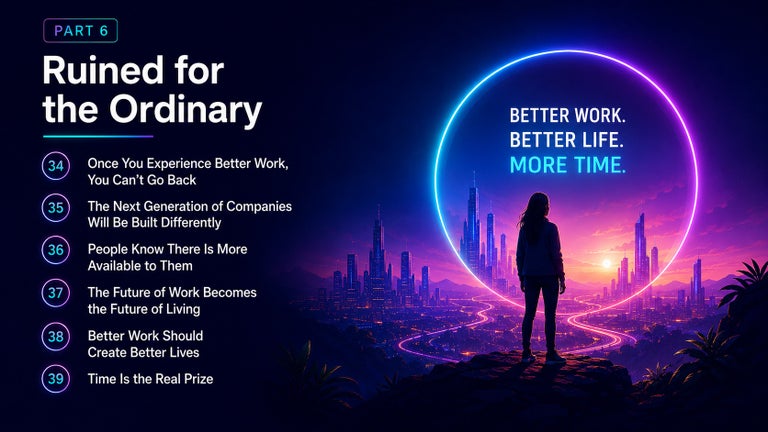
Part 6 - Ruined for the Ordinary
Better work changes your standards.
Once you’ve experienced authentic autonomy, whip-smart AI systems and mega-control over your time - traditional work starts to feel….too small to bear.
Darren’s point is that AI-driven distributed work will give you so much more than increased productivity or the ability to build bigger things inside a small job. It’ll create more freedom, better choices and a life that bends around what matters.
Once work gets better with AI, you’ll forever be ruined for the ordinary.
34. Once You Experience Better Work, You Can’t Go Back
What happens when extraordinary work resets your standards?
“When you have spent significant amounts of time in the extraordinary, you're kind of ruined for anything less than that.” - Darren Murph
When the conditions are right, and your team is brilliant, and the culture is AI-native and disciplined (and autonomous) – dysfunction in other jobs becomes impossible to ignore. You’ve seen what fantastic work looks and feels like.
You’ve experienced what it can do, given the right goals. Everything else becomes illogical, remnants of a time in your work history when you didn’t know any better.
But now, you do.
Better work gifts you a new quality bar and when that happens, the ordinary can’t hide beneath familiarity anymore.
Let your finest work experience define your standards – and reject the habits that most companies impose or accept.
35. The Next Generation of Companies Will Be Built Differently
Who will build the companies that will replace the old model?
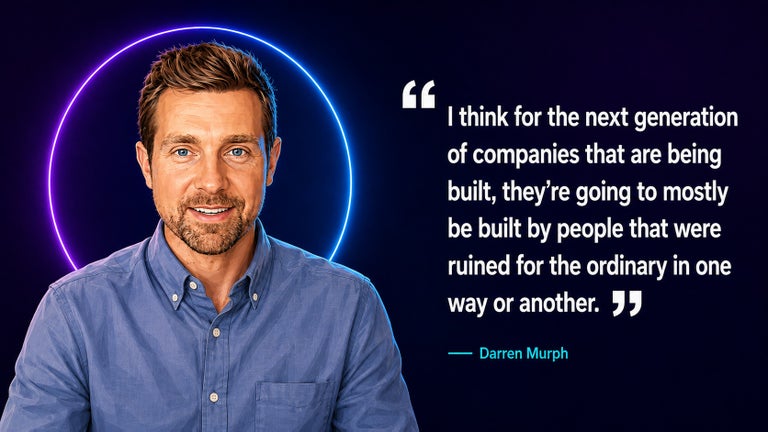
“I think for the next generation of companies that are being built, they're going to mostly be built by people that were ruined for the ordinary in one way or another.” – Darren Murph
Tech pros who have experienced better systems don’t want to recreate the sloggy bureaucracy that held them back. They just escaped it.
These Managers of One – the AI superusers who work remotely, they will build new companies around autonomy, documentation, global talent and AI-first workflows from day ONE.
Learn from extraordinary companies now, you could be building one tomorrow.
36. People Know There Is More Available to Them
What changes when you know a better way to work exists?
“I know there's more out there. I know that we can build this in a different way. And finally, we have the technology that's going to enable us to take a chance and bet on that.” – Darren Murph
Awareness creates restlessness. When you can see that smaller teams, autonomous careers and AI-forward companies are possible – it becomes nearly impossible to stay and operate inside a broken system.
When you do, it’s a choice instead of something inevitable. AI helps you understand that you have knowledge to act on.
So act.
Don’t confuse the most familiar career path with the best one available to you now.
37. The Future of Work Becomes the Future of Living
What if better work is only the beginning?
“I really think the future of work is going to be relabeled the future of living. I think what we're building in the future of work is a means to a very different way of living.” - Darren Murph
Infinite productivity or turning people into machines is not the goal. Or if it is, it’s a really bad one. As a power couple, distributed work and AI gives folks so much more freedom.
Freedom over where they choose to live, what they contribute at work, who they spend time with and how their careers fit into the rest of their lives.
Work becomes infrastructure for living – instead of having to build our lives around a job that only sustains us. Darren insists that the future of work is the future of living, because the end goal is better life design.
Build a career to enhance your life, not pin it down.
39. Better Work Should Create Better Lives
What should you do with the freedom this creates?
“People are able to be more deliberate about where they live, the community the communities that they're involved in, make decisions to live closer to a national park, for example, or closer to family, for example, and still be able to plug their professional talents into an organization. We have access to this amazing technology. How do we use it to live better lives?” – Darren Murph
Darren wants you to ask yourself:
- How do you work more efficiently?
- How do you live differently?
- How do you involve yourself in society in ways you didn’t before?
When you embrace becoming a Manager of One in the AI era – your choices beyond the job become that much richer. Professional opportunity doesn’t have to steal you away from your friends, family, happiness or life purpose ever again.
Measure AI’s impact by what it gives back to YOUR life, not only what it adds to your workload.
39. Time Is the Real Prize
What’s the point of all of this AI progress?
“Today is really precious. The time that you have is really precious. How do you steward that time in a useful way?” – Darren Murph
Some tech pros will say higher income, others greater industry authority. Perhaps it’s a blend of aspects unique to your professional leanings.
The one thing we all need yesterday, is more time.
The true promise of being a Manager of One is gaining enough AI leverage to spend less of your life on unnecessary, uninspired, boring work – and more of it on something meaningful. Only you know what that could be for you.
Point is – AI will help you reclaim your time, if you’re deliberate about where that time goes. Build a 4-day workweek. An empire! A new technology that saves people.
But have the best time of your life doing it.
Unlocking Your Own AI Superuser
It was always in your best interests to become a Manager of One.
But now, with advanced AI in your corner it can break the chains that have held you tethered to a single job, industry or career.
Being highly productive and tool-capable is only half of your story.
You were always meant for more.
You can be a deeply skilled, high-agency operator that uses AI to extend your expert judgement across more of your company. You can work asynchronously, communicate with intention, evaluate with a ruthless eye and train your systems using the strongest possible data around – your own work.
But using AI like a pro will only get you so far…without the right environment.
AI needs trusted knowledge beneath it and remote-first systems that make your expertise visible. It needs human-centered adoption that gives the people around you the confidence to use it. And it needs autonomy to turn these ideal conditions into action.
When you can get all of these conditions in the same room together, something happens. A different career path becomes possible.
You can own much larger outcomes without having to manage a gigantic team. You can shift between employment, fractional work and entrepreneurship – or do all three at once. You can also build things with fewer resources, contribute to illustrious projects from anywhere and create real impact – way beyond your current job title.
That’s the opportunity Darren Murph wants you to see.
Don’t fall into the trap of becoming a faster version of the worker bee your job requires. Become the expert who sees further into the future – makes stronger decisions and carries exceptional work all the way from idea to outcome.
Isn’t it time to build a career so powerful with AI that no ordinary role can hold it?
Unlock your remote career in ways you never thought possible.
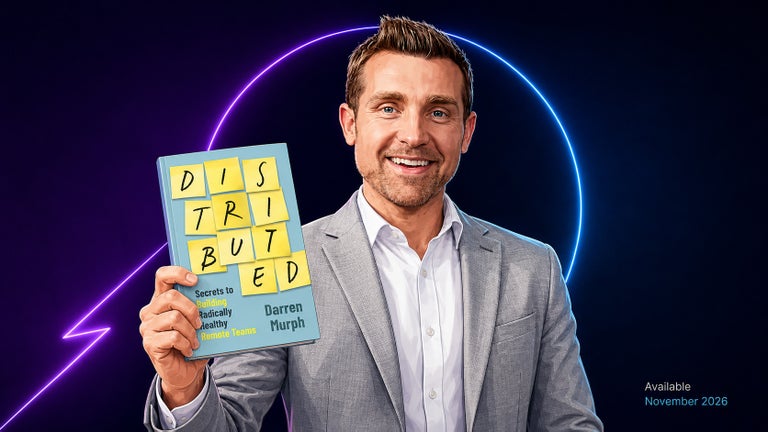
Darren Murph’s upcoming book Distributed: Secrets to Building Radically Healthy Remote Teams is available for pre-order now. Out in November 2026!
Similar post


Want to read more?
We have a lot more where that came from



 AI-first remote workers.