Contents
- The Rise of Worker-Built Shadow Apps
- Vibe Coding and The Personal App Explosion
- The Leadership Gap Inside Shadow AI
- #1: Bring Shadow Apps into The Light
- #2: Transfer Ownership Before the Tool Becomes Critical
- #3: Put a Production Gate Between Hacks and Systems
- The Shadow AI App Decision-Tree
- Leading in The Shadow AI Era
What happens when high performers stop waiting for better tools and start building their own? AI has turned non-coders into app builders almost overnight. Here’s why worker-built shadow apps are spreading fast, where the risks begin, and the three remote leadership moves that keep clever shortcuts from becoming company problems.
AI has made every remote worker a halfway decent coder.
But what happens when leaders realize they have swarms of apps, automations and workflows being created outside of the usual system protections?
This BYOAI (bring your own AI) culture has ushered in the age of employee-built personal apps, and without proper management this shadow AI could disrupt your remote team in ways you didn’t see coming.
The vibes are off.
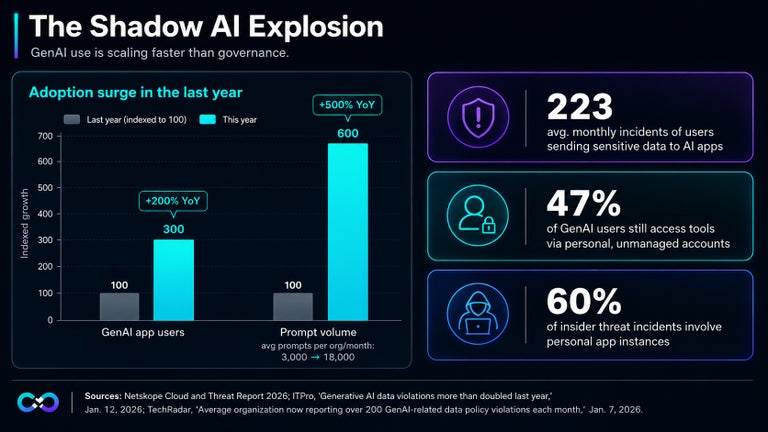
According to the latest data, GenAI is scaling at work – hard.
Users are up 200% YoY, prompt volumes are up 500% YoY, and organizations are seeing an average of 223 incidents involving sensitive data being sent to AI apps.
Consider -
- 8 in 10 workers bring their own AI tools to work, outside of what IT knows about.
- 72% of enterprise GenAI use is shadow IT – which means the AI strategy is outside company governance.
- Cyberhaven says 39.7% of AI interactions involve sensitive data.
- Remote workers are more exposed to shadow IT patterns – with 81% using shadow IT compared to 71% of office workers.
We know people are all-in on AI adoption – that’s old news. The risk now is that AI use is scaling a heck-of-a-lot faster than AI governance.
In this article I’m going to talk about how Shadow AI apps spread, where the real risks begin, and the three leadership moves remote teams need now - visibility, ownership and production review.
The Rise of Worker-Built Shadow Apps
While your remote team is learning to harness the power of AI speed and efficiency – they’re also rewriting the rules of risk management. Your AI strategy is getting results, but those results might not be company-owned just yet.
It lives in personal accounts, private workflows, unapproved tools and weekend vibe-coded apps nobody really owns beyond the person who built them.
Shadow apps are what happen when employees use or build AI tools, models, apps, agents and workflows outside company visibility, ownership or review.
So, how do you govern AI when everyone on your team has their own tools, practices and processes? And more importantly – how do you manage the risk when experimental agents and apps suddenly become critical to your team functions?
When high performing remote workers (who are also non-coders) can build useful software of their own in days, in hours…this is when you need to act. Building faster than leadership can see, govern or transfer these apps is risky.
If you don’t know what your team has built you can’t protect, improve or keep it working when that team member gets promoted or leaves.
Shadow IT used to mean workers using unofficial tools. Shadow AI means they’re building unofficial systems. That’s a much bigger leadership problem.
Before the next impressive app automation or workflow becomes an integral part of how your team runs – ask the tough question. Is this a personal productivity tool, or has it become company infrastructure?
They’re not the same, and you need to define the difference.
Vibe Coding and The Personal App Explosion
For decades, software engineers were the builders of online apps.
Now – 63% of people vibe coding apps aren’t developers at all.
These non-developers lean heavily on no-code platforms and AI assistants to code for them. It speeds development time up by 90%, making simple app creation a breeze.
And we’re only at the gate of this castle. The market is projected to grow by an incredible 31.13% CAGR by 2034, turning an 8-billion-dollar industry into a 75 billion dollar one in a few years’ time.
Writing apps will be something everyone just does, and soon.
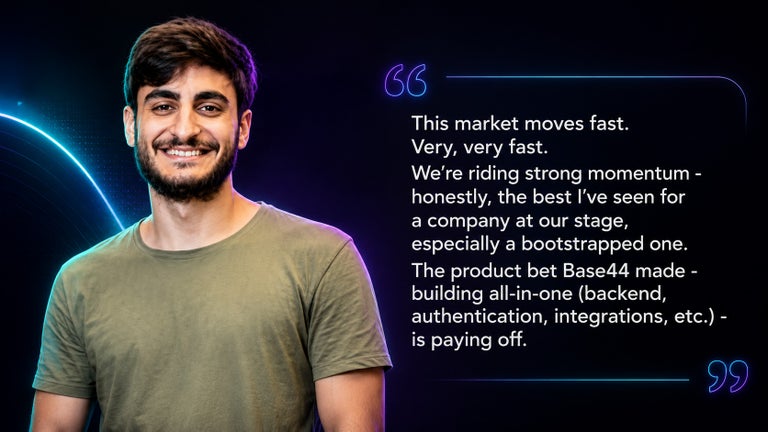
Look at Base44. This AI-powered no-code app builder got 250,000 users and sold to Wix for $80M just 5 months after it launched. Vibe-coded solo unicorns are already here!
Developers are tapping AI too, with 90% of them regularly using AI tools to code and accelerate their own workflows. So, the language of online creation is now democratized in a way that currently allows the best of us to build unimaginable things.
Coders can be 100X faster. Non-coders with specialist expertise are creating new and valuable things previously thought impossible.
The consensus is that AI has made coding ‘fast but flawed.’
Speed is not the same as reliability, you see. Early research into vibe coding shows the same pattern leaders should be watching for - rapid first wins, skipped QA, fragile code and a dangerous gap between what works and ‘oh yeah, this should run part of the business.’
In one controlled study, experienced developers authentically believed AI made them faster, when in reality measured task completion time moved the other way.
So, limitations exist, for now.
The Leadership Gap Inside Shadow AI
Shadow AI is fast-growing branch of Shadow IT.
When AI tools, models, apps and agents operate within the organization but without its knowledge, approval or oversight – risk is inevitable.
There’s no denying the fundamental way we work has changed forever.
Most recently this was acknowledged by the World Economic Forum who earmarked two types of human-led role for this era of AI execution. Roles that involve framing and design, and those that involve review and decision-making.
The AI work architect and the AI steward.
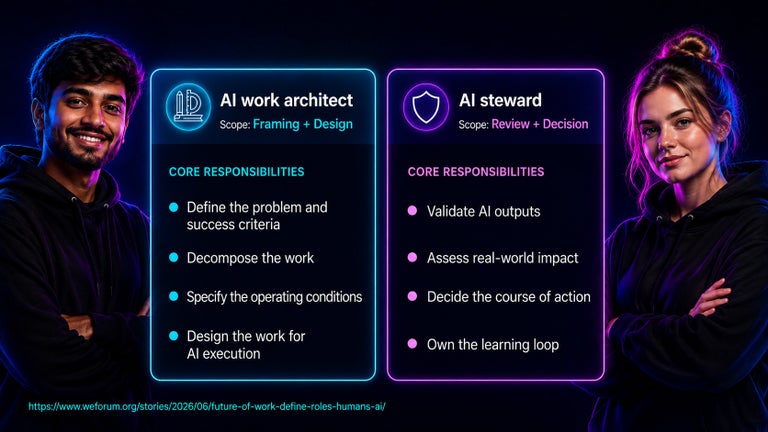
Why this matters right now is that we’re in the pre-clarification zone. The messy middle where both roles have been smooshed into the individual – the person on your team creating these shadow AI vibe-coded apps.
Most teams don’t know what good looks like…yet. That’s why these roles are key.
- An AI work architect designs the system before the AI runs. They define the workflow problem, success criteria, data boundaries, human checkpoints, risk limits and what should never be automated.
- An AI steward reviews what comes out the other side. They test whether the app is accurate, safe, policy-aligned, better than the current process and ready to stay personal, become a team tool or graduate into company infrastructure.
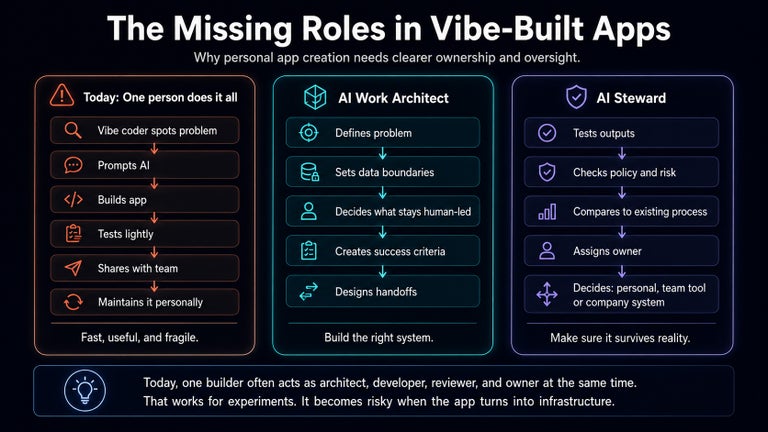
For now, remote leaders and teams have to muddle through these questions together. Making a lot of mistakes, creating a lot of random, not-very long lived or useful apps.
We can’t escape the fact that vibe-coding without architecture creates junk. And vibe-coding without stewardship creates risk.
That’s where we are now – coding away, solving problems en masse – and making trouble for ourselves with Shadow AI as we do it all.
So until these roles become normal, how do remote leaders reduce the risk right now?
#1: Bring Shadow Apps into The Light
You can’t manage tools if you don’t know they exist. The moment a tool is shared with the team for use, you need tool transparency.
Shadow AI doesn’t start out this nefarious monster, but it can creep in if left unchecked. Business Insider reported that mid-sizes companies have about 200 unsanctioned AI tools being used per 1000 workers.
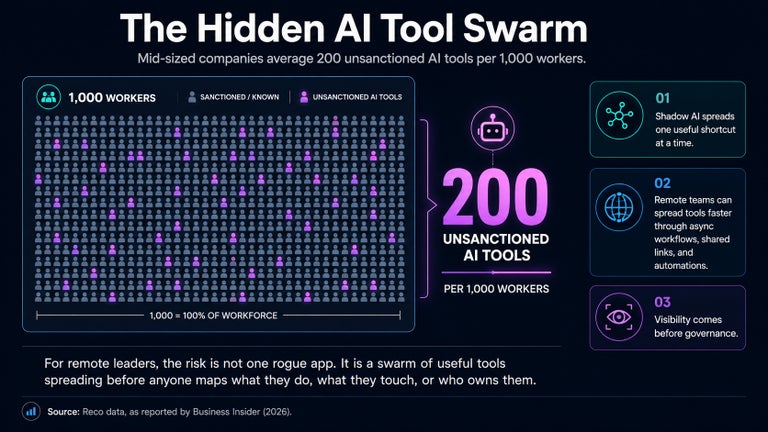
We’re not talking about a single faulty app here, we’re talking about app swarms that spread throughout your company before anyone has correctly mapped what they do, what they touch and who owns them.
Here’s what you risk:
- Visibility risk: You don’t know what personal apps, bots, automations or AI workflows exist across your team.
- Access risk: Apps might run through personal accounts, private API keys, browser extensions, personal drives or unmanaged AI tools.
- Data leakage risk: Sensitive information can be pasted, uploaded, processed or stored in AI tools the company doesn’t control.
- Duplication risk: Several people could build different tools to solve the same problem, creating conflicting workflows and super messy sources of truth.
- Remote scaling risk: Distributed teams will spread these tools faster because async work rewards shortcuts, templates, automations and shared links.
The moment a vibe-coded app, workflow or agentic system shifts to public use, you need to document:
- What AI tools, personal apps, bots, dashboards or automations are you using?
- Who built them?
- Who uses them?
- What workflow do they support?
- What data do they touch?
- What account owns them?
- What process did they replace?
- What breaks if they disappear?
Don’t treat these useful shadow apps as evil contraband. But it’s important to make visibility a cornerstone in your AI adoption strategy. If your team depends on it, they need the details.
That’s how you lift these tools from the shadows.
#2: Transfer Ownership Before the Tool Becomes Critical
Your team member can’t be the only person who understands, owns and keeps the tool alive if it’s shared use. You have to shift from personal to shared ownership.
The risks -
- Ownership risk: Your builder becomes the only person who understands the tool, maintains it, or knows where it lives.
- Continuity risk: When your builder leaves, goes on vacation, changes role or loses interest, the workflow can (and will) stop working.
- Documentation risk: Nobody records the prompts, logic, workflows, data sources, dependencies, edge cases or failure modes.
- Accountability risk: When something breaks, nobody knows who approved the tool, who owns the fix… or who is responsible for the janky outcome.
- Dependency risk: Teams may become dependent on a tool that was meant to be extremely temporary.
Once your app is visible and documented, you need to deal with who owns it. A shared AI app can be dangerous if it’s run through someone’s personal account, personal API keys, prompt libraries and workspaces.
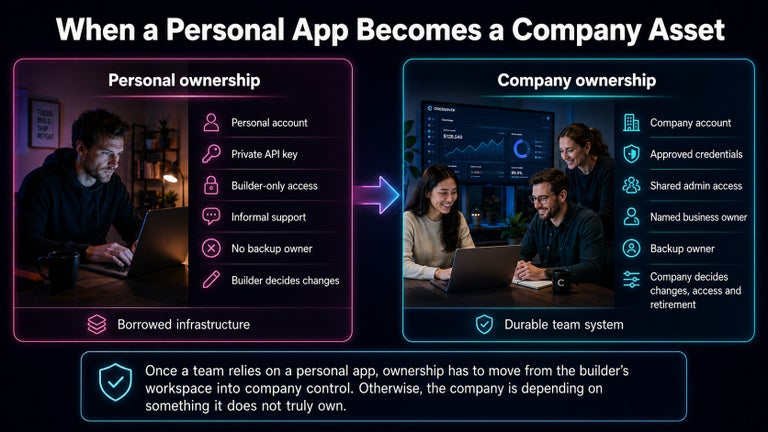
Here’s what you have to change:
- The account moves from personal to company controlled.
- Access moves from individual login to shared admin access.
- The builder moves from sole owner to technical or workflow lead.
- The manager or function lead becomes accountable for business use.
- A backup owner is assigned before anyone needs one.
- API keys, prompts, files and data sources move into approved company storage.
- The company decides who can edit, run, share, pause or retire the tool.
When we talk about AI scope creep, this often happens when a single app owner is forced to be a tools support desk, security reviewer and dev team all in one. But the builder shouldn’t retain ownership once the app is a company asset.
#3: Put a Production Gate Between Hacks and Systems
Useful hacks and shortcuts are too risky to keep personal when they replace real processes without security review. Know the difference and ratify it.
Moltbook went viral early this year after its creator said it was vibe-coded. The AI-agent social network had some serious security flaws! Wiz researchers discovered an exposed Supabase API key in the front-end JavaScript.
Who cares right?
Well, the key gave hackers access to production data, exposing 1.5 million API authentication tokens, 35,000 email addresses and private messages between agents. It was patched, but the lesson was learned.
Don’t deploy insecure code written purely by AI agents during vibe-coding. Once you’ve shifted your personal app to company ownership – you have to acknowledge some fundamental truths, namely that you’re not a coder and security risks are REAL.
- Permission risk: A small personal app may have broader access than intended, especially to shared docs, customer data, candidate data, finance files or internal systems.
- Process drift risk: A shadow AI app slowly replaces an approved process without anyone checking what controls, review steps or safeguards were lost.
- Quality risk: Vibe-built tools can look polished while producing wrong, outdated, biased, incomplete or unreliable outputs.
- Halo-effect risk: Non-coders may trust a slick AI-built app because it looks impressive, even if the logic underneath is trash.
- Security risk: Apps can include hardcoded credentials, exposed API keys, weak authentication, open databases or unsafe integrations.
- Compliance risk: Tools may process regulated data without the right privacy, retention, audit or consent controls.
- Brand risk: Vibe marketing tools can generate off-brand content, outdated claims, hallucinated facts or inconsistent messaging - at scale.
- Decision-risk: AI tools can influence hiring, pricing, customer support, reporting or prioritization without human review.
- Retirement risk: Old personal apps keep running after they are no longer needed, updated, accurate or safe.
- Innovation drag risk: Without a clear path from personal app to team tool to company system, remote leaders either let calamity spread or overcorrect and kill useful experimentation.
It’s great that your code solves problems, but that doesn’t mean it’s safe to run. There’s a reason why there’s a current boom in AI-literate dev hiring. We need senior devs to review these AI apps before secure deployment.
A vibe-coded app can look real, feel useful, and still carry a production-level security flaw in plain sight. And no-one wants to let the hackers in.
The fix is a production gate.
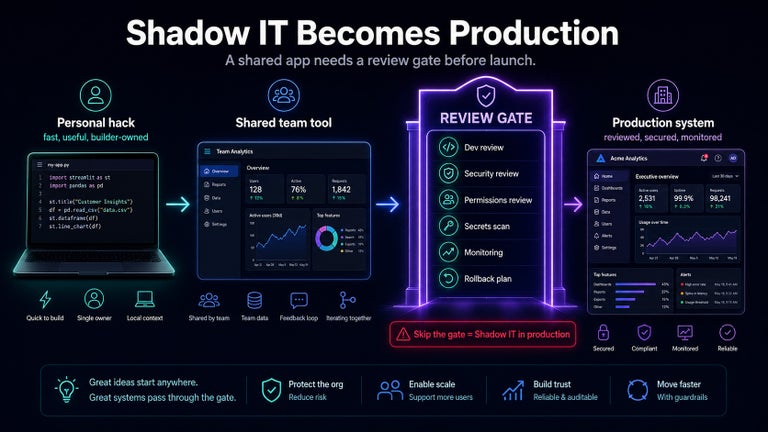
Before any vibe-built app becomes part of a shared workflow, leaders should ask:
- Has a real developer reviewed the code, logic and deployment setup?
- What automated AI agents are reviewing your code pre-deployment?
- Has someone checked authentication, permissions and access levels?
- Are API keys, secrets and credentials stored safely?
- Does the app use approved data sources?
- Does it have logging, monitoring and a rollback plan?
- Has the team tested real failure cases?
- Is there a clear owner for security, business use and retirement?
A properly governed system will earn the trust your originally vibe-coded app deserves. So don’t cripple your team by launching unreviewed code into the ether in the hopes that hackers won’t notice. They will.
The Shadow AI App Decision-Tree
AI has given us the gift of speed – what we do with it is up to us.
And by us, I mean the non-coding teams working with advanced AI – marketing, sales customer support, finance, and ops. Whatever sector you’re in, if you’re vibe coding at work, for work - this is your wake-up call to set key processes for your remote team.
Anyone can build personal AI apps to superpower their workflows now. Folks are building hundreds of these apps and agentic flows every quarter.
What lags sadly behind is governance. It can’t keep up.
But leadership is about seeing the trouble on the horizon and setting things in motion to avoid the worst of it. So even in these scrappy, messy build-fast and crush goals environments – we need to pepper in some common sense.
Speed is a gift, but it’s also the biggest risk because it means after deployment, scale will be the iceberg that sinks your titanic.
So, know the difference between your team’s personal app prototypes and the kind that are dipping their toes into unsecured waters.
Use this decision-tree:
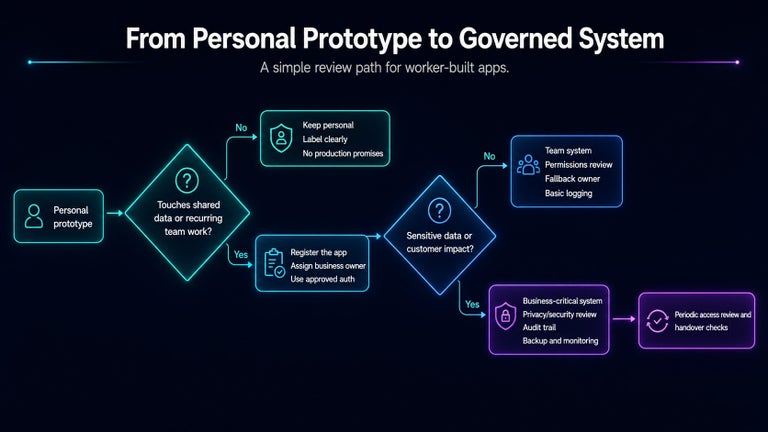
Some apps can stay personal, but others need ownership, review and security checks before they become part of how your team runs.
That’s the difference between scaling AI and scaling regret!
Leading in The Shadow AI Era
Shadow IT once meant team members sneakily using a hidden Saas tool to make a clunky, horrible process faster. Now, they’re building their own software using AI.
This shadow AI is bigger, faster and carries a load more risk.
We’ve gone from using secret tools to building them ourselves. Personal apps, vibe-coded workflows, agentic automations, dashboards, bots and shortcuts are cropping up every time we spot an inefficiency or minor issue.
It’s a good thing!
It’s diamond hard proof that your remote team is ambitious, adaptive and using AI in advanced ways. Turning problems into systems is the ultimate remote team flex.
But it needs careful leadership.
That means lifting personal apps out of the shadows. Transferring ownership before a tool becomes mission critical. And putting a production gate between clever hacks and real company systems.
Now you know when your teams vibe-coded apps should stay personal or be dragged into the light of day.
The future of work belongs to teams who can build fast AND govern like pros.
The hottest remote leadership skill right now isn’t just making things. It’s making things your company can trust.
Similar post


Want to read more?
We have a lot more where that came from



 AI-first remote workers.