Contents
- The Business Case for Unpaid Job Auditions
- Why Job Candidates Still Do Work For Free
- 3 Things to Consider Before Doing Unpaid Candidate Work
- Ignore The Work-for-Free Witch Hunt
Are unpaid job assignments proof of exploitation…or the price of competing for better work? Candidates are tired of ghosting, sprawling take-home projects, and companies fishing for free ideas - so the red flags and pitchforks are out. But treating every skills test like a scam can shut you out of the very roles worth fighting for. Today, we separate fair auditions from free-labor traps, explain why top tech companies need proof, and show you exactly when to say yes, when to walk, and when to ask who owns the work.
Never work for free.
It’s a catchy slogan we can all get behind, and one a lot of people on the internet have embraced lately. Everyone deserves to be paid for the time, expertise and care they put into their work – we can agree on that.
Especially if it’s during an interview process.
But that’s not what’s happening these days. Instead, job candidates are being treated as a source of free labor, made to endure multi-stage, weeks-long assignments with zero chance of pay at the end of a long arduous process.
You can understand why the red flags and pitchforks have come out en masse.
It’s unfair. It’s undignified. And it’s downright exploitative!
…Or is it?
Unpaid work is more complicated than LinkedIn thinks.
I fear that a liberal combination of AI-recommended sentiment from public opinion forums like Reddit, confirmation bias and curated rage-bait by one-track-minded algorithms, AND LLMs doing what they do best – disguising average opinion as absolute industry truth, has distorted things on the platform.
And it’s dangerous for high performers to buy into polarized thinking.
The other day I opened LinkedIn to a well-known tech expert exclaiming:
“I am never, EVER doing unpaid work for a job application again!”
Oof – emotions are high. Six months without work, dealing with companies ghosting you and now expecting you to be a circus Charlie-like character, jumping through flaming hoops of their design…it sucks.
And it’s not uncommon.
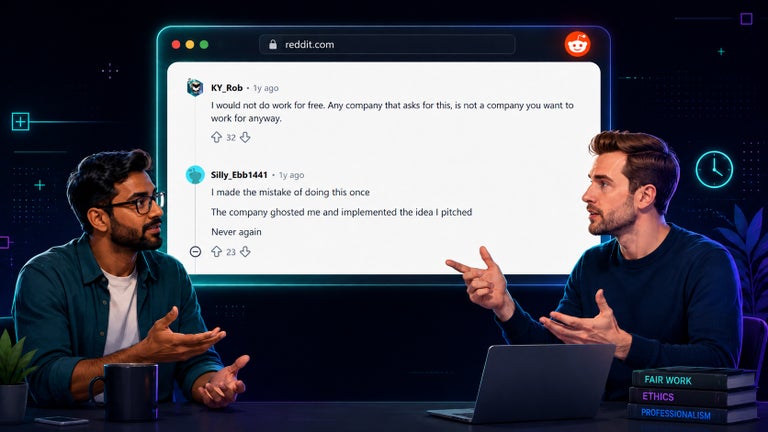
- In one poll, 85% of people said that they’d been asked to work for free before anyone offered them a job.
- According to Huntr’s 2025 annual job search trends report, of 1000 folks, 56% of them had been asked to complete an unpaid assignment, test or project during an interview process. Women experienced this a bit more than men, at 58%.
- MarketWatch warns that unpaid take-home assignments are becoming extremely common in tech, with growth in both frequency across the industry and intensity.
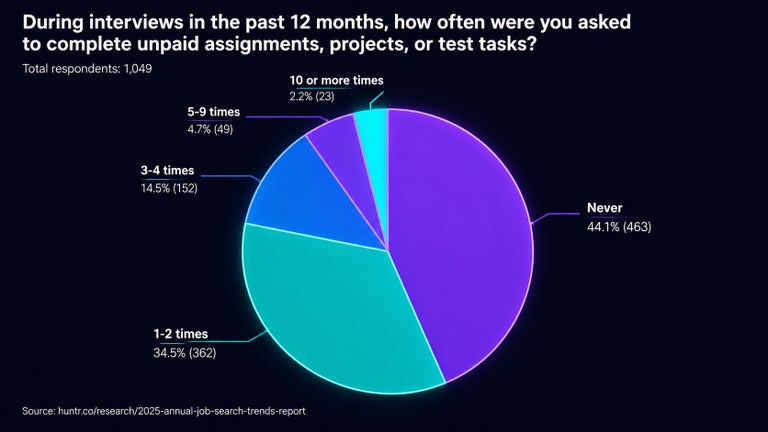
So, most people on the job market have experienced unpaid work during an interview process, and it’s only going to increase as demand for better, more competent workers arises.
Plus, more applications = more unpaid work requests, right?
Who among us can successfully complete 9-10 unpaid work assignments over months, be ghosted – and not be completely and utterly decimated by a heartless, feckless hiring landscape?
It only really takes one bad experience to make one bad decision that can last your entire career.
Here’s the thing – NEVER do unpaid work is lousy career advice, and following it is a one-way ticket to mediocre-ville, lower pay and fewer tech opportunities.
In this article, I’m drawing the line between exploitative free labor and the legitimate job assessments that help big tech companies identify and hire top talent – so you can protect your time without sabotaging your shot at roles worth competing for.
The Business Case for Unpaid Job Auditions
Tech companies need skill tests to find high performers. That’s the reality, folks.
The rise in unpaid work assignments is the result of a growing hiring problem – interviews and résumés are no longer accurate sources of truth.
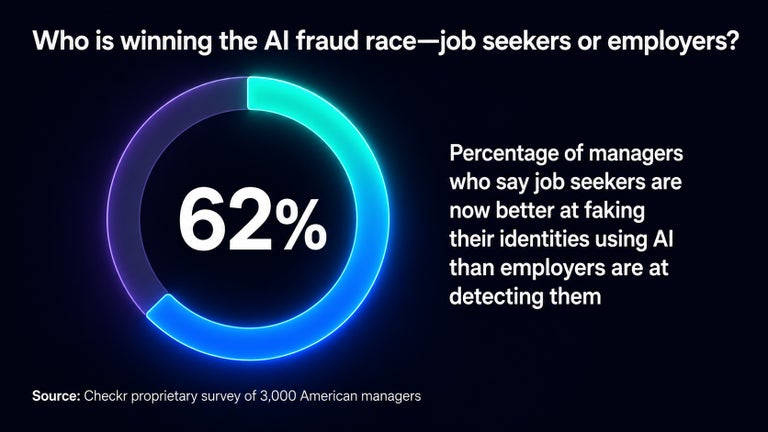
- AI makes looking qualified super easy: In a 2025 survey of 3,000 managers, 59% suspected that job candidates had used AI to misrepresent themselves, 35% had encountered someone else appearing in a virtual interview, and 62% believed candidates were now better at faking identities than employers were at detecting them. Hiring fraud is sharply rising!
Let’s not forget the fateful story of Soham Parekh who worked at 3-5 start-ups at the same time. These were once fringe incidents, now they’re mainstream.
- Hiring the wrong person is incredibly expensive: SHRM says that bad hires cost companies through recruitment, onboarding, lost productivity, management time, and the need to restart the entire process from scratch. One analysis puts the average loss at around $17,000 per bad hire, with costs skyrocketing for senior roles.
And the thing is, costs only increase when you factor in top performers.
Here at Crossover, we ask our candidates to submit unpaid work assignments late in the hiring process, after they've passed the CCAT. And we do it because we have a century of hiring research that shows people who can prove capability and aptitude will be WAY better at their jobs.
The gap between average and above-average can reach up to 48%!
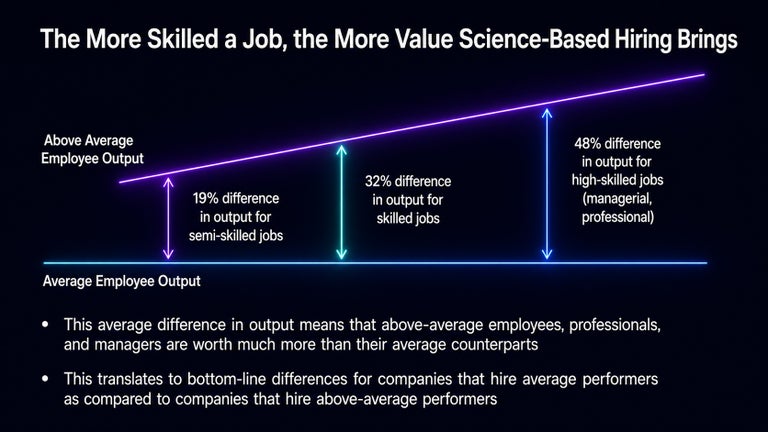
Things like years of experience, references and resumes are rubbish predictors of human performance. What matters most is general mental ability and job knowledge tests or simulations as proof-of-ability.
These can’t be tricked. And for jobs that require high performers who can hit the ground running from day one, there’s no space for error. Most big tech companies feel this way.
I’m talking about Amazon, Meta, Microsoft, Google, GitLab – you name it. Upwards of 80% of big tech companies demand that we do skill tests and work assignments, the majority of which are unpaid.
The business case for tech companies asking for unpaid work assignments makes sense. We’re talking highly paid, highly competitive roles here.
And the cost of consideration – is your time and effort.
Why Job Candidates Still Do Work For Free
No one enjoys doing unpaid assignments – let’s get that out of the way.
I’d compare it to drinking green smoothies in the morning, or getting up at 4am in winter for a 5km hike with friends – blooming awful but ultimately rewarding.
It’s a normal part of career strategy – if you’ve taken the time to pick your battles and focus your energy on jobs that are likely to convert.
Even then, things don’t always go to plan.
A couple years back I reached the final stage of an interview process with a well-known blockchain start-up. They asked me to do a blog strategy for their current blog.
I spent hours doing authentic research into their market, diagnosing the gaps in their existing content and mapping out the subjects and capabilities that would help them grow their audience.
I was hopeful and I clicked submit. Then – silence.
I didn’t get any feedback, or rejection email, not even an automated one. After two live interviews and multiple tests, I was totally ghosted. It felt horrible.
Then – their job description changed.

The revised role included several of the skills and strategic priorities I’d outlined in my submission. Had they used me as a research tool? I couldn’t prove it.
I should’ve known there were shady practices afoot – there were signs. I learned a lot from that experience, namely when to say yes to unpaid work that was fair – and when to politely pass on something distinctly unfair.
Clear boundaries do so much more than protect your time.
They reveal how much you value your work, how seriously you take an opportunity and whether you can tell the difference between a demanding hiring process – and a dodgy company rummaging through candidates for free ideas.
According to Interviewing.io, 66% of coders complete unpaid take-home assignments, with only 6% of them flat out refusing to do so. And that’s because software engineering is the most practical, competitive job in tech.
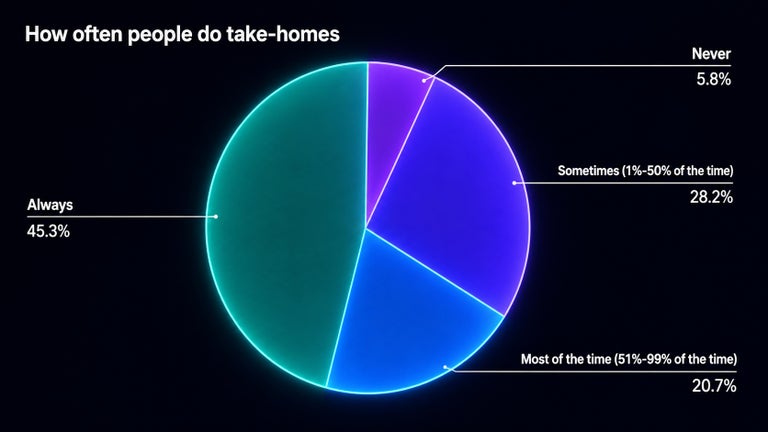
No evidence of skill = no shot.
Red flag assignments exist. So do HIGH opportunity ones.
Your job is to learn to tell the difference.
3 Things to Consider Before Doing Unpaid Candidate Work
So here we are.
If you want to stay in the running for top jobs at the best tech companies in the world, you can’t be delulu and swear off unpaid work assignments.
That’s a great way to guarantee your career stays in second gear forever.
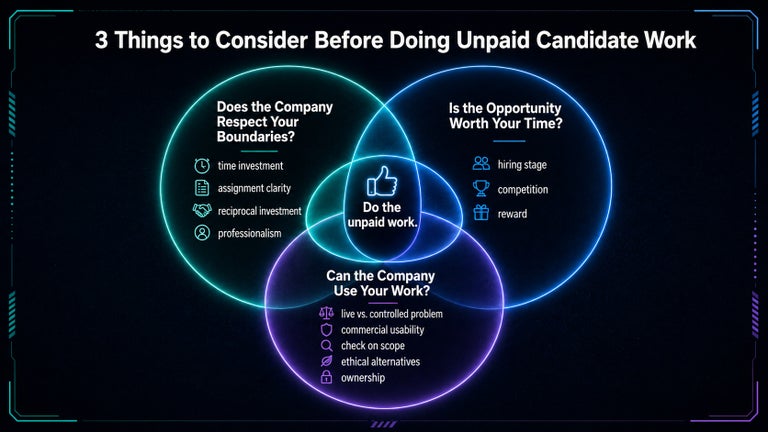
Don’t think about unpaid work as good or bad, these polarizing opinions work on social media to spread (weak) information, but they’re trash in real life. Like anything worthwhile, unpaid work assignments have nuance and deserve proper scrutiny.
I want you to start thinking of these unpaid work requests as opportunities. If they can make it beyond your decision framework, that’s when you go all in on them.
And assessing an opportunity is simple enough. You just have to ask – is it worth your time, is the company profiting from your work and are you a serious contender in the job race?
This is how you find unpaid work opportunities that win you six-figure pay.
#1: Does the Company Respect Your Boundaries?
The first thing I like to look for is evidence of mutual respect. Has the company requesting your assignment thought about your time, effort, and position in the process, or has it simply pushed the hiring burden onto you?

Time investment: Check how long the assignment should take. The company should clearly and accurately define it. The more senior the role, the higher the time investment will be. As a rule, nothing should take longer than a weekend.
- Green flag: A final-stage task with a clear four-hour limit.
- Red flag: A ‘quick’ exercise that requires three days, six deliverables, and your remaining will to live.
Assignment clarity: Make sure the company has clearly stated what is being assessed and why, what tools are allowed and how the submission will be judged. If none of this is available, it’s a red flag.
- Green flag: A structured brief with scoring criteria and clear instructions.
- Red flag: A vague, broad brief, followed by zero context and a blank page.
Reciprocal investment: The company shouldn’t behave like a faceless ghost and then send you a nine-page PDF assignment to complete over three days. It needs to have invested something in you first, whether through interviews, a well-built assessment system, or access to the people making the decision.
- Green flag: You’ve met the hiring manager, discussed the role, and know you are a serious contender.
- Red flag: An automated email greets you by the wrong name and attaches a weekend of unpaid work.
Professionalism: If your recruiters or hiring managers seem chaotic, disinterested or unaware of how things are supposed to work – red flag. Easy communication, supportive orientation and neat process is a good sign.
- Green flag: A seamless, official process that makes sense.
- Red flag: Things keep changing, no one knows what’s happening.
Top Tip! Not every worthwhile opportunity arrives gift-wrapped in a flawless hiring process. Before reaching for a pitchfork, assess the full picture. A minor communication glitch is different from a pattern of vagueness, disregard, and escalating demands.
Mutual respect looks like clarity, professionalism, and time sensitivity. Indeed advises employers to keep take-home work simple, explain it clearly, estimate the time required, and consider paying candidates when a larger sample is needed.
Don’t forget - a demanding assessment can still be fair when you understand why it exists, what it requires, and how close it can bring you to the job.
#2: Is the Opportunity Worth Your Time?
Next is to look at the unpaid work assignment as an investment that you’re making. Your job is to judge it against the value and likelihood of the role, rather than the task itself.

- Hiring stage: A work assignment sent after interviews or a major test is a lot more reasonable than one automatically dumped on every single applicant. Late-stage assignments are naturally higher value.
- Competition: If you’ve been shortlisted after being in the hiring process for a while – competition is fierce. That’s when work assignments make the most sense if the company is using them as a final decision filter.
- Reward: Check out the pay, scope, contract terms and work environment before investing in the assignment. Only do it if you really want the job.
A 2026 survey found that nearly half of all candidates wouldn’t apply for a role without a salary range, while 59% were less likely to apply when the process involved unpaid or excessive take-home work.
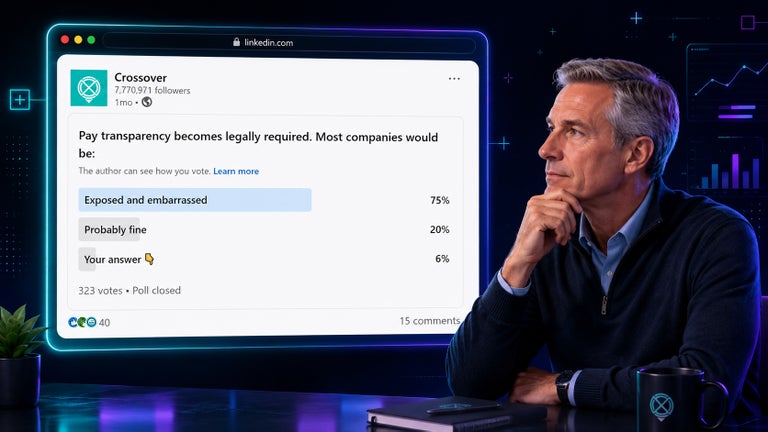
Our community feels the same way. In a Crossover LinkedIn poll of 323 people, 75% believed most companies would be exposed and embarrassed if pay disclosure became compulsory, while only 20% thought they would probably be fine.
If a company won’t tell you what they pay – don’t do unpaid work for them. Before giving away several hours, you deserve to know what you’re competing for.
Top Tip! Rethink your application strategy. If you find yourself flooded with unpaid work assignment requests, you’re probably applying too much. The buckshot approach doesn’t work, the higher your application volume the more scammy, terrible requests you’ll get. Only apply to companies that deserve your time and effort.
Go all in when the job is clear, valuable, credible, and within reach – that’s totally worth your time! Walk when the company wants substantial effort before giving you basic facts. Everyone deserves the basics folks.
#3: Can the Company Use Your Work?
I learned this one the hard way.
A fair assessment tests your ability, an exploitative one solves a company problem. Reddit is drenched in people complaining about companies stealing their work, and sometimes this is exactly the case.

- Live vs controlled problem: Is your assignment based on a current product, campaign, customer, market, or operational issue the company is having?
- Commercial usability: Could the work be published, implemented, sold, coded into production, or handed to the team after they reject you? Sometimes it’s not a process at fault, it’s an unethical team member, manager or recruiter.
- Check on scope: A full strategy, working product, complete campaign, or multi-day audit has crossed out of sample territory. It’s extremely unlikely a company will ask you to do something so big, and so complex before you’re hired.
- Ethical alternatives: Strong employers will often use fictional cases, old problems, synthetic data, standardized tasks, or simulations already completed by other candidates. These are graded on rubrics, so they need to be formalized.
- Ownership: Candidates should ask directly whether their submission will ever be used outside evaluation. Ethical companies clearly state how candidate submissions and personal data will be used, stored, and protected.
Crossover, for example, has a clear data policy – and we only ever use applicant submissions to assess job fit.
Top Tip! Unethical companies will lie in order to scam work out of you. Avoid them by taking the time to understand what they’re asking of you, and if it’s really fair.
If a company can publish, implement, sell, or otherwise profit from your submission, ask about ownership and compensation before you start.
Ignore The Work-for-Free Witch Hunt
Don’t listen to LinkedIn experts saying, "never do unpaid work again".
It’s tempting because it’s emotionally charged and removes uncertainty at a time when you could really use some.
The job market is insane right now.
It’s nice to avoid difficult decisions, not weigh risk against real reward, and to obliterate your chances of being taken for a ride. Just declare all unpaid work evil, wave your red flag while brandishing the pitchfork and… walk away.
But it’s a witch hunt.
Because a few unethical companies disguise free labor as recruitment, and steal candidate ideas, everyone does?
It begins when suspicion spreads so far that every skills test and work assignment gets dragged into the square and declared guilty without evidence.
So, I’m saying - before condemning the ask – examine the evidence.

Great tech jobs are extremely competitive, and companies are determined to find the best people to do them.
The price of being considered is showing them what you can do.
It’s up to you to understand the difference between a fair audition and an unfair extraction.
Just ask -
- Does the company respect your boundaries?
Look for clear instructions, realistic timing, professional communication, and evidence that the company has invested in you too. - Is the opportunity worth your time?
Know the pay, role, hiring stage, and potential reward before giving the process your best work. - Can the company use your submission?
A fair assessment produces evidence of skill. If the company can publish, implement, sell, or profit from your work, pay and ownership need to be discussed first.
Top performers are happy to give companies their best sample work assignments, when asked. They just make darn sure that it’s a good decision before they do.
So don’t replace career strategy with witch-hunt mentality.
Protect your value, choose your unpaid work opportunities carefully and know when a demanding assignment can open the door to work worth fighting for.
Your tech career depends on it.
Find your next big opportunity.
Similar post


Want to read more?
We have a lot more where that came from



 AI-first remote workers.