Contents
- The Dangers of The Anti-Social Remote Team
- Why Avoiding AI Message Slop Will Save Your Team
- #1: Don’t One Click Your Reputation Away
- #2: Return AI Message Slop to Sender
- #3: Use AI for Clarity (Not Personality Theft)
- Opting Out of Social Offloading
What happens when AI makes work more productive…but less social? With the rise of social offloading – remote workers face a new risk hiding inside all those helpful AI shortcuts. In this article, we’re exploring what happens when people accidentally remove themselves from the loop completely, allowing AI to tackle awkward, emotional, social communication that once made work worthwhile.
Ever used AI to respond to a team email, DM or give feedback on a key project?
Everyone’s doing it these days. Companies have been falling over each other to insist that AI be used extensively at work, including internal communications.
But for remote teams whose relationships rely on async collaboration, this doesn’t strike me as the best plan ever. Lately, tech workers have come face to face with the secondary consequence of AI overuse – social offloading.
Think of it as cognitive offloading’s eccentric cousin.
Social offloading happens when you start to delegate expertise, judgment, communication and social decision-making to your AI agents. So instead of not thinking, you’re not engaging authentically with your team.
The crucial interpersonal skills that give you value as a remote pro are outsourced to an overconfident, extremely neutral and slightly sociopathic AI assistant.
And now, with your team members doing the same – it’s AI talking to AI, talking to AI – with hidden consequences that we should drag kicking and screaming into the light before it’s too late.
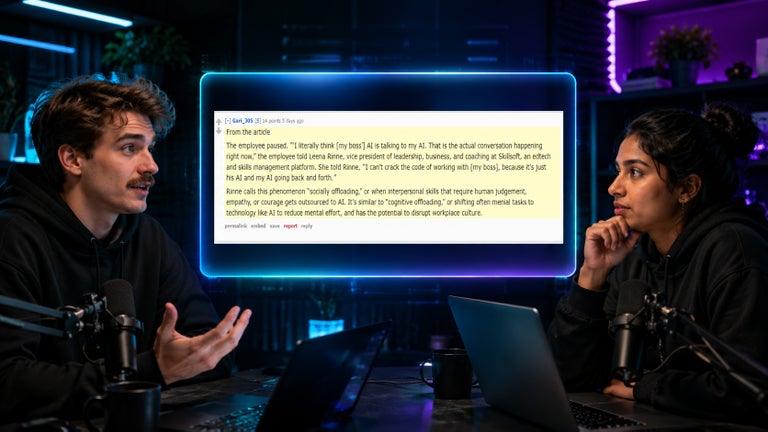
Folks on Reddit have posted extensively about their experiences with bosses and other team members who no longer engage with each other.
By proxy, they’ve inserted AI as a horrendous middlebot to stir oatmeal into relationships that were once Kellogg’s pick and mix.
Your remote team is at risk because three forces are colliding - digital overload, AI adoption, and workslop.
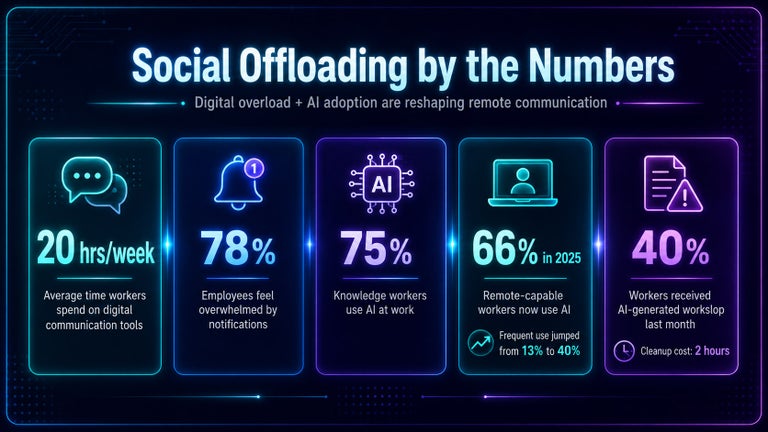
- Workers spend 20 hours a week on average using digital communication tools
- 78% of employees feel overwhelmed by the volume of notifications from communication tools – digital overload is real
- 75% of global knowledge workers use AI at work (increasingly to combat comms overload, constant context-switching and heavier workloads)
- AI use in remote-capable roles has exploded to 66% in 2025, with frequent use up from 13 to 40% (yes, your team is using AI to talk to you)
- Workslop is up, with 40% of workers receiving AI generated slop at work the previous month, with a time cost of 2 hours
Right now, AI is being used as a convenient answer to the growing digital overload and cognitive fatigue present in daily remote life.
Trouble is, the cost of productivity here is social – and remote workers already have to work harder to maintain our online relationships. It’s a concern – and a big one.
What exactly happens when AI becomes the main character on your remote team?
In this article I’m going to outline the dangers of social offloading for your remote team, show you how to treat AI message slop and give you three team-saving practices you can use to keep AI loops from dismantling your remote team culture.
The Dangers of The Anti-Social Remote Team
Are you chatting to your remote team as much as you did before AI?
Chances are, you’re not.
A lot of people have swapped colleague exchanges with AI exchanges – and it’s not good for anybody.
A few years back, async communication was all about thoughtfully managing relationships, social growth and team dynamics via media – be it email, DMs or video chat. Regardless of the medium, the individual was always the person in the driver’s seat. Now, it feels like AI is hijacking these moments of connection.
- Recommended gifs become the ones you choose
- One-click email responses you barely read and are ‘good enough’
- DMs that autofill a response before your brain has even turned on
- Feedback that is way more complicated because it’s automated
I’m extremely AI positive. But I don't agree with using AI for social interaction, not on this level. Not all AI use is progress. For remote workers it spells the death of colleague intimacy, the degradation of mentorship and the slow unravelling of shared vision.
It looks useful, but it’s not. AI to AI communication often doesn’t make sense. None of it is you, and none of it is real.
AI work looks impressive but it’s wrong on the reg.
In KPMG and the University of Melbourne’s 2025 global workplace study, 66% of employees said they relied on AI output WITHOUT critically evaluating it and 56% said they made mistakes because of AI.
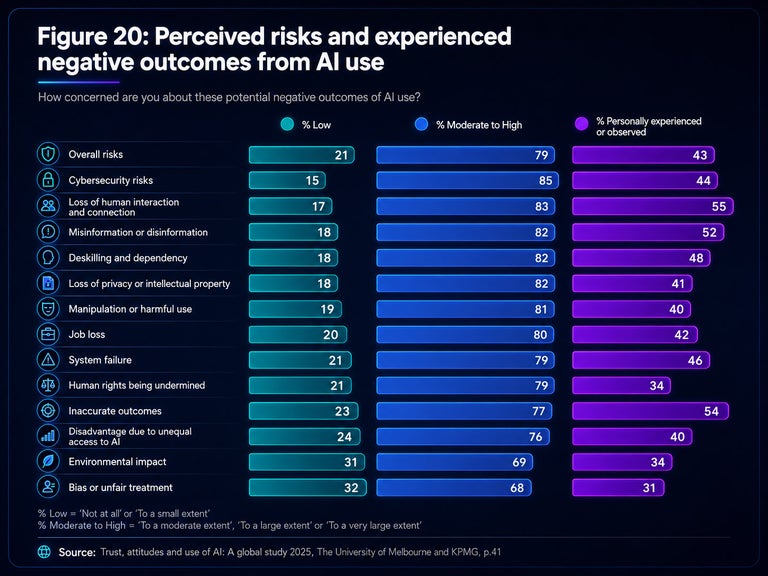
Loss of human interaction and connection literally ranks as the #1 personally experienced or observed negative outcome from AI.
When we replace our own voices with AI models, we replace ourselves. It’s too far, and it’s the same reason social media has turned into a slop trough.
If you aren’t careful – you will find yourself working in an anti-social remote team. Once this happens communication becomes unclear, workload drastically escalates and nothing seems to fit together.
The result is that nobody trusts anyone, anymore.
This isn’t a problem with AI – it’s a people problem.
Nobody wants to work with bots and get caught in nonsensical bot loops.
Why Avoiding AI Message Slop Will Save Your Team
Messages are the lifeblood of remote asynchronous work.
They’re how we get to know our remote colleagues, discover their sense of humor and the little idiosyncrasies that turn a workday, into work memories.
AI message slop is a particularly insidious type of workslop.
Not only does AI generally look for inflated things to say (and for others to do) – it also creates bizarre responses that can come across as insensitive, cold, ignorant or create weird bot loops. And this leads to escalations and disagreements.
- AI not agreeing with another AI, or itself
- The owner not clued up enough to know how to fix it
- The jarring realization your colleague isn’t behind any of it
- No-one really knowing what to do next, or how (too many cooks in the kitchen)
Here’s an example from Reddit:
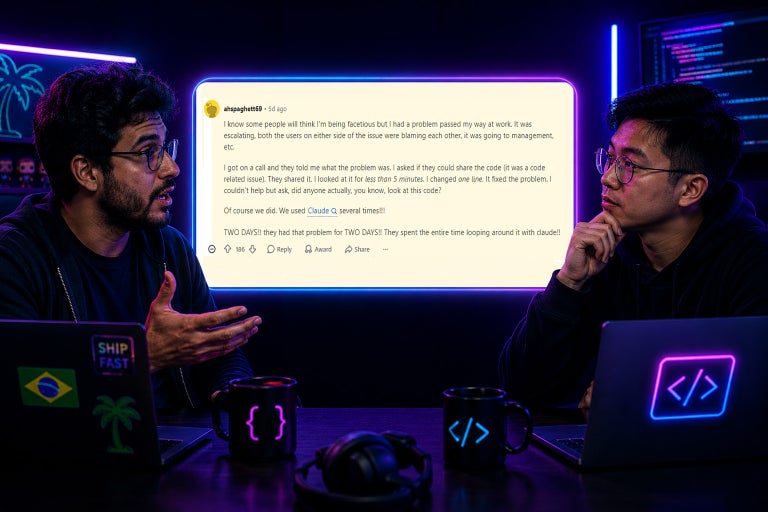
Messages are the first line of defense when you’re an async worker. While it’s often okay to use AI for small little things, I think it’s important to remember that for remote workers – a lot of our relationships live in writing.
Thoughtless AI messages cause havoc.
Workday’s 2026 Human Connection Workplace Index found that 33% of employees rarely or never have conversations with colleagues beyond transactional work. While 76% have used AI for advice, 52% for brainstorming, and 37% for companionship.
Since adopting AI, 16% say they have less patience for small talk.
If this is happening at the office, it’s definitely happening in remote work.
AI messages make leaders look less trustworthy, did you know that? In a 2025 study of 1,100 working professionals – researchers found that medium to high AI assistance in manager emails made recipients question the sender’s authorship, caring, sincerity, confidence AND ability. Just wow.
Considering DMs and emails (and feedback) are the basis of successful mentorships in remote teams – it’s no wonder people are disillusioned.
So many teams are accidentally removing themselves from their own careers. And yes, I mean careers. They happen because of who you know, and how they value you.
Value friends, isn’t just what you produce. It’s the experience you create for others while you’re producing it.
In a workplace environment where communication happens through layers of automation and people are passively standing by letting it happen – you’re destroying team culture AND you’re trashing your own career momentum.
Anyone with AI can be you now. That’s a HUGE fail.
I strongly encourage you to be the bastion of personality, reputation and authenticity on your team. Remind your colleagues what real engagement looks and feels like.
Here’s what you can do.
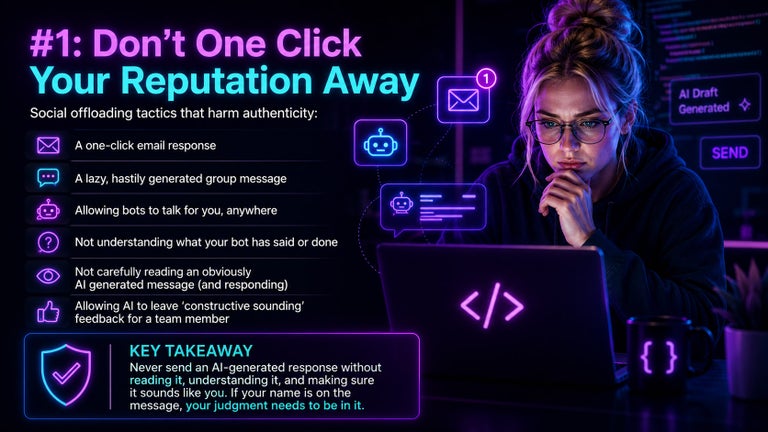
#1: Don’t One Click Your Reputation Away
Your reputation matters. It’s career capital that you’ll cash out as opportunity, new connections and the evolution of your professional identity.
Fuqua researchers recently discovered that overusing AI (like for social communication) can make others perceive you as less competent, lazier and less motivated.
Consider the old-school measures of reputation – confidence, character and commitment. These must ALWAYS be top-of-mind when responding to messages.
Everything with your name on it, should carry your voice and be YOUR opinion.
Social offloading tactics that harm authenticity:
- A one-click email response
- A lazy, hastily generated group message
- Allowing bots to talk for you, anywhere
- Not understanding what your bot has said or done
- Not carefully reading an obviously AI generated message (and responding)
- Allowing AI to leave ‘constructive sounding’ feedback for a team member
The last thing you want to do is be part of the social exclusion loop that inflates work for everyone else and has your hard-earned reputation circling the drain.
As a hard rule – never, ever instant generate a social response to anyone before completely understanding the context of the conversation. If you don’t have time to read your AI’s response, you don’t have time to respond.
In the future you’ll differentiate yourself by being yourself and not taking the easy road. AI can’t generate your reputation for you. You should always make time for a thoughtful message, honest pushback, shared experience in group feedback, and awareness over how flat, generic and unoriginal AI sounds.
In remote work people get to know you based on what you send, how you think and how much it helps. Don’t outsource that to AI!
Key takeaway: Never send an AI-generated response without reading it, understanding it, and making sure it sounds like you. If your name is on the message, your judgment needs to be in it.
#2: Return AI Message Slop to Sender
Direct communication is hard.
Even harder, is dealing with the fallout of not exhibiting the courage required to call people on their AI use.
There is a brutal cleanup tax for folks who ignore AI slop landing in their inbox. In Zapier’s 2026 workslop research, they found the average worker spends 4.5 hours a week cleaning up AI outputs, with 74% reporting at least one negative consequence from trash low-quality work.
Those consequences included stakeholder rejection, customer complaints, privacy issues and missed deadlines. Imagine if social offloading was the reason you found yourself at the end of a performance improvement plan, or worse.
A colleague who receives workslop from you is going to see you as less creative, less capable and less reliable – and you never want to be seen that way. That means protecting your ability to engage, judge and execute your own work.
Your new mantra is going to be ‘return to sender.’
Messages that sound impressive and make no sense demand ownership.
Don’t waste your precious time decoding the dead sea scrolls for someone else. Chances are, when slop lands in front of you – it was sent because someone was rushing, avoiding the hard part, or trying to look finished before they’d done the thinking.
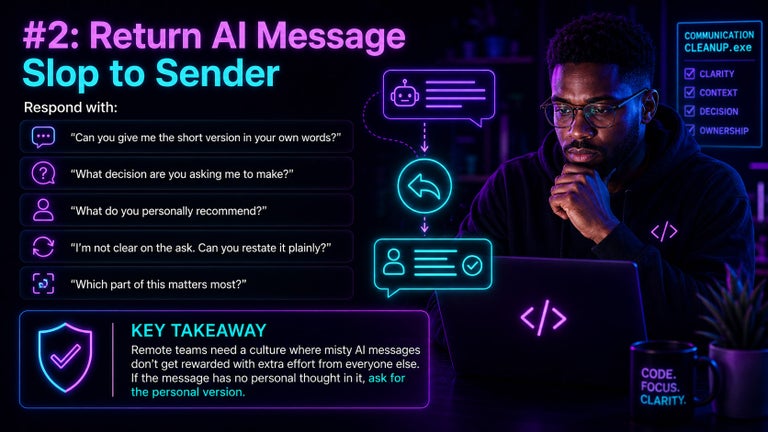
Respond with:
“Can you give me the short version in your own words?”
“What decision are you asking me to make?”
“What do you personally recommend?”
“I’m not clear on the ask. Can you restate it plainly?”
“Which part of this matters most?”
Break bot loops by not starting them in the first place, and not indulging teammates who haven’t thought far enough ahead.
Key takeaway: Remote teams need a culture where misty AI messages don’t get rewarded with extra effort from everyone else. If the message has no personal thought in it, ask for the personal version.
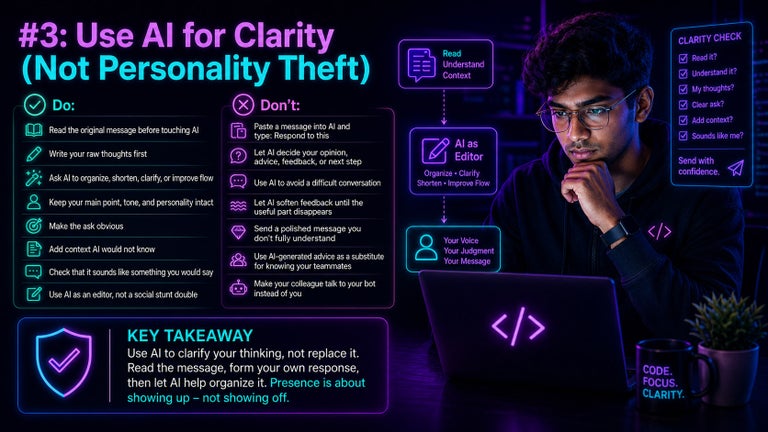
#3: Use AI for Clarity (Not Personality Theft)
There’s a right way to use AI socially, and a wrong way.
The right way includes reading the message you received, then drafting your thoughts based on the message and using AI to organize and finesse them.
The wrong way is with copy and paste prompts.
Wrong is also allowing a smarter model to automate a response that lacks context, personality and clear takeaways.
AI is brilliant at being fake. Fake warmth, fake validation, fake professionalism – it can absolutely draft you a passable message to your team member based on almost nothing. Your job is to never let it do that.
It’s also your job to not ask AI for its opinion or direction in social contexts. If you do that, you lose the benefit of learning how to truly engage with important people – like your colleagues, bosses and friends at work.
Do:
- Read the original message properly before touching AI
- Write your raw thoughts first: what you mean, what you want, and what the person needs to know
- Ask AI to organize, shorten, clarify, or improve flow
- Keep your main point, tone, and personality intact
- Make the ask obvious: decision, feedback, next step, or question
- Add context AI would not know: history, relationship, stakes, team norms
- Check that the message sounds like something you would say
- Use AI as an editor, not a social stunt double
Don’t:
- Paste a message into AI and type, “Respond to this”
- Let AI decide your opinion, advice, feedback, or next step
- Use AI to avoid a difficult conversation
- Let AI soften feedback until the useful part disappears
- Send a polished message you don’t fully understand
- Use AI-generated advice as a substitute for knowing your teammates
- Make your colleague talk to your bot instead of you
Good communication means being present, for the good, the bad and the awkward learning moments that will teach you how to form strong social connections.
Staying engaged means staying in the loop. So never remove yourself from the equation.
Key takeaway: Use AI to clarify your thinking, not replace it. Read the message, form your own response, then let AI help organize it. Presence is about showing up – not showing off.
Opting Out of Social Offloading
The next time you come across social offloading in action, opt out.
It’s what happens when AI is gently allowed to shimmy into the driver’s seat. All too soon you have a lot of passive passengers, and their agents going round and round until we’ve all somehow lost ourselves and each other in the loop.
Don’t pretend you’re steering if you’re not. And don’t tolerate the absence of team presence. That’s when everything you’ve worked for starts to dissolve.
Remote team collaboration relies on transparency and deep thought.

Colleagues know when a reply wasn’t really from you. When your feedback sounds like vanilla pudding, they’re eventually going to stop asking for it. And when a boss outsources mentorship, care and hard conversations – trust gets run over.
You can’t replace your own hard-won experience with bot fakery, or your own voice for neutral generalizations. That’s where impact goes to die.
Authentic team bonds come from the daily proof that someone is paying attention. Someone on your team is there alongside you, battling the same issues, grappling with the hardships of what it means to work remotely with AI today.
A remote team that says, “I understand your work, and I understand you,” is what makes the job worth doing. Erase that, and you erase the experience of work.
Career momentum can’t exist without working experiences that are messy, hard, colorful, mildly traumatic – and uniquely human.
When the price of social offloading is connection – that price will always be too high.
So don’t let AI hijack your voice or your team - that’s not the future of work we’re trying to build.
Similar post


Want to read more?
We have a lot more where that came from

![Crossover’s Basic Fit Check [Official AI Screening Guide]](https://assets-us-01.kc-usercontent.com:443/7beb5311-75a4-0049-50f5-8f58fd55aba7/90bfc8de-1a38-4802-8432-c063c215e90a/BasciCheckGuide.jpg?fm=jpg&auto=format&w=500&h=500&fit=clip)




 AI-first remote workers.