


Contents
- The Absurdity of the 9-5
- Remote Work’s Unfinished Business
- The Nonlinear Workday
- Time as Compensation
- Why Buy Someone’s Least Productive Hours?
- What They Don’t Want You to Know About RTO
- Your Time Needs a Better Manager (You)
- The Engagement Crisis
What if your best work doesn’t keep office hours? Darren Murph makes the case for breaking up the 9-5 - and getting more out of your work and your life. In this interview feature, Andrew and Darren unpack the nonlinear workday, time as compensation, and why your boss’s RTO policy is a project management problem in disguise.
Is your workday wasting your best work hours?
Elite coaches prep their athletes to be at their best when a match starts. Farmers plant their crops when sun and soil conditions are just right. Power grids regularly adjust supply as demand changes around the city.
Time is variable. It’s inconsistent… and it generally reflects reality.
We understand that key systems work better when this is the case. That’s why athletes vary their training intensity and take rest periods. It’s why we don’t plant the same crops every month or blast our grid on maximum everywhere.
Time (and resources) are finite and ever-changing.
Yet our own workplaces reject these systemic fundamentals. It happens at the office and when we work remotely. We’re told that we have to work every day for 8 consecutive hours, like it’s normal.
It’s not.
Worse still – experts have been telling us hard truths about the negative impact of these legacy systems for years. Experts like the oracle of work, Darren Murph.
Andrew recently sat down with Darren to talk about the 9-5, and its impact on our working lives. In this interview he shares a fresh perspective on how to think about time, productivity and the systems between employers and employees that underpin everything from work quality, to how we’re paid, and when we get promoted.
The former GitLab Head of Remote argues that knowledge workers can only be at their best when they have more control over their workday.
And he proposes an elegant solution to the tyranny of the 9-5 – the nonlinear workday – a concept explored in Chapter 9 of his latest book, Distributed.
Get your copy of Distributed here.
The question is so relevant I’m embarrassed by how rarely we ask it: why must eight hours of work happen in a row?
Here’s Darren’s case for breaking up the workday. It uncovers how taking back control of your time can help you do better work – and what you’ve been sacrificing all along by letting an absurd system run your life.
The Absurdity of the 9-5
Great work doesn’t keep office hours folks, and life doesn’t wait for your lunchbreak.

The 9-5 has been around since the 8-hour movement of the 19th century. Back then labor parties pushed to reduce the exploitative working hours of the every-man.
It wasn’t unusual to work a 14-16 hour day in 1867. Protests continued until post WW1, when angry railroad workers demanded an 8-hour day, even as America was on the brink of war.
It resulted in the first 8-hour workday law.
Fast forward a few decades to Henry Ford using time as leverage to get workers to stay in their jobs at the factory, and the modern 40-hour work week was normalized and ratified into law by the Fair Labor Standards Act of 1938.
It’s been 88 years.
Today’s workday STILL assumes that early risers and night owls produce their best work in the same window of consecutive time.
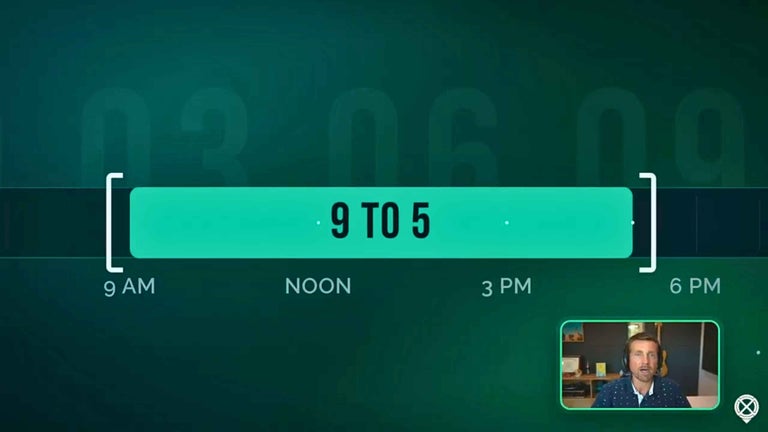
Even though the way we work has drastically evolved.
It also unjustly assumes that staying at your desk through a slump is a sensible use of your time.
Darren rejects this absurdity and asks a better question: What if we could organize work around the hours when people are best equipped to do it?
He realized the power of remote freedom when he and his wife decided to pursue adoption. This deeply personal process involved agencies, appointments, calls and a lot of life coming at him at inconvenient business hours.
But because of remote work – he could participate without making every commitment a workplace issue. If he needed to be offline at 1pm on a Wednesday, he could be.
“With remote work, we were able to go on our adoption journey and I was able to be more present and be more available for the various things that are needed on that journey without it being a big deal at work.”- Darren Murph
Darren could be present for something life-changing, something enormously important – without having to typecast professional commitment as this season’s obstacle.
Even something seemingly small like the ability to drop off or pick up your child from school, adds years of additional time spent together, time that can never be recovered if lost. Time flexibility is a compounding value.
A daily school run looks trivial and exasperating on a company calendar, but for a childhood – it becomes a relationship foundation. We’re so comfortable asking people to rearrange these important relationships around work!
But what’s possible when we flip that tired, old script. When we can suddenly and effortlessly fit work in around the important moments instead?
Fully distributed remote work gave him that time.

Remote Work’s Unfinished Business
Remote workers know – just because you work remotely or in a hybrid situation doesn’t mean you have flexibility. Free from the office doesn’t always mean free from the 9-5 grind.
So, moving your desk home doesn’t automatically give you control over your day. You can rid yourself of the nightmare commute and still be trapped in the clutches of a permissions culture that demands a rigid schedule.
Darren uncovered a statistic that blew his mind. Turns out EVERYONE wants time flexibility. Yes, everyone.
In a 2022 survey from Future Forum research, looking at what 10,766 desk-based workers across 6 countries wanted from work – 80% wanted location flexibility sure, but 94% wanted schedule flexibility.
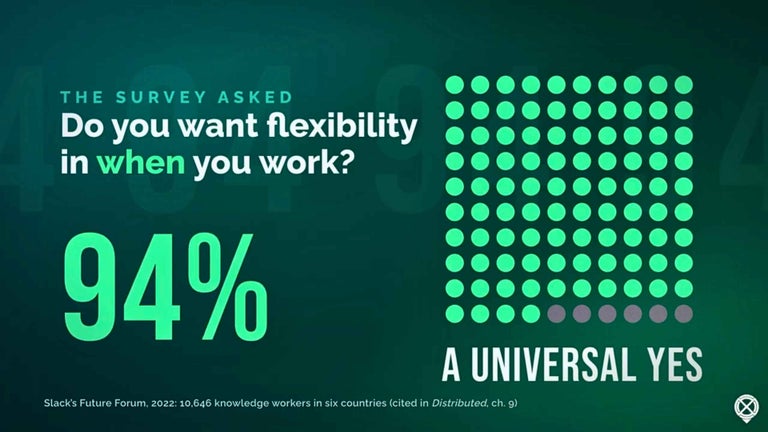
“That’s as close to a universal yes as you’re ever going to get in the world of surveys.” – Darren Murph
While we argue about office-relevance and where people should work, there’s a much more pressing question we’re not asking. People want more say over their hours, they want flexibility more than anything else.
Even as remote work has taken steps to being a better way to work, only fully distributed, totally time flexible remote work is the gold standard.
The same type Andrew mentions that we use here at Crossover. Here, as long as we work our 40-hours in a week, we can stack those hours however we want. It’s a level of freedom few knowledge workers get to truly experience.
Because even remote work struggles with the outdated 9-5 system.
The Nonlinear Workday
You see, Darren says that eight hours of work don’t have to happen in a row. It’s called a nonlinear workday, and it’s a system for creating consistently great work.
He describes it as a distinct way of working for knowledge workers in the digital era. Lucky for us, it exposes and shatters what we previously thought about the 9-5.
When a workday is divided into blocks across a 24-hour cycle, knowledge workers can choose the hours that best suit their productivity and personal circumstances.
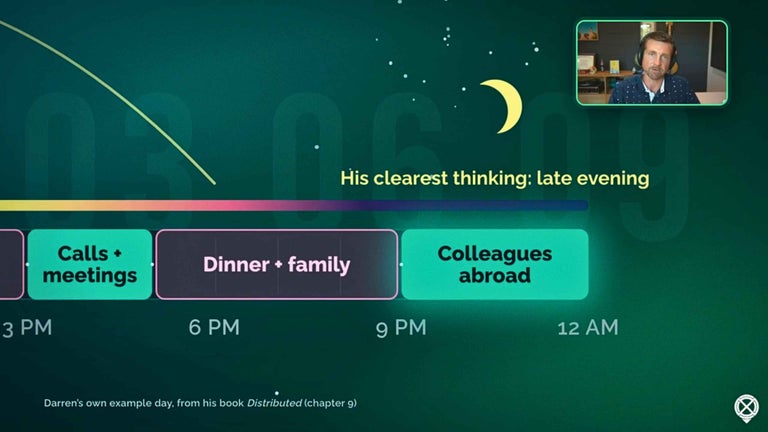
For some that will mean starting early, taking time for a personal commitment, then returning for another focused session later on.
The big question is how to keep work moving when folks aren’t simultaneously available. A practical problem with a proven solution!
Darren calls these ‘around the sun’ models – people contribute at different times, with enough shared information for the next person to move things forward. It requires codifying work – clear expectations about ownership, deadlines, handovers and when folks need to overlap.
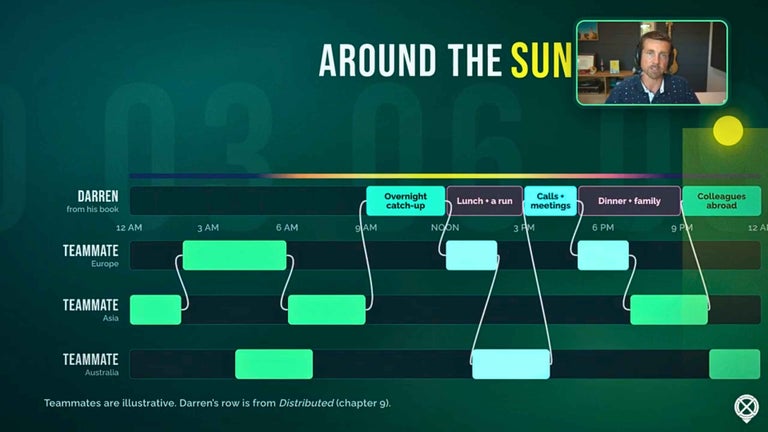
A flexible schedule demands reliable co-ordination after all.
Time as Compensation
“I would argue you can only compensate people in two ways, money or time,” Darren says in the interview.
And all employers limit what they will pay. But when you give people more control over their time it creates a second way to jack up the value of their job. Remember Henry Ford? Time is a type of compensation!
It’s an incredible incentive and a powerful reward.

That level of freedom changes what a job lets you do with your day, with your life. It’s something meaningful an employer can bring to a hiring conversation.
Something everyone wants.
It also gives companies a reason to invest in systems that support this flexibility. Those systems (like fully distributed remote work) create compensation that employees can use in their daily lives. It’s reason to stay in their jobs.
It’s bizarre that more companies aren’t tapping into this obvious benefit.
Why Buy Someone’s Least Productive Hours?
Employers continue to insist on 8 consecutive hours, which is insane.
We might work with AI and machines, but we don’t operate like they do. That’s literally why you get early risers and night owls – some folks are more productive in the morning, and some at night.
It’s a known and measurable fact that not all hours will be equally productive.
Darren’s argument is that this unnecessarily rigid system forces an average of someone’s high and low periods of work. You’re getting the bad with the good.
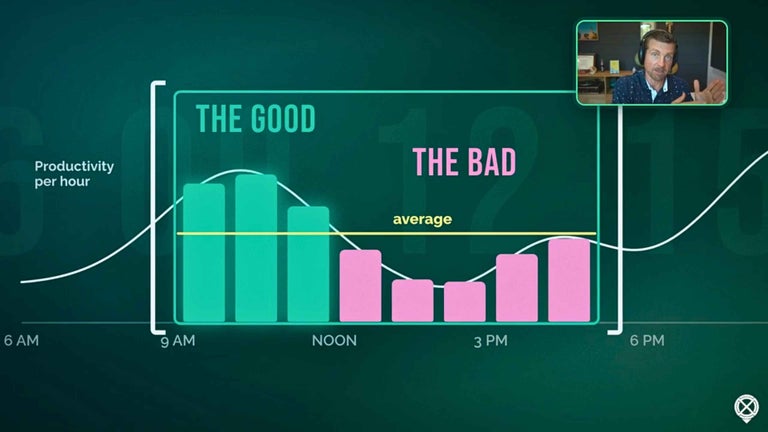
The company gets sharp thinking, and ALSO the hours of lull, distraction, low-energy and disinterest. Overall, it results in a much lower average after 8 hours of work.
If folks can step away during those low productivity hours – to recharge their batteries with a chat, a walk or something else valuable, they’re better equipped to contribute on return. This amounts to higher quality working time spread over 24 hours, not sardined into 8. It’s non-linear, and it’s better for everyone.
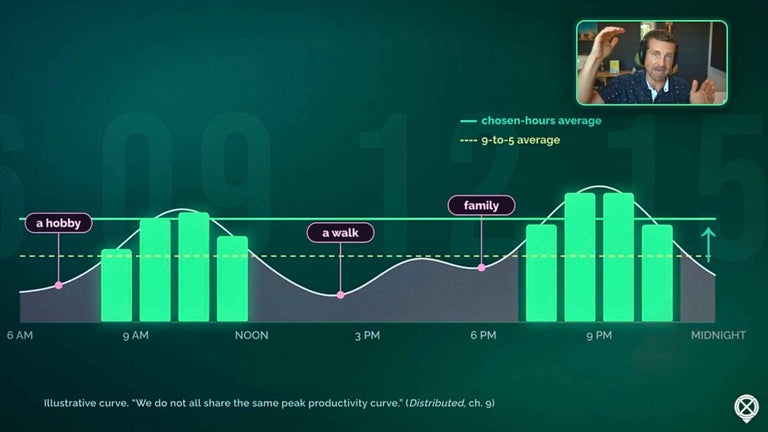
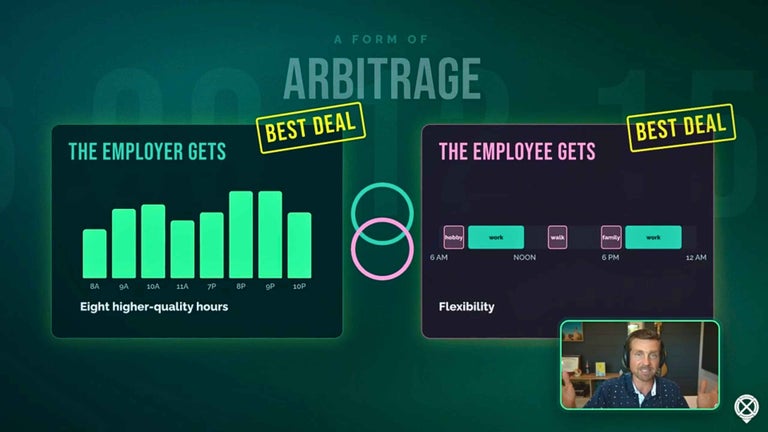
He describes it as arbitrage:
- Your employer gets more useful hours (higher productivity)
- You get time flexibility (more room for reality)
It’s a seriously improved deal on BOTH sides.
Ultimately, it’s time we acknowledge that the quality of working hours matters. It’s not 1938 anymore, we’re not putting toothpaste caps on tubes. This is multi-faceted, highly engaged, cognitive-load heavy work and optimizing it just makes sense.
Work can be great, if we let it be.
What They Don’t Want You to Know About RTO
Return to office is a project management tool. A bad one.
Darren says that this comes with specific conditions – if everyone has to be back in the office because you can’t tell who is doing what otherwise – visibility is your management system. And to be frank, it’s an archaic one.
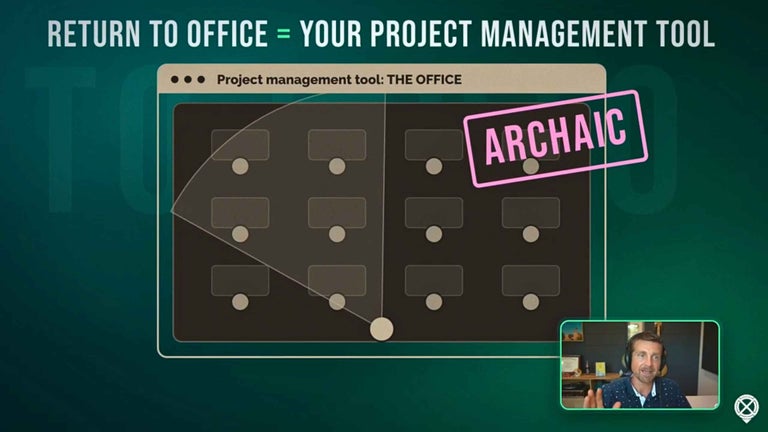
Your boss can see you. Whether or not the work is getting anywhere is an entirely different question.
So, like Andrew - he recommends documenting work in tools like Asana or ClickUp where progress can be inspected without assembling everyone in front of a manager.
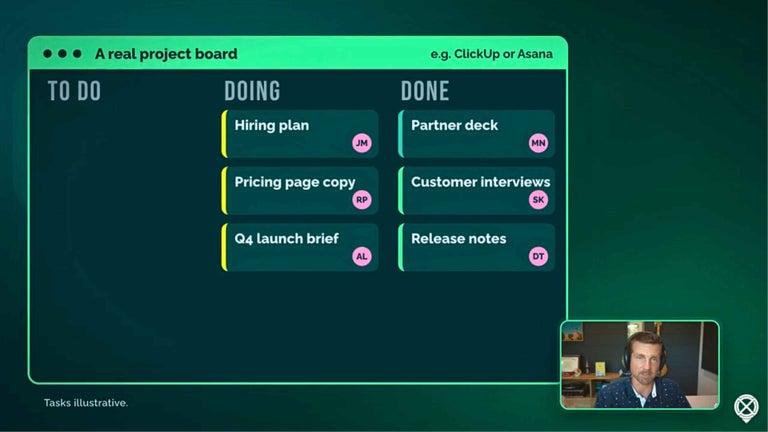
It’s connected to an insidious thing called proximity bias – which is the advantage that people gain from being closer to influential colleagues. That’s why it’s often the wrong people in office environments getting promoted!
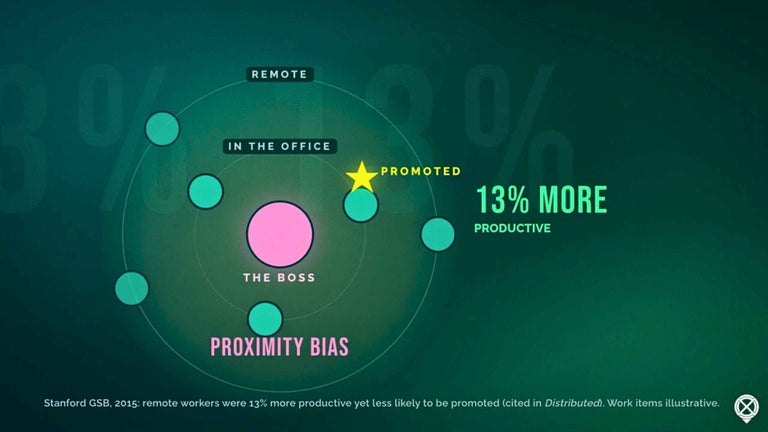
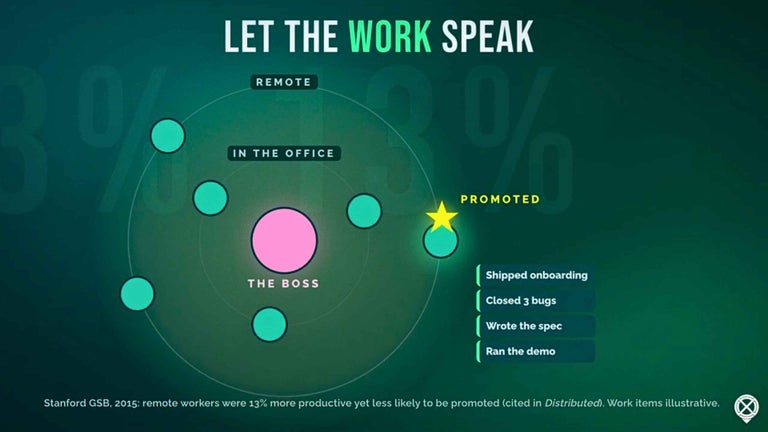
When work is documented, there’s a stronger bias for assessing contribution beyond who is the loudest, or who happens to be nearest the boss. Documentation lets your work speak for itself.
Of course, there are implications for AI too.
Darren argues that companies introducing AI desperately need codified operations, culture and team agreements. The very knowledge required to coordinate flexible work, gives something useful to AI – and it can tap in and work with it too.
Line of sight from an old school manager is a darn poor substitute for either of those things. So, the 9-5 really is the worst of both worlds.
And companies are behaving like ostriches with their heads in the sand, ignoring the vital and proven benefits of breaking out of that legacy system that no longer serves our best interests.
Your Time Needs a Better Manager (You)
Be a Manager of One, and create higher quality work over time.
For individual contractors, Darren recommends embracing being a Manager of One, the ultimate state of work that dials you into your best, more often via radical accountability.
It means - “I am the manager of my own time and attention,” he explains.
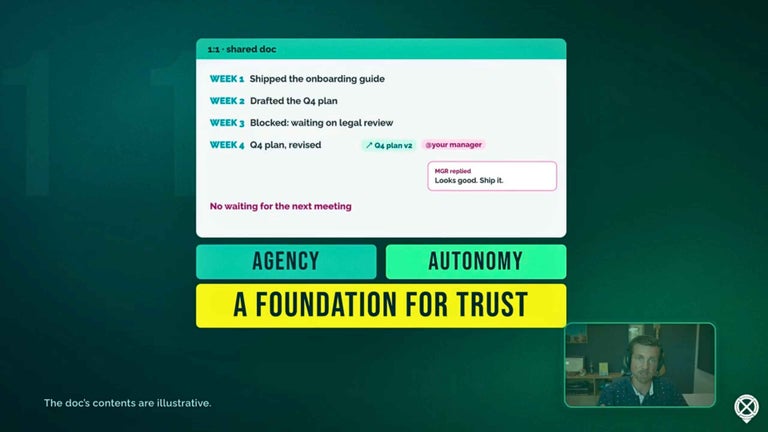
Practically speaking it can be as simple as creating a shared document for your one-on-ones. Record what you’ve worked on, link to relevant material and keep questions or changes visible as you go.
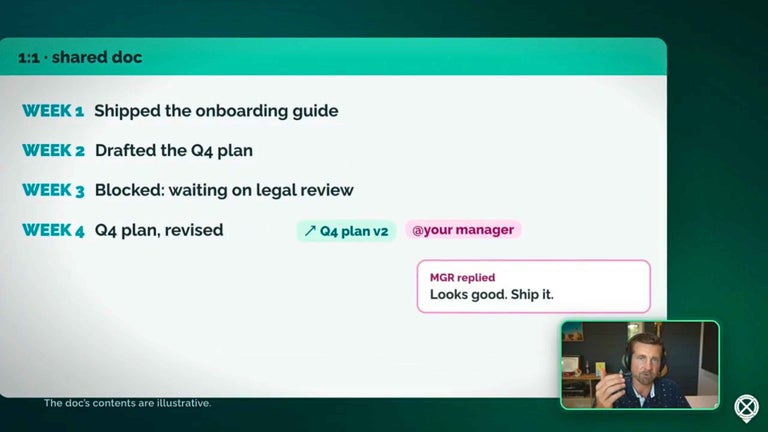
That way, your manager can respond asynchronously as things develop – rather than waiting for the next scheduled call.
This record creation creates a contribution track record, and it massively reduces over dependence on synchronous work, which slows down productivity.
Even better, you’re giving your manager something concrete to trust!
To learn more about the organizational thinking behind this concept, grab Darren’s new book – Distributed: Secrets to Building Radically Healthy Remote Teams.
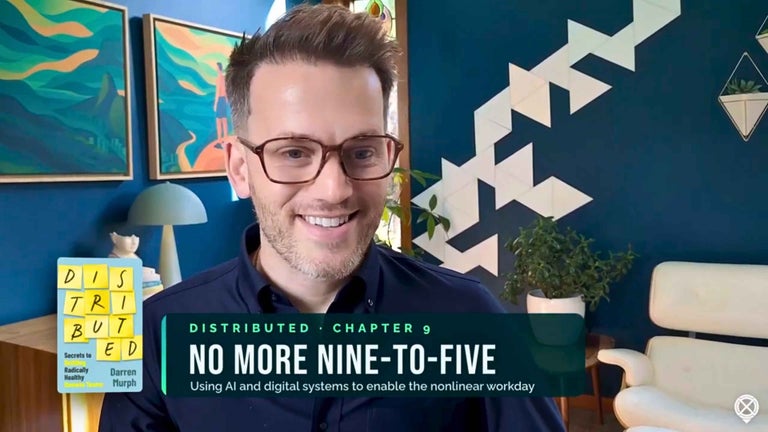
It examines how communication, culture, productivity and leadership work in a distributed company.
But if you want to do your best work, time flexibility is a non-negotiable.
The Engagement Crisis
So many people clock in, then check out.
At the end of this powerful interview with Darren, he speaks about the engagement problem plaguing teams all over the world.
According to Gallup’s State of the Global Workplace 2026 report, only 20% of employees worldwide were engaged in 2025. That’s the lowest level since 2020, and it costs the global economy about $10 trillion in lost productivity.
Darren also cites Gartner - who says roughly two-thirds of the world’s workforce is disengaged at work. Turning that tide means challenging the 9-5.
We should give folks greater control over their time.
Flexible schedules won’t fix every broken job. But asking people to accept increased levels of ownership without giving them any say over their day is nuts.
Of course tension is the result.
Employers should build systems that allow more autonomy, and give people a meaningful reason to invest themselves in work again.
Great work takes attention, energy and judgement – and a workday that gives you room to use them. If your best hours constantly fall outside of your scheduled ones, that’s definitely worth questioning before you decide that you’re the problem.
Notice when your best work happens and why. Make your contributions visible – and use that evidence to ask for a day that works better for you.
The real promise of a nonlinear workday is so much bigger than more productivity in your eight hours. It’s being able to give your work your best, without giving it every important moment of your life.
The 9-5 has had 88 years of our time - it’s well overdue for a performance review.
Similar post


Want to read more?
We have a lot more where that came from


 AI-first remote workers.

