Contents
- OpenAI: How AI is Expanding What People Do at Work
- #1: AI is Outgrowing Your Job Description
- #2: AI is Making Specialists – Cross-Stack Specialists
- #3: AI is Rebuilding the Org Chart Around Outcomes
- #4: AI is Replacing the People Manager with the Judgement Leader
- Restacking Your Tower: Build a Bigger Career
- The Next Move is Yours
What happens when AI stops taking tasks off your plate... and starts handing you pieces of everyone else’s job? OpenAI’s latest research shows task crossover is already blurring the lines between professions, and that creates a huge opportunity for remote workers. In this article, I explore how to turn those new task blocks into a bigger career, why the great role rebundling could reshape teams and leadership, and how to build a stronger career pyramid around deep expertise, wider reach and more valuable outcomes at work.
Not that long ago, AI was unbundling your job. By stripping away the easy tasks it exposed what you’d really been building your career on.
Now it’s giving you other people’s easy tasks.
And while that sounds like just another AI-related thing to add to your to-do list, it’s probably the best thing that has ever happened to high performing remote workers.
OpenAI’s new ‘Work at the Frontier’ research has unearthed that 43.5% of occupation specific AI use already involves tasks that have been historically associated with other professions.
AKA – people use AI to do parts of other people’s jobs.
You get your marketers now who spend their time coding products. Sales teams who go deep into data analytics and advanced analysis. And a lot of non-finance workers who are suddenly running complex financial calculations and projections.
It’s called task crossover.
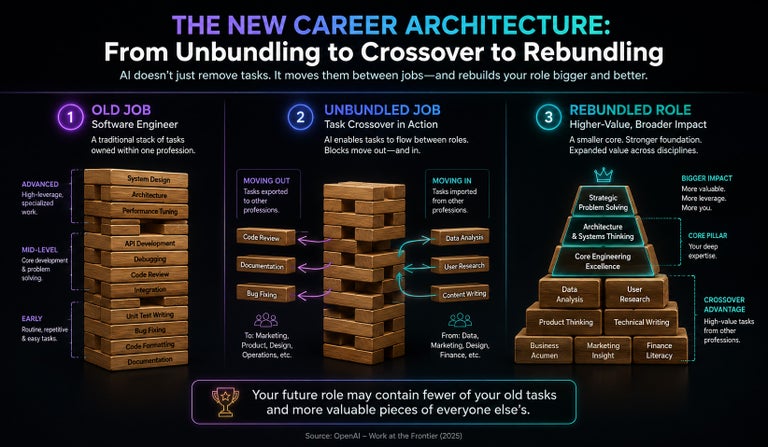
And it gives us the next shape of the Jenga tower:
Task unbundling → Task crossover → Role rebundling
Earlier, AI pulled task blocks out of your job. Now those blocks are moving between towers. What we can expect next, is that companies will have to figure out how to rebuild the towers around the work people can suddenly do.
So, everyone’s becoming a generalist, right? No, that’s not right either!
What we’re seeing is more nuanced than that. AI isn’t devaluing expertise, like many nay-sayers insist it’s doing. Instead, it’s allowing specialists to operate far outside of their old boundaries – extending their operational radius (and value).
And now that these task blocks are moving between jobs, companies will eventually have to completely rebuild the jobs themselves.
I bet you’re seeing this already.
I bet the great role rebundling is about to kick off.
I’m talking about smaller teams, fewer handoffs – and ultra broad specialist roles (an oxymoron to be sure, but a relevant one). We’re facing a future with extreme ownership and a very different kind of manager than we’ve ever known before now.
One that is valued less for the load of people who report to them, and more for the expert judgement they bring to their team environment.
That’s right folks, very soon the corporate ladder is going to look extremely different. Your future career won’t be about climbing inside one job description. It will be about expanding beyond it… taking on valuable work that used to belong to other teams.
The OpenAI research is pretty revealing. It gives us a closer look at the new career map unfurling beneath the old one.
Last time, the challenge was to keep your Jenga tower standing while AI pulled blocks out of it. This time, it’s about deciding which new blocks are worth adding back in.
Let’s look at where task crossover is already happening, what kinds of bigger roles and leaner teams it could create – and how to restack your career around work that gives you more reach, not just more tasks.
How big could your role become?
OpenAI: How AI is Expanding What People Do at Work
AI takes the easy tasks - but where does it take them?
In my previous article when we spoke about Anthropic’s study and the impact AI will have on your job, I assumed you would be the one automating away the easy work.
And to a large degree, you are – but that’s not all that’s happening.
OpenAI’s new research gives us clarity on what happens after those Jenga task blocks are removed, and it’s not what we thought.
In a massive study of 800,000 real work-related ChatGPT messages from folks working across niches like engineering, HR, legal, marketing, sales, finance, customer support and design – we can now see what they’re using AI to DO in their day-to-day work.
As it turns out:
- Tasks aren’t being removed…they’re being swapped!
- Some occupations are task exporters (like engineering & marketing)
- Some occupations are task importers (HR, design, customer support)
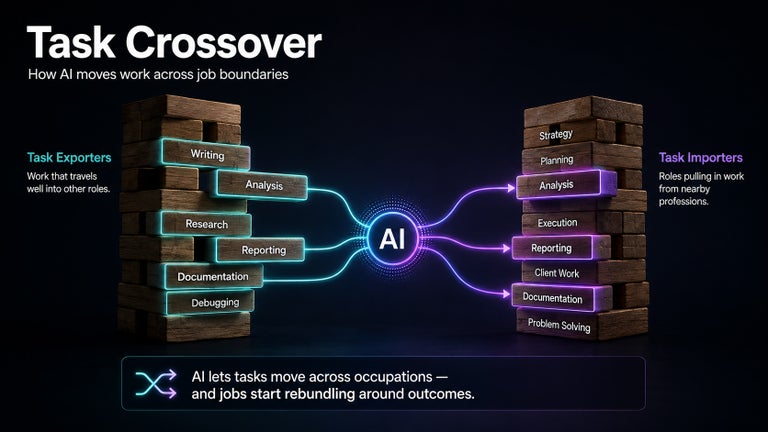
According to the study, task importers use AI to pull pieces of other jobs into their own. Task exporters have pieces of their work spreading into everyone else’s.
OpenAI calls it task crossover – and nearly HALF of occupation-specific AI use is cross-occupation. If you think about it, it’s astounding that some people are using AI so extensively to execute tasks that are outside of their own job descriptions.
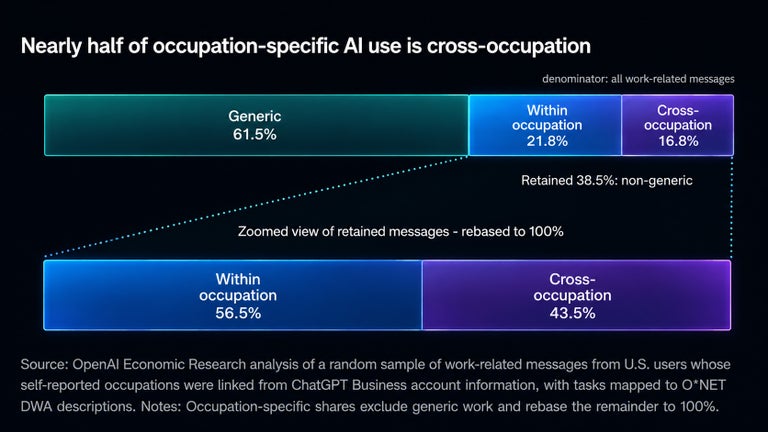
Seriously though, OpenAI mapped workers requests against traditional occupational boundaries and discovered that this task crossover was ALREADY the majority of occupation-specific AI use in 5 of the 8 fields studied.
These requests weren’t generic.
This is empirical evidence that the Jenga blocks are travelling.
Jobs have always been defined by who does what. A job description has always been a list of tasks that you are paid to execute.
So, what happens when AI blurs these occupational boundaries?
When specialist work is available to people OUTSIDE of that profession – it really does smash the old ladder to bits and pieces.
If tasks really can travel between professions, then careers stop being defined by the work inside a single title. Specialists can do more, teams can shrink, leadership evolves and jobs as we know it, change forever.
In real time we’re watching AI redistribute job tasks – which will soon force companies to rebundle roles around something different.
Something other than occupational borders.
So here we are at the fun part - whose career gets bigger, what new roles emerge when specialist work starts crossing boundaries, and how do you position yourself to own more valuable pieces of the task stack?
Here’s what you need to know.
#1: AI is Outgrowing Your Job Description
AKA: If you’re experiencing job title discomfort, you’re not alone.
Are you still doing the same job you did a year ago?
Probably not.
A LOT of people in tech are floating around with old, outdated titles that no longer match what they do. And it’s because OG job titles follow the old job hierarchy.
What you do is your title. But that’s just not valid anymore.
OpenAI found that workers were already ‘testing and recombining tasks before firms revise job descriptions or invent new job titles altogether.’
The work is changing before your role does.
Forget about generic summaries and email writing – the study zoomed in on occupation-centric uses, the work that’s supposed to belong to a single profession.
This is where things get a bit hinky.
In those 5 of the 8 groups that OpenAI studied, most of the occupation-specific AI work was going on way outside their traditional role. Boundaries be damned.
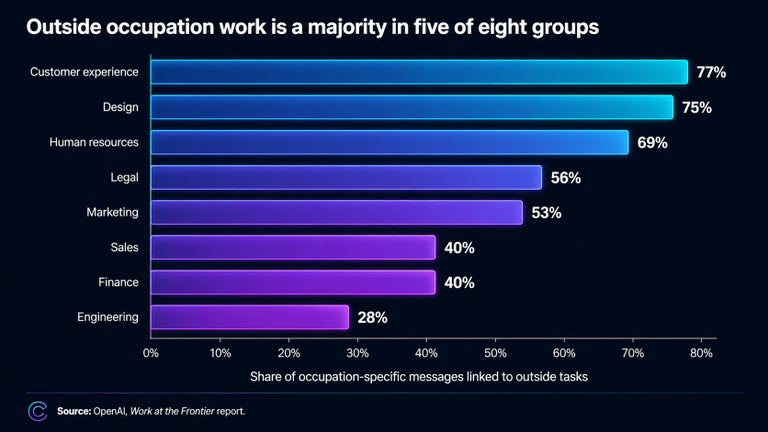
Customer experience led the pack at 77%, followed by design at 75%, HR at 69%, legal at 56% and marketing at 53%.
A designer isn’t using AI to design faster. They’re using it to pull in pieces of research, analysis, marketing, legal and other work that used to live elsewhere and not be readily available to them at all.
A marketer isn’t just using AI to automate campaigns. They’re modelling and forecasting numbers, troubleshooting technical problems and building and launching assets in a day that once took 15 people, 3 teams and 7 weeks to execute.
The job says they’re in marketing or customer support. The task stack in their Jenga tower certainly doesn’t.
Task crossover wreaks havoc on these OG notions of what we’re all meant to be doing. It’s so much bigger than just becoming more versatile in your field.
So, it creates an obvious problem for the current corporate ladder.
Our lovely old hierarchy assumes roles get bigger in 1 of 2 fundamental ways:
- Specialist > Senior Specialist > Manager > Director > VP > SVP…
You either deepen your expertise OR you manage more people.
Task crossover gives us a third (better) option:
- Specialist > Cross-stack Specialist > Outcome Owner > Domain Leader
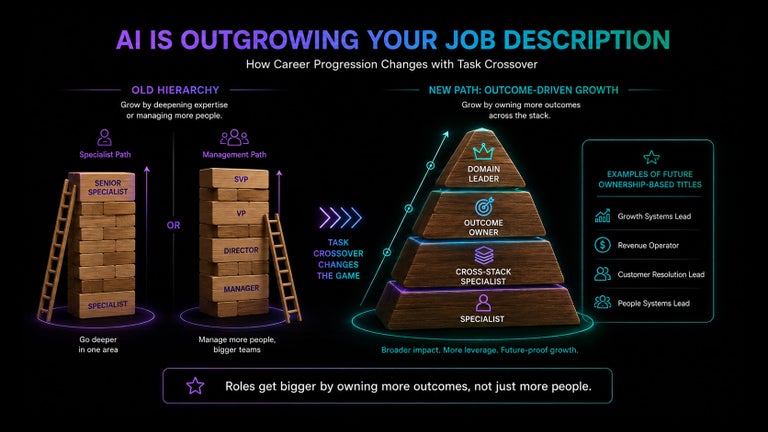
Your role gets bigger because you own more of your end results, not because you manage more people or collect hundreds of direct reports.
This is going to impact job TITLES! In the future we’ll see titles progress to ownership-based titles, instead of our usual descriptive ones.
- Growth systems lead, Revenue operator, Customer resolution lead, people systems lead.
That’s my prediction, not OpenAI’s. But the direction is sitting right there in the data. If tasks are recombining faster than companies can rename jobs, then the hierarchy will eventually have to catch up.
Be aware – your next promotion might not be another rung up the old ladder. It may be a much wider role built around how much of the outcome you can now OWN.
And if companies expect that ownership to keep expanding, the pay model will need to get onboard. You can’t keep rebundling 3 jobs into one role and call the extra scope ‘growth.’ Bigger task stacks, broader accountability and more valuable outcomes will eventually mean bigger compensation too!
#2: AI is Making Specialists – Cross-Stack Specialists
AKA: Your expertise isn't getting smaller at all.
Are you becoming more of a generalist?
That’s not what’s happening here.
It’s more like what happens to a coder, when they start working on multiple parts of a complex system. They become a full stack engineer.
I think the theory that AI makes people generalists only applies to entry-level workers doing superficial work. But for experts, work gets wider, not more shallow.
OpenAI discovered that different professions are frolicking over job boundaries in very different ways. And this is significant if you’re paying attention – because tasks travel.
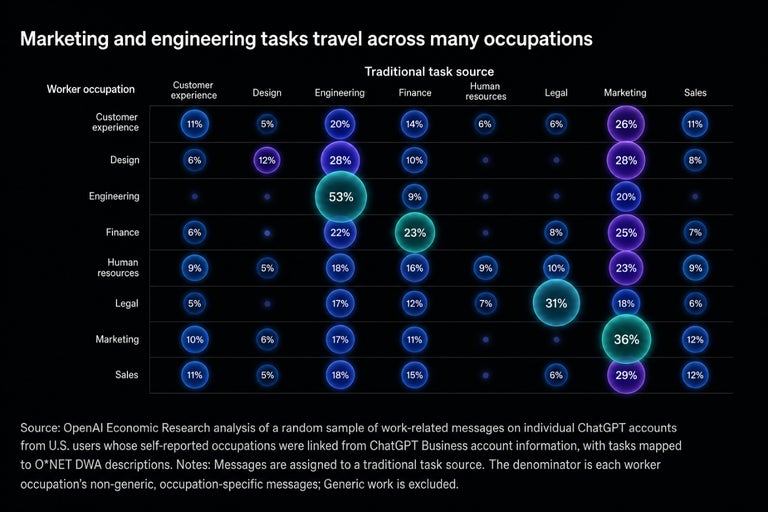
As we know – Design is a major task importer.
About 35.2% of their work-related AI messages involve tasks associated with another occupation. But design work itself, only makes up 1.7% of messages from people in other fields.
So designers borrow aggressively, but people don’t borrow design.
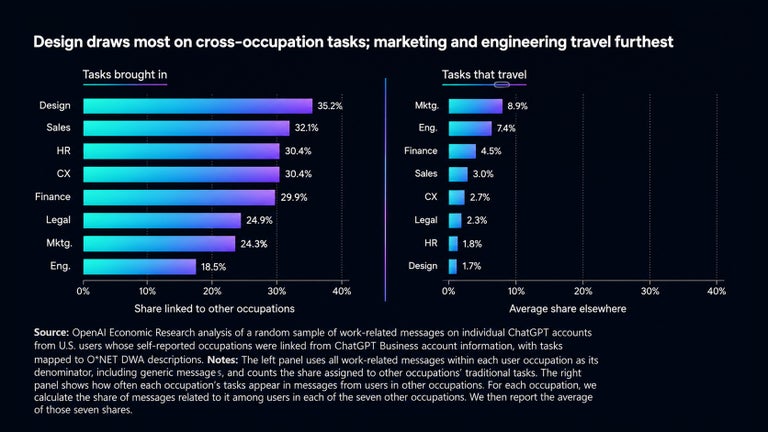
Engineering is almost the same thing in reverse!
Some 18.5% of engineering messages involve work from other fields – but engineering tasks make up 7.4% of messages among workers from other professions. Engineering is a major task exporter in the stack.
Meanwhile marketing is happily causing chaos in both directions.
Marketers tend to spend 24.3% of their AI use on tasks from other occupations – while marketing work accounts for 8.9% of messages among people in other fields. That’s the highest outward share OpenAI found during this research period.
Based on this data – AI isn’t creating a new kind of generalist. This is what cross-stack specialization looks like.
It’s literally building a longer more solid base around your core job – turning what was once a Jenga tower, into a Jenga pyramid!
AI lets you add task blocks around your expertise:
- Your marketing core (strategy / content / paid media / SEO)
- AI expanded reach (analytics / finance / design / automation / engineering)
In this case that wider reach is insanely valuable.
It’s also quite dangerous and occasionally gets people into enormous trouble. Remember – AI expands execution faster than it expands your expertise.
There’s that false competence risk I mention from time to time!
OpenAI researchers warn that task crossover doesn’t mean occupations are disappearing. It just means AI makes specialist work easier for outsiders to attempt – while experts stay the critical point for judgement and review.
So… we have a new set of career assets to nurture:
- Depth: What do you know well enough to judge?
- Reach: How far can AI help you operate beyond that expertise?
- Boundary judgement: When do you know enough to stop and bring in someone better?
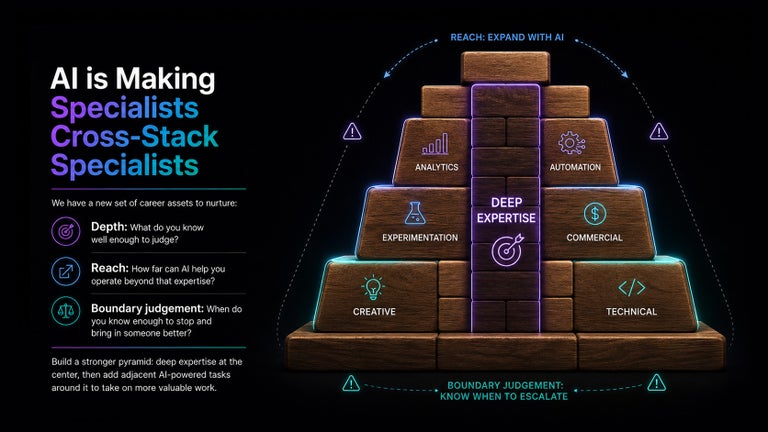
Your goal is to build a stronger pyramid - deep expertise at the center, then add adjacent AI-powered tasks around it that help you take on more valuable work.
Your specialty stays the foundation - the wider layers are what make your role bigger.
#3: AI is Rebuilding the Org Chart Around Outcomes
AKA: This weird limbo where you don't fit in your job won't last.
Do you own more of the work than you did a year ago?
Almost certainly.
Everyone in tech is experiencing it. Goals are getting more ambitious – and someone has to be responsible for them. Well, task crossover doesn’t just make individual jobs wider. At some point, it makes the way companies divide up work look super outdated.
OpenAI found an early clue on - in smaller workplaces. Among typical users, some 18.9% of work-related messages in 2-5 seat workplaces involved tasks outside of the person’s occupation. Compare that with 16.3% in workspaces with 101+ seats.
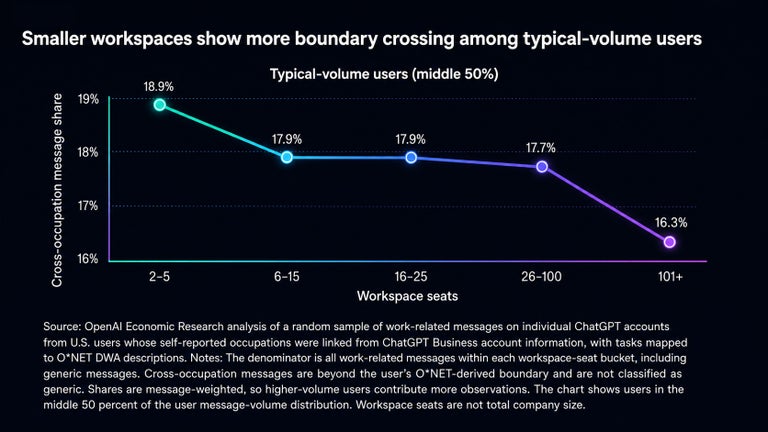
One explanation could be that when specialist resources are skint, people closest to the issue are way more likely to use AI to handle work they might otherwise have to send to an entirely different team.
In other words – AI lets folks carry the work further before they need to pass it on. Once enough people can do that, you don’t just get broader jobs…you get different teams.
Darren Murph talks about the small, remote super-performing team growing in popularity right now. They fly in the face of the traditional org model.
It used to look something like:
Marketing > Analytics > Design > Engineering > Finance …
Each department owns its slice of the pie. The work moves between these silos via briefs, tickets, approvals, meetings, emails – and that special corporate purgatory known as ‘waiting for someone else.’
Yes, the handoff.
But OpenAI says that AI is already changing who does what. It’s beyond making people faster and more efficient. The research argues that many jobs are going to reorganize as their day-to-day task bundles change.
So, after task crossover comes the natural progression to role rebundling.
There isn’t going to be five departments being rallied around a piece of work. Companies are going to build smaller crack teams of cross-functional specialists around the OUTCOME.
Independent contractors and freelancers have known this fact for years. An outcome – and your ability to achieve it – is the only thing that matters.
Take growth for example.
A rebundled Growth Pod could have:
- A Growth Specialist (strategy – acquisition – experimentation)
- A Creative Specialist (Messaging – brand – content)
- A Technical Specialist (Systems – automation – architecture)
These three capable people are specialists, but AI allows each one of them to reach further into the other execution territory before someone needs to step in.
They each become more individually autonomous, but also more interdependent as a team. Each person is able to carry out MORE work on their own, so collaboration happens at a much higher level – around judgement, trade-offs, specialist input, alignment and the shared outcome.
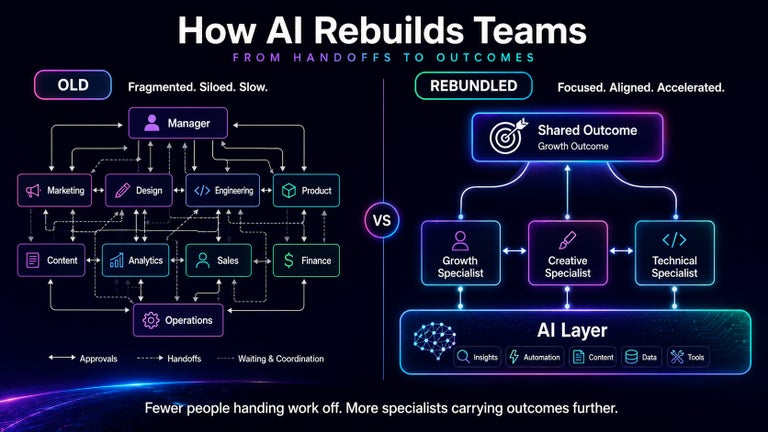
I’ve personally experienced this working within our team at Crossover. Instead of handoffs, approvals or erroneous supervision – you get apex interdependence.
A small group of highly capable, AI-enhanced specialists who operate independently cross into adjacent territory when needed, and pull one another in at the exact moment deeper expertise matters most.
Everyone still brings something that others can’t replace. They just don’t need to keep passing the work around to prove it.
We’re all there – but the handoffs are gone.
And that’s what a rebundled team looks like – fewer people coordinating pieces of work, more specialists autonomously carrying the same outcome toward the finish line together.
RIP approvals, no-one will miss you.
The competitive advantage of the ideal future team may not be how many people it has, but how little work gets lost between them as they crush their goals.
#4: AI is Replacing the People Manager with the Judgement Leader
AKA: The old promotion path is definitely looking a touch dusty.
What if you could lead without having to manage MORE people?
That would change the ladder completely.
Not so long ago the old career ladder rewarded distance from the work. Leaders would be promoted and then automatically be focused on people, instead of projects.
This new career architecture doesn’t do that – it rewards proximity to the hardest decisions. As execution is bound to get cheaper, it makes sense that judgement becomes more expensive.
It’s going to totally rewrite who gets promoted in the future.
SO MUCH management still exists to manage the ‘handoff.’ But now that AI is making the handoff less important, leaders will change as teams change.
As managerial work diminishes, we’ll see the role split in two:
1: The People Co-Ordinator
This leader’s value will come from moving information, connecting people, tracking status, controlling flow, assigning work and managing approvals.
2: The Judgement Leader
This leader’s value will inevitably come from extensive domain expertise, standard setting, the ability to make trade-offs in a time crunch, reviewing consequential work, ultra-fast pivots, coaching other specialists, owning quality and knowing when AI is wrong.
In AI’s future of work, the Judgement Leader has higher value.
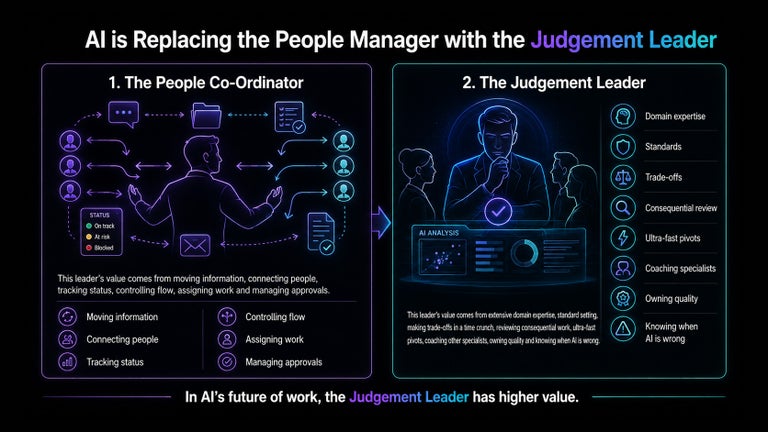
OpenAI insists that as these cross-stack specialists take on more work outside of their traditional occupations – companies will absolutely need clearer processes for review and accountability.
So, the scarce leadership skill may not be co-ordination after all.
It might be sound judgement.
The domain leader who can look at AI-assisted work crossing multiple domains and know when something is good enough, when it’s risky, when it needs more authentic expertise - when a trade-off is worth it and when it isn’t.
There was another clue hidden in OpenAI’s data.
When they split users by how heavily they used AI, the clean relationship between smaller workspaces and more task crossover disappeared among the top 25% of users.
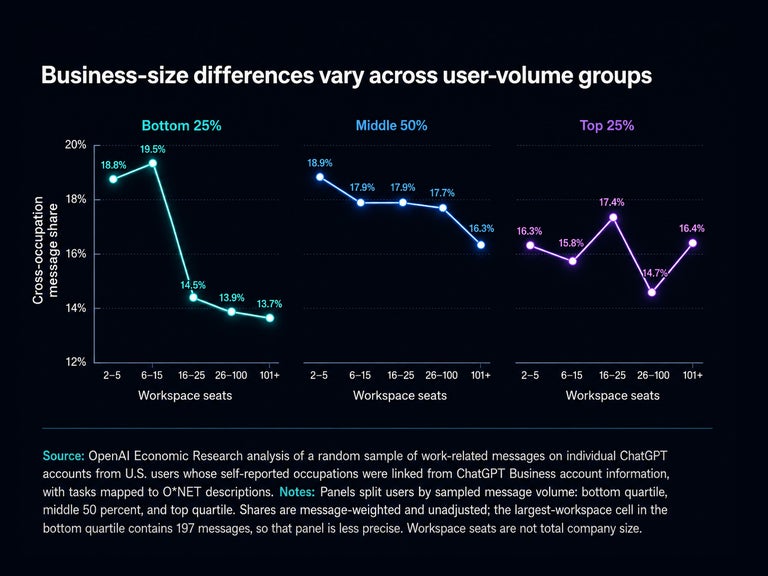
It looks like heavy users crossed occupational boundaries at similar rates across very different workspace sizes – rather than following the steady decline we can see among typical users.
If the future’s strongest leaders are among it’s most AI fluent….they may be less constrained by traditional boundaries anyway.
And they’re the people most capable of crossing them without losing sight of where real expertise matters! The data certainly hints that AI-fluent leadership = broader operating range, regardless of company structure.
In keeping with our pyramid metaphor - the wider the pyramid gets, the more valuable the leader who knows which blocks can carry the weight.
So, a high-value leader’s job becomes less about managing activity and more about protecting the quality of the team’s outcome.
Restacking Your Tower: Build a Bigger Career
For a while now, AI has been taking parts of your job.
But now, it’s giving you parts of other people’s jobs.
And this is a real opportunity for ambitious high performers. The trick is not to get distracted and grab every task block on offer.
Here’s what you need to do:
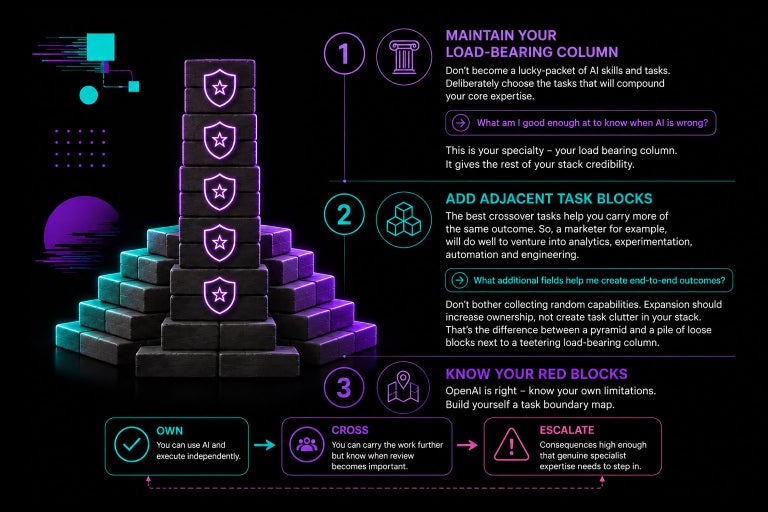
- Maintain your load-bearing column: Don’t become a lucky-packet of AI skills and tasks. Deliberately choose the tasks that will compound your core expertise.
- What am I good enough at to know when AI is wrong?
This is your specialty – your load bearing column. It gives the rest of your stack credibility.
- Add adjacent task blocks: The best crossover tasks help you carry more of the same outcome. So, a marketer for example, will do well to venture into analytics, experimentation, automation and engineering.
- What additional fields help me create end-to-end outcomes?
Don’t bother collecting random capabilities. Expansion should increase ownership, not create task clutter in your stack. That’s the difference between a pyramid and a pile of loose blocks next to a teetering load-bearing column.
- Know your red blocks: OpenAI is right – know your own limitations. Build yourself a task boundary map.
- Own – Cross – Escalate: Own is when you can use AI and execute independently, Cross is when you can carry the work further but know when review becomes important and Escalate is for consequences high enough that genuine specialist expertise needs to step in.
When you’re a judgement leader, that’s part of the skill.
The Next Move is Yours
We’re seeing new career architecture spring to life before our very eyes. Since AI began, we've been on a journey that is completely changing how we work.
It's been a process of:
- Task Unbundling -
What can AI take from my old job? - Task Crossover -
What can AI help me take on from somewhere else? - Role Rebundling -
What bigger role can now be built around what I uniquely own?
Task crossover is already happening - OpenAI’s research confirms it.
The borders around our jobs are fading away, and we’re all doing work that once belonged to entirely different professions.
What happens next is up to you.
Your company will catch up, eventually. As those task blocks keep moving, they’ll be forced into the great rebundling – rebuilding roles, teams and leadership around what people can carry now from start to finish.
This gives you a rare chance to get there first.
You don’t have to wait for a new title, the next promotion cycle or a rewritten job description before your career gets bigger. You can start rebuilding your role right now by protecting the expertise that makes you invaluable.
By adding those adjacent capabilities that increase your ownership and by learning where your judgement is strong enough to lead, or stand aside for another specialist.
It’s time to turn your Jenga tower into a pyramid. Keep your deepest expertise as the load-bearing center, then build outward with work that strengthens it and lets you own increasingly important outcomes.

The wider base gives you reach. The core is what lets you carry the weight.
Task crossover is putting new pieces within your reach!
The great rebundling will decide how those pieces get assembled into tomorrow’s jobs. You don’t have to wait for someone else to draw the blueprint for yours.
Last time, the goal was to keep this Jenga tower standing. But now, it’s to rebuild it into something broader, stronger and capable of carrying way more than the job you started with.
Similar post


Want to read more?
We have a lot more where that came from



 AI-first remote workers.