Contents
- The New Anatomy of Customer Service
- Reflex and Reason Split
- Reflex and Reason Unify
- Become a Human-AI Cyborg
- The Future of Customer Service Belongs to the Cyborg
The future of customer service doesn't need another human with a script. AI can already answer, route, and resolve faster than the best agents alive, so smart CS professionals are repositioning themselves as the brain and heart behind support. Run-of-the-mill ticket management is dead as doornails - but the new anatomy of support is giving elite CS pros something better.
Basic ticket clearance won't save you in the future of customer service.
Artificial intelligence (AI) is already masterful at the high-volume, low-complexity work - able to cut through basic tasks like a snowplow through slush. If you've tied your value to answering the obvious, you’re competing with a machine built to do that job better.
The script-and-queue era of CS has ended. But the shifting terrain has raised the value of professionals able to strategically bridge the new AI-human divide.
Curious about what the future of customer service holds in the AI age? We’re here to map the new anatomy of AI-augmented support, and share four steps that will put you ahead of the pack.
The New Anatomy of Customer Service
Customer service used to run on one overworked system - the human brain.
Every alert, every 'quick' ticket, everything drawing from the same limited resource. But with AI, that’s no longer the case.
Back in 2023, analysts predicted that, by 2025, ~80% of service organizations would be using generative AI to improve productivity and customer experience. And that came true, with modern platforms now able to resolve up to 80% of routine requests autonomously.
Across the industry, AI has expanded from simple scripts to real-world systems that actually solve problems and lift capacity.
And you don't need to look far to find a success story.
Swedish fintech Klarna recently shared results for its OpenAI-enabled assistant. The data showed their AI-assistant was able to handle around 2.3 million customer conversations in a single month - the workload of about 700 full-time service agents. And it did that while keeping customer satisfaction on par with their human teams.
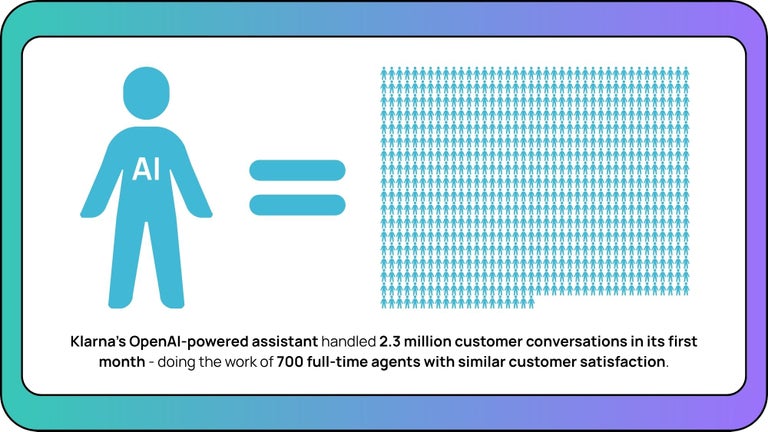
If you’re content with reading scripts, '700 to 1 on 80% of tasks' is a very worrying shift. But ambitious CS professionals see an opportunity.
AI has effectively split CS into two cooperating systems. I like to think about it in terms of the body’s nervous system.
On one side, we have the autonomic system - the automatic layer that keeps things running without conscious effort. In CS, these are the systems that provide instant answers to clear, repeatable queries.
On the other side, we have the conscious somatic system. This is the human layer where empathy lives, strategies are built, and messy, multi-layered problems get resolved.
It's reflex on one side. Thinking on the other.
Here's the big deal: when the autonomic layer absorbs the mundane, it frees resources for impact work. And it's the impact work that will make you irreplaceable in the AI age.
Reflex and Reason Split
To take advantage of the new two-layer system of customer support, you need to know the boundaries of each.
Because those who grasp where each layer begins and ends decide what gets automated, how the systems are built, and, ultimately, where they apply their human thinking skills for maximum impact.
Each side of the system has its jobs. Each has its limits. Knowing where the lines fall gives you leverage.
1. Autonomic System: The Reflex Layer
The autonomic system is the machinery that fires without you being active in the moment. Yes, you'll design and improve it, but it runs the routine work on its own.
Here’s how it operates in practice.
AI is tuned on your company’s source-of-truth - FAQs, policies, product docs, order data. When a routine query arrives, it identifies intent, pulls the relevant facts, structures a clear answer, and takes the next step. Without you lifting a finger.
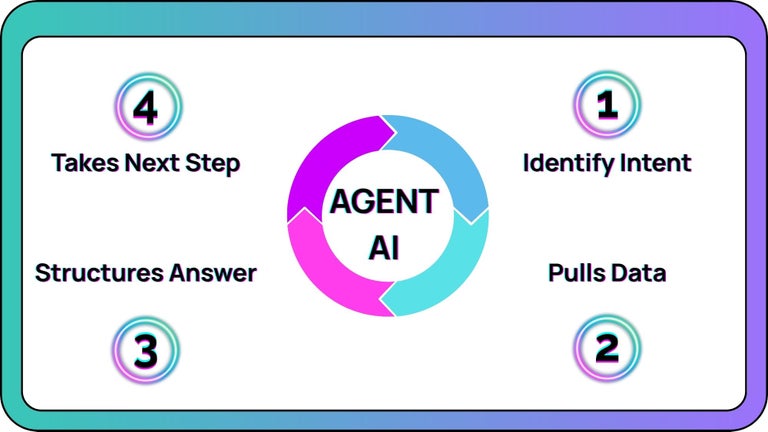
These are the predictable customer interactions that cost you time and energy without demanding your full expertise. Think straightforward password resets or simple data updates.
Just like in the body, the CS autonomic layer is built to conserve energy and attention while keeping everything alive and moving. It works through the thousands of tiny, repetitive tasks that cross your desk. Replacing them with a steady, reliable reflex that clears noise before it saturates your thinking.
And when the predictable path breaks, the reflex knows to step aside. It flags the case, compiles the relevant context, and hands it to a human who can start the process three steps ahead of zero.
It handles the shallow work, so the somatic layer can handle the deep work.
2. Somatic System: The Reason Layer
The somatic system is where conscious thought kicks in. It brings the heart - empathy and care - and the brain - creative problem-solving, systems thinking - into the moments where outcomes hinge.
Take a scenario with an angry VIP on a renewal cliff.
A machine could absolutely answer basic questions. But it can’t listen between the lines, rebuild trust, weigh trade-offs, or problem-solve through an 'unwinnable' situation. An elite customer service pro can.

This is one example of a broader class of work where facts alone don’t decide outcome. Because success comes down to empathy, depth of understanding, communication, and the willingness to own a decision under pressure.
Uniquely human skills that need space to breathe.
The two-system model creates that space. The reflex layer absorbs routine noise and hands over clean context, so the human mind arrives three steps ahead and stays there long enough to make a decision that earns trust.
CS can get seriously complex. But that complexity is where elite professionals earn their stripes.
Reflex and Reason Unify
Earlier, we split CS into two distinct systems. But the future of customer service appears when those systems work together.
Effectively unifying the autonomic and somatic systems needs cyborgs - people able to blend their work with AI. Yahya Miled - an AI-first customer support agent at Trilogy - puts it like this:
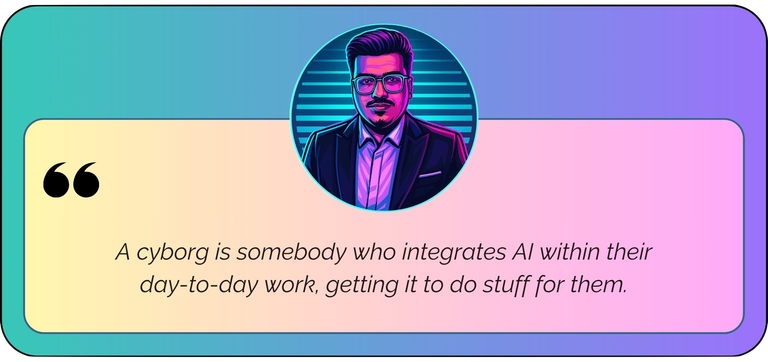
Here’s why that mindset matters.
Cyborgs don’t 'use a tool' and carry on. They shape the autonomic layer while they work, encoding what should happen on a routine path, testing against real tickets, feeding back into the system, and refining the learning so the reflex improves with every pass.
When Andrew Allen caught up with Yahya at his home base in Tunisia, Yahya shared a personal example of what this looks like:

Breaking the Global Pay Barrier with Yahya Miled | OOO Destination Tunisia
Yahya’s example shows the autonomic layer at work. He designed a system that runs in the background and clears the predictable queue.
Requesters get the right details immediately; his workload drops.
But he also keeps iterating, with each new refinement honing the reflex to deliver better and faster. Because as the reflex grows, the somatic side gets more room to breathe.
And we see similar results elsewhere.
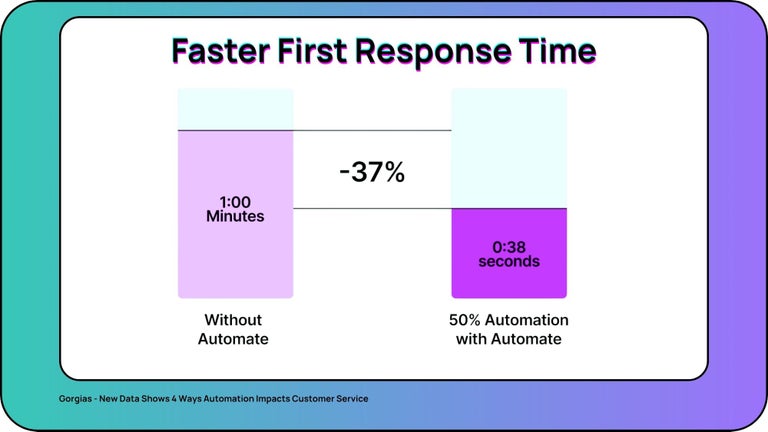
I recently read an article about an agentic AI tool - Automate - built by e-commerce helpdesk Gorgias. Real-world data showed that Automate helped cut first response time by 37% (from ~1 minute to 0.38 seconds) at 50% automation.
And these AI-agents are constantly improving.
The professionals who win in AI-powered CS will be the cyborgs able to work across the autonomic and somatic layers. Able to continuously work under the hood to improve the 80% reflex layer, WHILE doubling down on the ±20% where emotion and critical human reasoning are essential.
CS pros who can do this become irreplaceable.
Become a Human-AI Cyborg
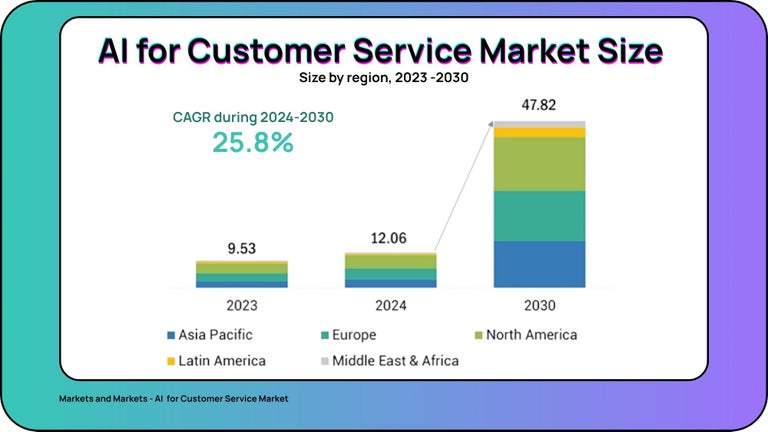
Investment in AI for customer service is going wild - growing from roughly $12B in 2024 to almost $48B by 2030. And with new investment comes expanding capability.
AI is no longer experimental. It’s fully embedded in customer service, and it’s not going anywhere.
But that doesn’t need to be daunting. Getting ahead could come down to four simple moves:
- Map the role
- Build your autonomic layer
- Test and refine
- Double down on human skills
1. Map the role
Step one is clarity.
Not all customer service roles are built the same, so you need to break your role down to the atomic layer. Take a magnifying glass to your workflow and separate what’s repeatable (prime for automation) from what’s variable (where human judgment is essential).
This isn’t about making yourself redundant. You're looking for AI touchpoints that protect your brain from the noise that doesn't require it.
2. Build your autonomic layer
This is where you start building the systems that drive your reflexes.
Don't make the mistake of thinking you need complex automations from day one. Start with small wins: custom GPTs that surface key product info, macros that clean up repetitive requests, or mini sub-flows that shave seconds off routine work.
When you know what's working (and your skills grow), scale those micro-reflexes into full automations that clear entire ticket categories.
Need a push?
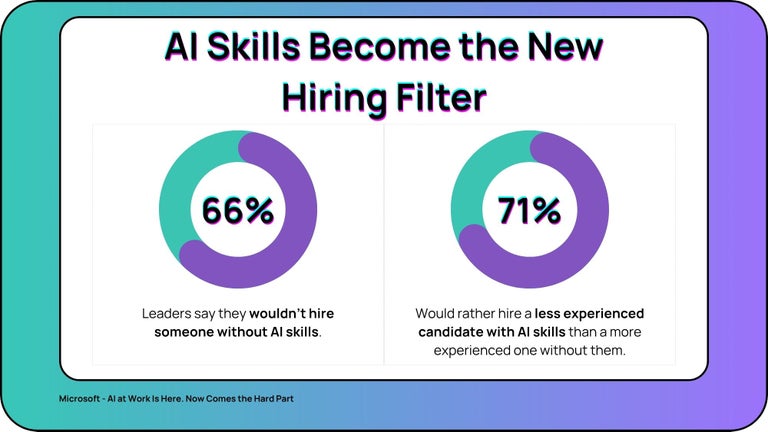
A recent Microsoft study found that 66% of business leaders wouldn’t hire someone without AI skills, and 71% said they’d rather hire a less-experienced candidate who has them.
Working on AI-reflexes today is a long term investment that WILL compound your value over time.
3. Test and refine
Building the system isn’t enough. True cyborgs improve their systems over time.
Once you have a working reflex layer, start stretching it. Test your automations, track performance, and identify edge cases. When an issue pops up that the system can’t handle, teach it.
Every tweak strengthens the reflex and frees more of your mental bandwidth for deep, creative problem-solving. The goal is to have your autonomic system handle more, faster, with less low-stakes input from you.
4. Double down on human skills
Once you’ve won back your time and mental space, spend it wisely.
Reinvest in your somatic system: empathy, communication, problem-solving, creativity, systems thinking. The traits that AI can’t replicate and customers still crave.
Recent data shows that 75% of consumers prefer to talk to a human service agent when dealing with complex issues. That’s your competitive edge.
The more technology floods the frontlines, the rarer (and more valuable) authentic human connection becomes.
Use that to your advantage.
The Future of Customer Service Belongs to the Cyborg
AI has split customer service into two cooperating systems - the autonomic and somatic.
The professionals who thrive won't pick a side. They'll become cyborgs who refine the autonomic layer while doubling down on the human skills that make the somatic layer irreplaceable.
And becoming that irreplaceable cyborg comes down to 4 Steps:
- Map the role - Separate what's repeatable from what requires human judgment.
- Build your autonomic - Start small with macros and custom GPTs, then scale into full automations.
- Test and refine - Push the reflex and expand its capabilities over time.
- Double down on human skills - Empathy, creativity, and problem-solving are your competitive edge.
These four moves will separate successful cyborgs from the casualties.
Here's your decision point.
You can keep competing with AI on speed and volume, watching machines handle more of what used to be your job. Or you can become the architect who trains those machines while focusing on the complex, high-stakes work only humans can do.
You can't measure your success by manually cleared tickets. So start building the reflex that holds up the system, and reserve your focus for the work that only you can do.
Similar post


Want to read more?
We have a lot more where that came from



 AI-first remote workers.