Contents
- Gilded Cages: Why We Can’t All Be Google
- The Crossover Blueprint: A Factory for Deep Work
- The Unfiltered Truth: Who Belongs Here?
- The Kind of Contractor Who Excels With Crossover
- A Quick Look Inside the Crossover's Client Companies
- There Is No Utopia. Choose Your Hard.
What if remote work didn’t fail - our idea of culture did? As companies scrambled to go virtual, they brought outdated assumptions with them - that camaraderie equals culture, and meetings equal management. In this article, we explore how most remote cultures missed the mark - and what it actually takes to build a high-performance remote culture that works.
Was the great remote work revolution a beautifully packaged lie?
We were promised a utopia of work-life balance, flexibility and autonomy. We traded our soul-crushing commutes for the freedom to work from anywhere.
But now many people in tech live in a digital cage. I’m going to unpack why that’s happened and how we built something radically different.
You’ve noticed:
- Hallmarks of toxic office culture like micromanagement, information silos, and limited social interaction do commonly exist in remote environments.
Here’s the thing, though.
The problem isn’t remote work - it’s that most companies are doing it wrong.
They took the physical office - with its endless meetings, political landmines, and fluorescent lighting - and just tried to copy-paste it onto the internet.
It’s a deeply flawed imitation game, and it impacts everyone.
They’re trying to treat the supposed symptoms - loneliness and disconnection - with superficial cures like virtual happy hours, because they’ve completely misdiagnosed the disease.
The disease isn’t a lack of social time - it’s the evaporation of clarity.
In an office, you absorb a ton of ambient information. You can feel the mood, see who is working with whom, and understand priorities by osmosis.
Remote work doesn’t operate like that.
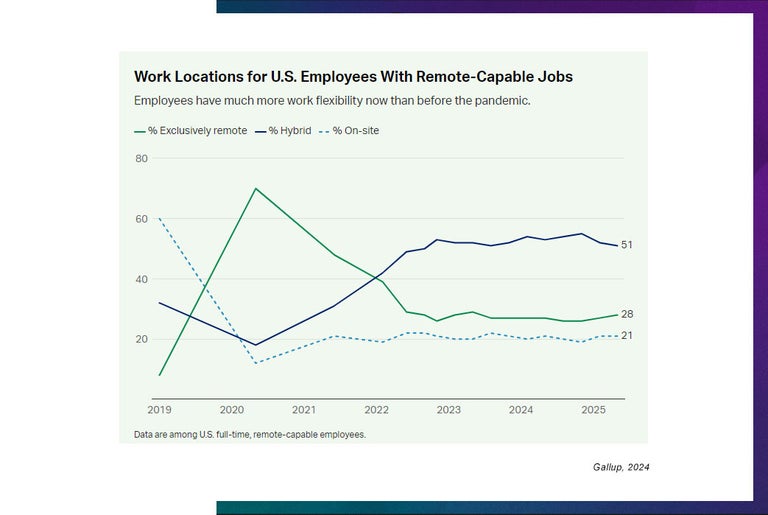
- Gallup recently declared that employee experience hinges on good managers and business practices, not remote work itself.
- That’s why 93% of people in remote-capable jobs prefer to work remotely – at least some of the time.
The answer isn't to get better at faking the office online, but instead to re-architect work from the ground up.
I’ve been working with a company that’s taken a defiantly different approach.
Crossover, and its partner companies like Trilogy, 2 Hour Learning and IgniteTech, built a system that looks less like a tech campus and more like a factory for deep work.
And it’s the blueprint for the future of work.
Gilded Cages: Why We Can’t All Be Google
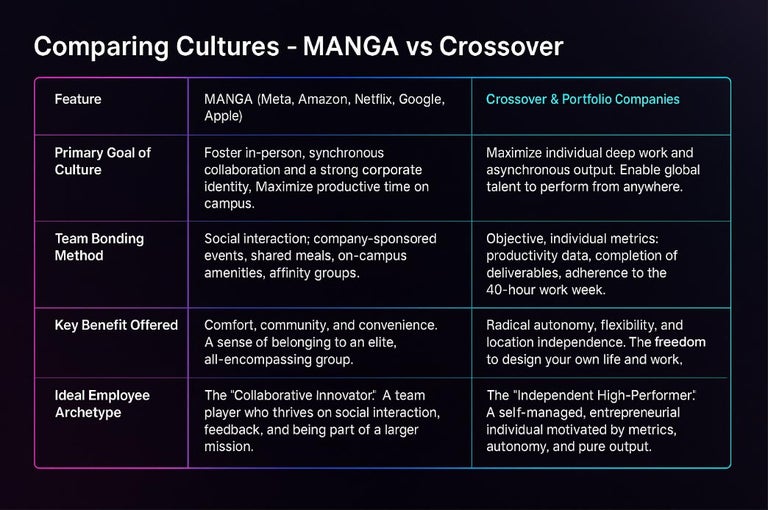
To understand how radical Crossover’s model is, you first have to look at the gold standard: the MANGA companies (Meta, Amazon, Netflix, Google, Apple).

Their cultures are legendary, but they were built for a different world. Every work culture is a series of hard trade-offs – the goal for any professional is to consciously choose the culture that works best for them.
In other words, choose your hard.
Take Google and Meta. Their deal is total immersion. The gourmet meals, on-site gyms, and endless amenities are strategic tools to keep you on campus, fostering those spontaneous watercooler moments. The cost of that is enmeshment.
The line between your work life and your social life is intentionally blurred. It’s fantastic if you see your colleagues as your primary friend group, but a tough sell if you crave separation.
Then you have the gladiator arenas - Amazon and Netflix.
This is a chance to play on a dream team of hyper-performers. At Amazon, you live by the 16 Leadership Principles. At Netflix, you’re subject to the infamous keeper test, where adequate performance gets you a generous severance package.
The upside is you’re surrounded by the best. But the cost is relentless pressure and a culture of high anxiety. It’s a crucible, not a community.
Finally, there’s the cult of Apple.
There, the deal is a chance to make history. You get to work on the world’s most beautiful products, but you have to be a creative genius who also conforms perfectly to a top-down vision.
It’s a place for perfectionists who care more about the product than their personal spotlight.
These cultures are all brilliant, sophisticated systems for managing ambiguity.
The free lunch at Google engineers serendipity. Amazon’s principles are a shortcut for making decisions when data is messy.
They are human-centric solutions for a political, in-person world.
But if you could remove the ambiguity from the work itself, would you even need that kind of culture?
The Crossover Blueprint: A Factory for Deep Work
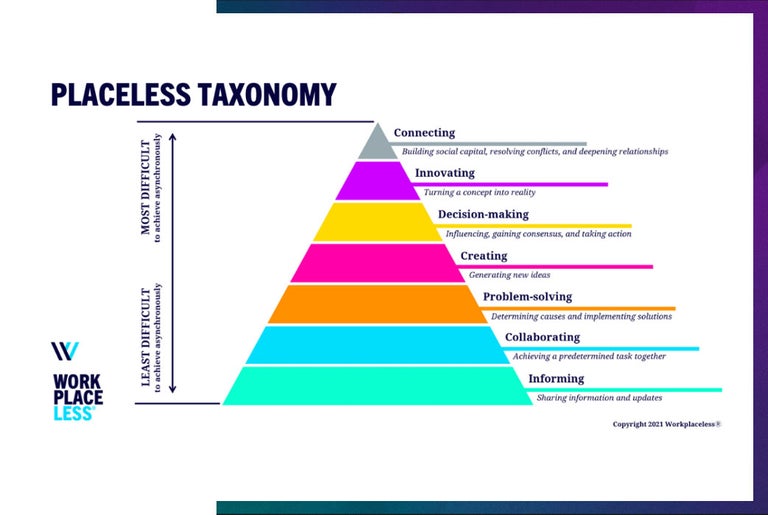
The prevailing wisdom among remote work experts is that the true future of work is not just remote, but asynchronous. It decouples productivity from the constraints of time and place, allowing for authentic flexibility.
This shift forces better planning, more deliberate communication, and deeper focused work by minimizing the constant interruptions of a synchronous environment.
But async environments face challenges too.
This is where Crossover comes in. Crossover and the portfolio of companies it hires for have taken remote work to its logical extreme and have built a factory for deep work where the ultimate cultural value is radical clarity.
It’s built on a few core ideas:
- Work Units & Quality Bars: Every job is broken down into its most fundamental, measurable outputs. An engineer submits a pull request. A support agent solves a ticket. A senior exec produces a deep-dive analysis. Paired with each work unit is a quality bar - a crystal-clear, documented standard of what great looks like. It’s the antidote to the most toxic question in any workplace: "Am I doing a good job?" The answer isn’t based on your manager’s mood or your political skills, it’s objective and transparent.
- Daily Written Coaching: Forget sporadic, emotionally charged performance reviews. In this culture, managers review work units daily and provide written coaching on how to improve. It’s a system of relentless, documented, and scalable mentorship. The goal is to make every team member as good as the top performer.
- The Talent Olympics: The gateway into this world is a notoriously tough, multi-stage testing process. Many who fail call it a scam or a request for free work. But they’re missing the point. The test is the company's most important cultural filter - it's an asynchronous, merit-based simulation of the job itself. The message is - if you hate the application process, you will absolutely hate the job. It filters for the top 1% who are self-directed, resilient, and motivated by measurable achievement, not social validation.
More on Crossover's culture here:
So, Crossover (and each client company) is not a family. We’re a professional sports team, and we like it that way.
The Unfiltered Truth: Who Belongs Here?
So, what is the trade-off for this model?
You won't find work-sponsored social events or friendships born from hallway chatter. And this is where the online reviews get spicy. People call the environment dehumanizing or like being a machine.
And for them, it probably is.
Most companies try to solve remote isolation with forced fun. I believe it’s a superficial fix for a deeper problem.
Crossover’s solution is to hire people who are already socially self-sufficient and who crave focus over chatter. You are the CEO of your own social life.
This is a deliberate rejection of emotional labor.
You’re not paid to be a team player in the social sense – you’re paid to do the work. For anyone who finds office politics and forced socializing utterly draining, this is liberation.
For others, it’s alienation.
This is the central choice. A normal job bundles compensation, benefits, social life, and career progression. MANGA companies supercharge that bundle.
Crossover unbundles it. It offers top-tier, globally competitive pay and radical autonomy for the work component, and then hands the responsibility for everything else - benefits, community, retirement - back to you.
You're not an employee - you're an independent contractor. Most of the time, at least (the model has expanded to include hybrid companies with full-time US employees too, but let's focus on remote here).
That’s the legal and financial backbone of how the group operates. This independent contractor model isn’t an inconsequential side detail. Aside from being the only real way to operate in the global arena - it’s the engine behind everything we believe about autonomy, ownership, and performance.

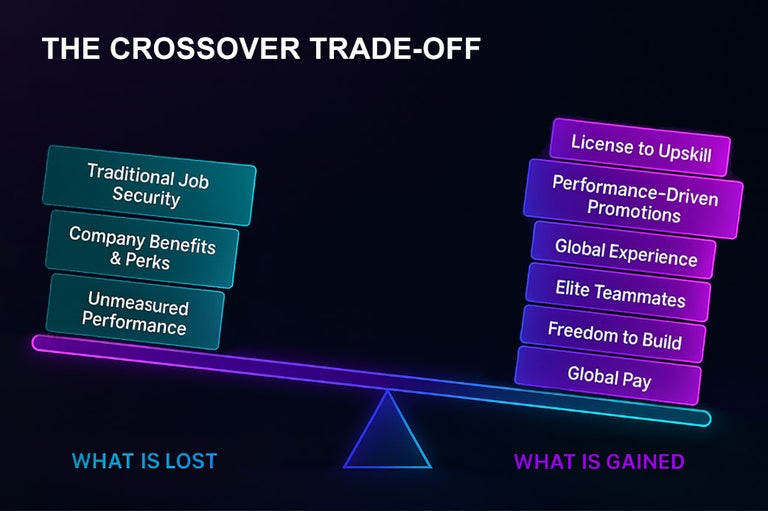
Crossover doesn't give remote workers:
- Traditional Job Security: Your contract isn’t permanent. If your performance drops, your role can be ended with written notice. That’s the trade-off for full autonomy.
- Company Benefits: There’s no health insurance, pension, or paid time off. Instead, you’re paid a premium rate to manage your own benefits, taxes, and financial planning - just like any independent business.
- Unmeasured Performance: Your output is tracked through objective metrics, including periodic screenshots using our WorkSmart tool. This system keeps everyone accountable to the 40-hour workweek and justifies the higher pay.
Instead, Crossover offers:
- License to Upskill: You have the freedom to learn what excites you and develop new skills on your own terms. With fewer restrictions, you can take on bigger challenges and grow faster.
- Performance-Driven Promotions: Your growth isn’t tied to tenure - it’s tied to results. If you deliver great work, you can move up fast, with clear paths to double your pay through performance-anchored promotions. You don’t have to wait years to lead big things, you just have to earn it.
- Global Experience: You’re not limited by geography. Working with diverse, high-performing teams around the world gives you constant exposure to new processes, perspectives, and mentors.
- Freedom to Build: As a global independent contractor, you can work on your own ideas and side projects without restrictions. There’s no conflict of interest - and that’s why entrepreneurial talent chooses this.
- Global Pay: Get competitive compensation in USD based on the value you deliver, not where you live. That means higher earnings, better savings, greater economic stability and more financial freedom.
- Total Flexibility: Embrace absolute async flexibility and work within the windows when you're most productive. And with performance monitoring, you'll never work an unpaid moment over 40 hours. It's a strict system that gives you your time back, pays you what you're worth, and doesn't control your day.
It was never a model meant for most people.
But if you’re the kind of person who’d rather run your own race than ask for permission, this is the track you want to be on.
The Kind of Contractor Who Excels With Crossover
So, this model isn’t for the masses, it’s for a specific kind of tech professional. For these people, our workplace culture isn’t cold, it’s clean. It’s not isolating, it’s empowering.
- The Self-Reliant Artisan: You’re naturally motivated and treat your work like a craft. You prefer deep focus over constant collaboration, and flexibility isn’t a perk - it’s how you do your best work.
- The Meritocracy Purist: You’ve been burned by office politics and subjective reviews. You want a system that judges you on output alone. For you, Crossover’s objective metrics feel like fairness, not pressure. Challenge wakes you up!
- The Entrepreneurial Rockstar: You already think like a business. Maybe you’re building a product, freelancing, or starting a consultancy. You’re not looking for job security - you’re looking for a high-paying, flexible anchor client.
- The Global Citizen: You live outside traditional tech hubs - in Brazil, South Africa, India, Pakistan, or Sri Lanka - and you want access to global compensation without relocating. Crossover offers pay without borders.
You’ll struggle if:
- You’re a Social Connector: If you rely on daily social interaction and feel energized by team lunches and hallway chats, our async, heads-down model will feel isolating.
- You’re a Traditional Careerist: If you’re looking for a stable salary, full benefits, a clear promotion path, and long-term job security, our independent contractor model likely won’t fit.
- You’re Process-Averse: If constant measurement, structured systems, and performance tracking make you uncomfortable, this environment will feel rigid, even robotic.
Ultimately MANGA culture makes work your life. It locks you into a weird paternalistic dependency that normalizes relying on your workplace for security.

At Crossover and it's portfolio of client companies, our culture unbundles that mess.
We hand responsibility back to the individual, giving them full power as independent economic actors, who are paid a premium to manage their own lives and stability.
It’s the ultimate expression of freedom and responsibility at work.
A Quick Look Inside the Crossover's Client Companies
Each company has its own mission, but all are built on the Crossover foundation of high-performance, remote-first work.
Client companies like these are proof this works at scale:
Trilogy – Radical Ownership in Action
Trilogy captures the entrepreneurial spirit of our model. Teams don’t just complete tasks - they own products from concept to customer pitch.
The culture is flat, fast, and built for builders. There’s zero micromanagement. Just smart people solving hard problems together.
It’s a haven for coders who want real ownership, not just tickets to close.
IgniteTech – The Async, AI-First Enterprise
IgniteTech is a fully async, global software company designed for an AI-first future.
It hires the top 1% of global talent through Crossover and runs entirely without a central office. CEO Eric Vaughan leads initiatives like ‘AI Mondays,’ where the team focuses on GenAI innovation - no calls, no meetings.
IgniteTech proves you can run a complex enterprise with near-zero sync.
2-Hour Learning – Redefining Efficiency in Education
2-Hour Learning applies our focus philosophy to K–12 education.
Students complete core academics in just two hours a day using AI tutors and learning apps, freeing up time for real-life skills like public speaking and financial literacy.
The results speak for themselves: top 1–2% national scores. They hire bold thinkers who value intensity over hours and outcomes over tradition.
Each is powered by high-agency individuals executing in an async-first, outcome-obsessed environment.
There Is No Utopia. Choose Your Hard.
Remote culture sucks because it tries to replicate office culture.
So, the real problem isn’t remote work - it’s trying to recreate outdated office rituals in a virtual world. The office demands your time. The campus demands your identity. Both come with hidden costs.
There is no system that will suit everyone.
Crossover hires for a workplace model that suits a very specific type of elite global talent.
It’s a meritocracy for the artisan who believes their work should speak for itself, free from the distortions of personality or politics.
If you want total freedom and top-tier compensation - expect to own everything – your schedule, your performance, AND your growth.
Most companies build a culture to make you feel like you belong. Crossover hires for a system that proves that you're the best.
If you'd rather earn your place than find it, you know where to apply.
Similar post


Want to read more?
We have a lot more where that came from



 AI-first remote workers.